ambcrypto.com
Polkadot [$DOT] returned to the center of crypto discussions, though not for the reasons bulls would have preferred.
Growing concerns about adoption, competition, and long-term growth prospects dominated conversations, pushing sentiment toward fear levels rarely seen in recent months.
Traders increasingly questioned whether Polkadot could convert its strong developer activity into stronger user growth and price performance.
The shift in sentiment became evident over the past month.
On the 18th of May, $DOT recorded a bullish comment ratio of 6.39. By the 18th of June, however, that figure had fallen to just 1.18, marking a sharp deterioration in confidence.
The reading also remained well below the 3.0 crowd-greed threshold, placing sentiment firmly in fear territory. Despite the negativity, discussion volume remained elevated, making $DOT one of crypto’s most debated assets.
$DOT outflows persisted despite growing attention
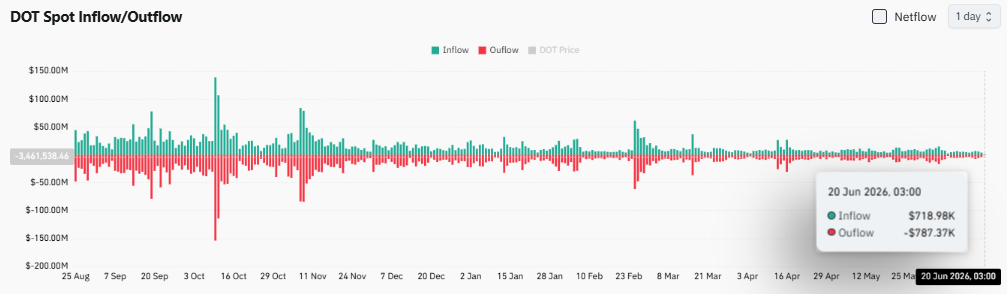
Exchange flow data showed capital continued leaving exchanges despite the increase in social activity surrounding $DOT.
At the time of writing, Spot inflows reached approximately $718,980, while outflows totaled about $787,370. This left a negative netflow of roughly $68,390.
The imbalance suggested holders continued withdrawing slightly more tokens than they deposited onto trading platforms.
Although persistent outflows can reflect reduced selling intentions, the margin between inflows and outflows remained relatively small.
As a result, exchange activity did not point to aggressive accumulation or heavy distribution.
Instead, investors appeared cautious while monitoring whether Polkadot’s growing visibility could translate into stronger market demand.
 Source: CoinGlass
$DOT defend support but resistance remain intact
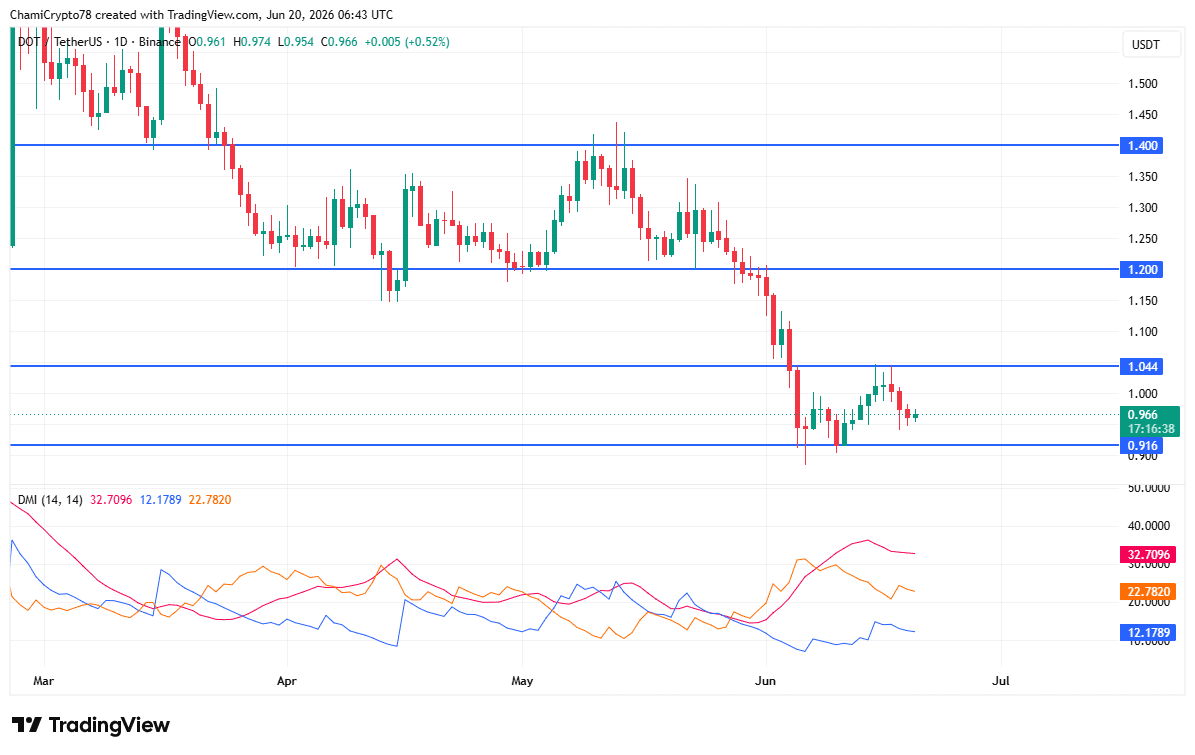
At the time of press, $DOT traded near $0.966 after stabilizing above the $0.916 support level that halted its recent decline.
Buyers prevented a deeper breakdown and helped price recover modestly from June lows. However, $DOT remained below the key $1.044 resistance zone, leaving the broader structure under pressure.
The DMI indicator showed bearish control persisted despite signs of stabilization. The ADX stood at 32.70, confirming a strong prevailing trend.
Meanwhile, the -DI measured 22.78, comfortably above the +DI reading of 12.18, indicating sellers still held the advantage.
If buyers reclaim $1.044, sentiment could improve further. Yet a break below $0.916 would likely place renewed pressure on the market.
 Source: TradingView
Liquidity zones highlight the next targets
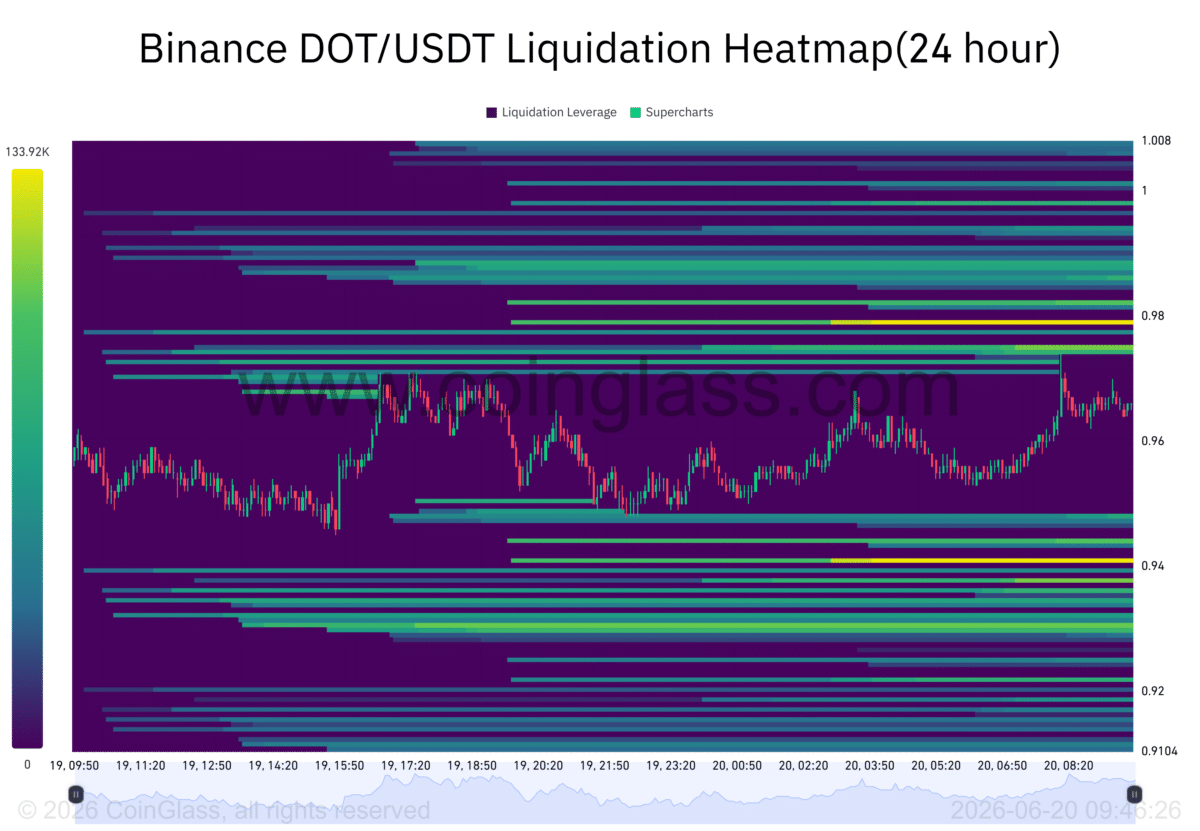
Liquidation data revealed notable liquidity concentrations above and below the current price. The strongest upside cluster sat between $0.98 and $1.00, creating a potential attraction zone if buyers extended the recovery.
Another significant liquidity pocket appeared near $1.008, reinforcing resistance overhead. Below the market, substantial liquidity remained concentrated around $0.94 and $0.93.
These levels could attract price if support weakened and sellers regained control. The heatmap therefore presented a balanced setup rather than a clearly directional one.
 Source: CoinGlass
Should $DOT move above $0.98, liquidity around $1.00 could come into focus. If bearish pressure strengthens, the clusters below current price could become the next downside targets.
Final Summary
- Polkadot remained heavily discussed even as investor confidence weakened sharply.
- $DOT held key support, but resistance continued limiting recovery attempts.