
US senators push to end CFTC ‘assault’ on state oversight of prediction markets

A group of 17 Democratic US senators is pressing leadership in a key committee to address the Commodity Futures Trading Commission (CFTC) using federal funds in lawsuits against state-level authorities cracking down on prediction markets.
In a Wednesday letter to the chair and ranking member of the Senate Appropriations Subcommittee on Financial Services and General Government, Senator Richard Blumenthal, Senator Jeff Merkley and 15 other Democrats urged the committee leadership to block the CFTC from using federal funds in Chair Michael Selig’s legal fights against state gaming authorities. Selig has defended the agency’s position that the CFTC has “exclusive jurisdiction” over prediction markets by claiming that the event contracts on the platforms qualify as “swaps” under its purview.
“Through engaging in this campaign of litigation and intimidation, the CFTC risks becoming an instrument and enabler of online prediction markets’ efforts to bypass states’ consumer protections and oversight, creating a race-to-the-bottom in gambling,” said the senators.
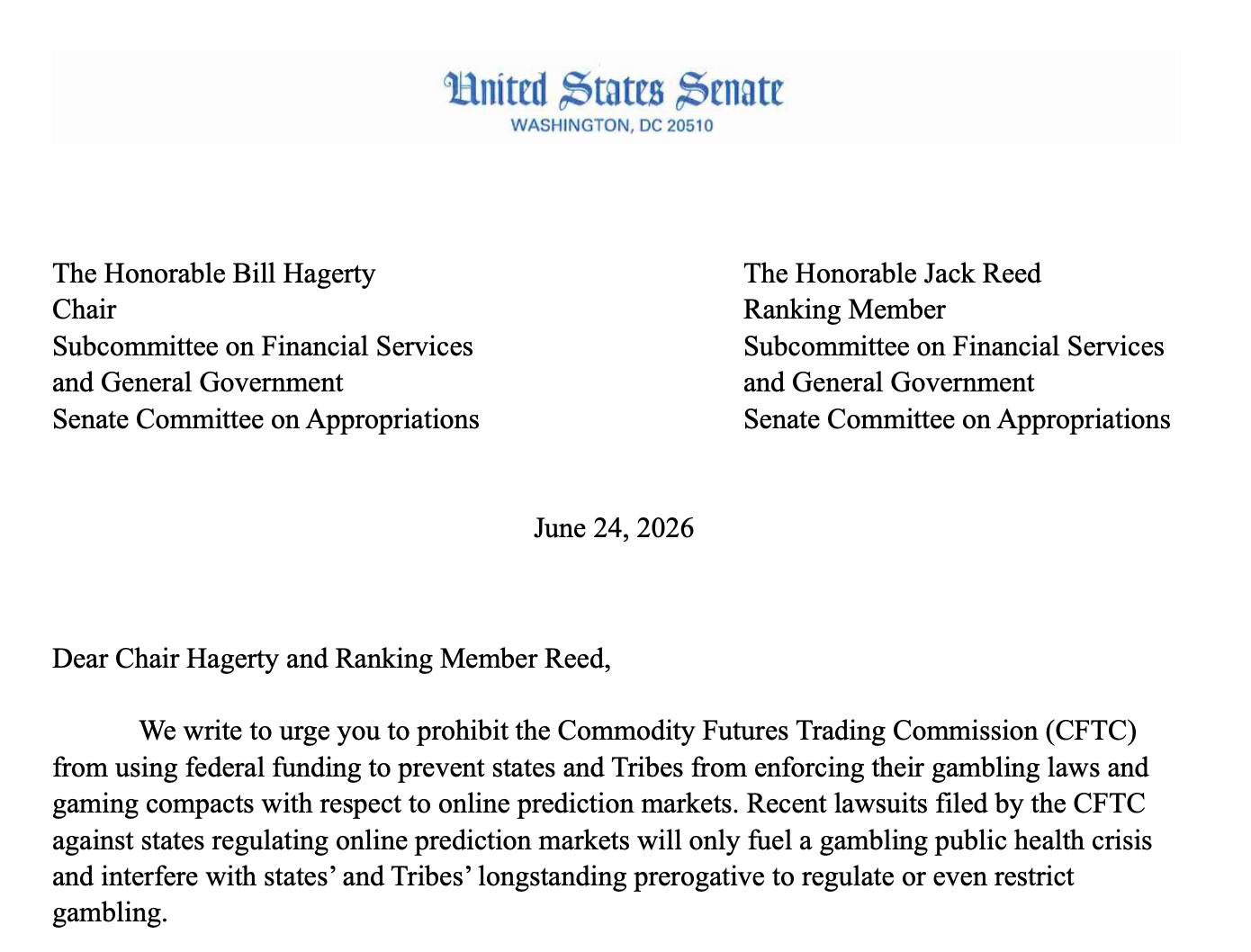
Source: Senator Richard Blumenthal
The CFTC has engaged in legal fights involving prediction markets in Connecticut, Illinois, Arizona, Kentucky, Wisconsin, New York, Minnesota, Rhode Island and New Mexico as of June. Some of the companies involved, including Kalshi and Polymarket, have filed their own lawsuits against state authorities, backing the CFTC’s position.
The ongoing legal battles have led some experts to expect that one of the cases involving the CFTC and state gaming regulators could ultimately reach the US Supreme Court. In its 2018 ruling in Murphy v. National Collegiate Athletic Association, the Court held that individual states have the authority to regulate sports betting. If the justices grant a writ of certiorari in one of the current cases, they could revisit questions about the scope of that authority.
Selig steers CFTC alone amid broader debate over the agency's authority
As the sole commissioner and chair of the CFTC, Selig has unilaterally led the agency’s policy agenda under US President Donald Trump, vowing to go after state authorities that crack down on prediction markets. While the CFTC’s leadership is expected to consist of a bipartisan group of five commissioners, Trump has not announced any intention of filling the seats as of Friday.
Selig’s actions come as the US Senate is expected to soon vote on the Digital Asset Market Clarity (CLARITY) Act, which would establish separate regulatory roles for the CFTC and Securities and Exchange Commission over digital assets. Last week, gaming organizations petitioned the Senate to add language barring sports event contracts in the CLARITY Act, arguing that the CFTC wasn’t created to regulate such wagers.
Disclaimer: The content of this article solely reflects the author's opinion and does not represent the platform in any capacity. This article is not intended to serve as a reference for making investment decisions.
You may also like
Institutions Declare September Nonfarm Payrolls "Killed" October Rate Hike Expectations! "New Fed News Agency": Jobs Report Does Not Change Fed's Stance, September CPI More Important
"The New Fed's Newsletter" stated that senior Federal Reserve officials have indicated this week that a rate hike in October may not be their baseline forecast. The current report's wage and unemployment rate data do not show the labor market is tightening enough to significantly increase price pressures. Traders’ pricing for an October rate hike dropped from nearly 30% before the data release to about 20%, and at one point, markets even stopped fully pricing in another hike this year. Institutions believe the job market is characterized by “low hiring, low layoffs,” giving the Fed reason to wait for more data; a December rate hike remains possible. Market reaction suggests “bad news is good news,” as Wall Street continues to focus on the 5% US Treasury yield.
Can NEAR crypto rebound? THESE metrics could decide what’s next
SHIB eyes $0.00001217 breakout as RSI signals new upside, could surpass TAO and LTC
New Zealand Dollar rebounds after sharp US employment disappointment
Crypto prices
More


