Bitget App
Trade smarter
Buy cryptoMarketsTradeFuturesStocksEarnInstitutionAI & More
Examining if STABLE’s uptrend is sustainable after its latest 5% price hike

Examining if STABLE’s uptrend is sustainable after its latest 5% price hike

CryptoNewsNetCryptoNewsNet2026/06/27 09:57
By:CryptoNewsNet
Back to the list

Examining if STABLE’s uptrend is sustainable after its latest 5% price hike

Examining if STABLE’s uptrend is sustainable after its latest 5% price hike image 0  ambcrypto.com 24 m
Examining if STABLE’s uptrend is sustainable after its latest 5% price hike image 1

While the broader crypto market has shown significant weakness, $STABLE has consistently held up. As the market crashed on 24th June, $STABLE defended the $0.33-support and climbed to a local high of $0.365.

At the time of writing, $STABLE was trading at around $0.362, up 5.5% over the past 24 hours in addition to its 7% weekly gains.

At the same time, the trading volume of the altcoin rose by 25% to $20.8 million, indicating an uptick in market participation.

Why is $STABLE holding up?

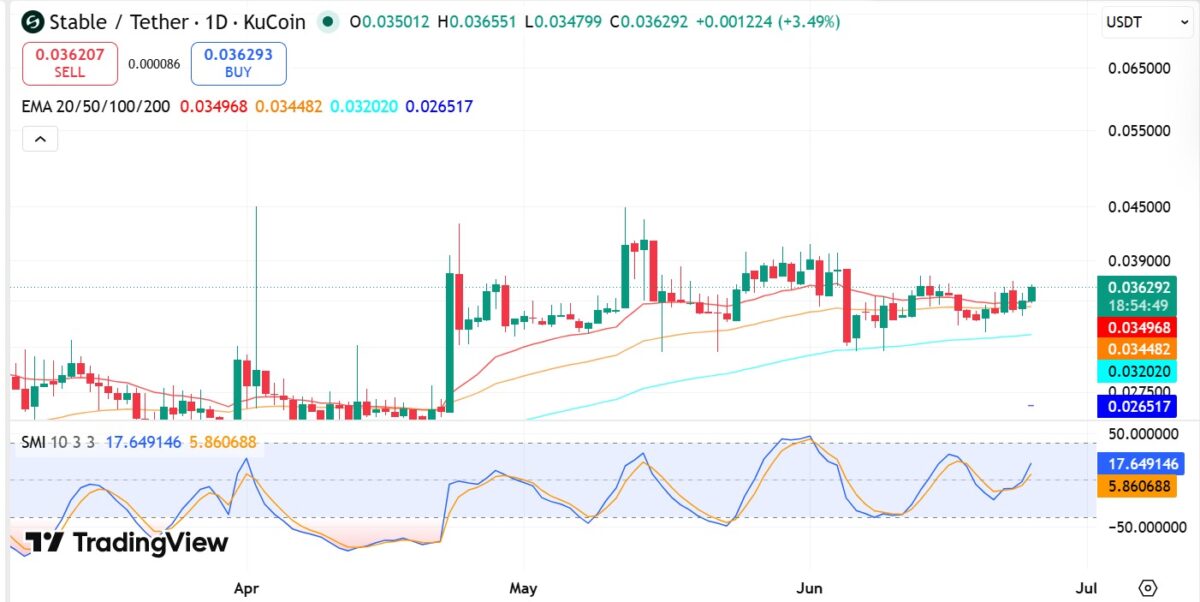
$STABLE’s daily charts underlined a strengthening bullish structure. The altcoin jumped above its 20 and 50-day EMAs at $0.349 and $0.344, respectively.

In doing so, the altcoin clearly sat above both its short and long-term moving averages, confirming the trend’s strength on the charts.
Examining if STABLE’s uptrend is sustainable after its latest 5% price hike image 2

The Stochastic Momentum Index further validated these market conditions. The SMI indicator rose to 17, while its signal rose to 7. Although the SMI remained within the bearish zone, its upward trajectory reflected improving momentum and buyer presence.

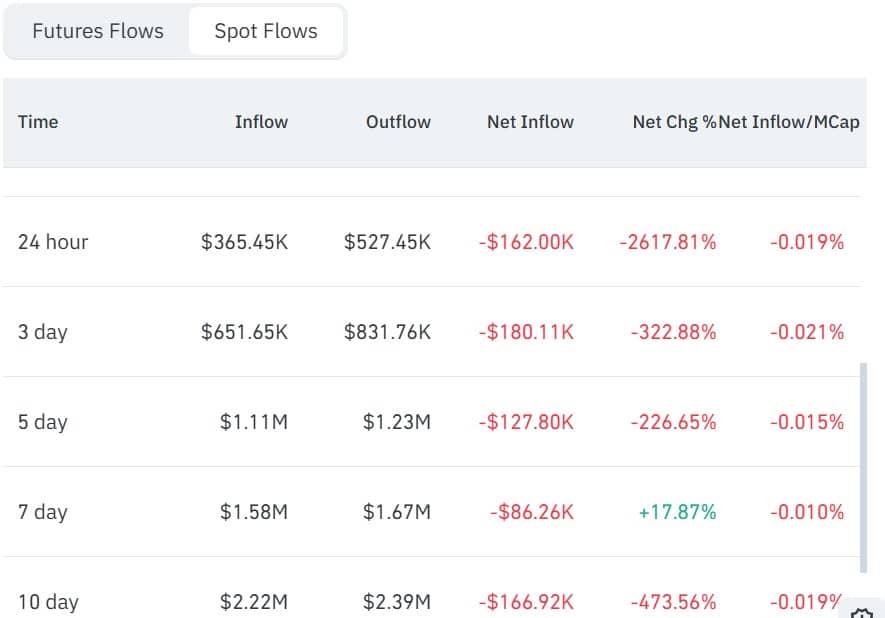
The spot activity further confirmed this point of view. The altcoin’s Spot Netflow extended its stay in negative territory, holding there for seven consecutive days.
Examining if STABLE’s uptrend is sustainable after its latest 5% price hike image 3

That’s not all though as over the last 24 hours, Spot Outflows rose to $527K while Inflows dropped to $365K. As a result, Netflow plunged 2617% to -$162K – A clear sign of sustained demand.

Therefore, it’s suitable to say that the altcoin has recently shown relative strength, largely driven by sustained spot demand.

Is the network’s sustainability of concern?

Although $STABLE has been exhibiting some strength, demand-wise, the market did raise some concerns.

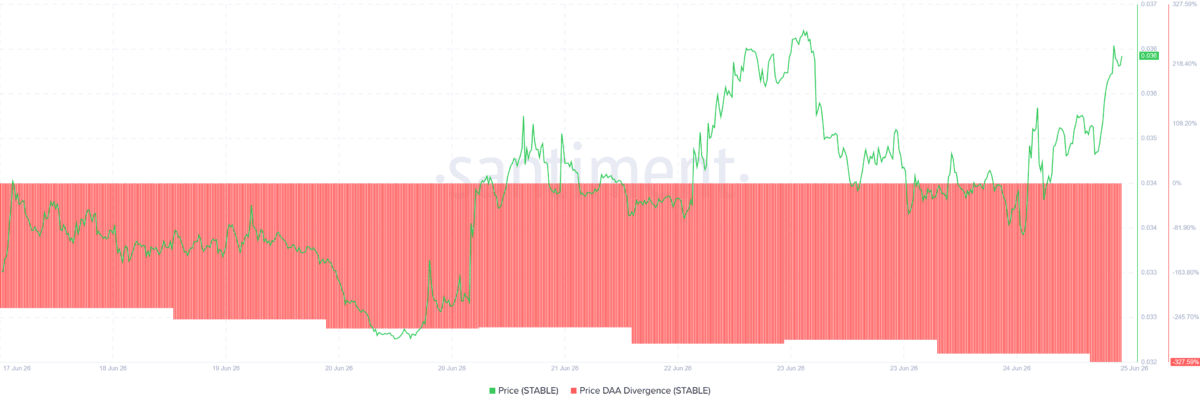
For starters, the network’s usage remains extremely weak. For instance, a look at $STABLE’s Price DAA Divergence revealed that the metric has remained negative for 7 consecutive days.
Examining if STABLE’s uptrend is sustainable after its latest 5% price hike image 4

A negative DAA Divergence means that Active Addresses have been failing and have not kept up with the price. User engagement often leads to weak network fundamentals, implying the uptrend lacks stronger user participation.

Historically, such structural weaknesses have extensively increased the risk of price correction.

Can the altcoin’s upside momentum hold?

$STABLE exhibited relative strength, driven by strong market demand. With upside momentum holding up, the altcoin might be positioned for further gains too.

Therefore, under these conditions, $STABLE will close above $0.36 and flip its $0.40-resistance.

However, as was observed, pullback risks remain due to structural weakness. If the bulls’ attempt fails and the price fails to close above $0.36, a retrace will follow.

Another pullback will see the altcoin drop below $0.34 and seek immediate support at $0.32.

Final Summary

  • $STABLE surged by 5% and successfully defended $0.33, hiking to a local high of $0.36 amid sustained demand.
  • Altcoin remains structurally weak, with low user engagement posing a risk for another pullback towards $0.32.
0
0

Disclaimer: The content of this article solely reflects the author's opinion and does not represent the platform in any capacity. This article is not intended to serve as a reference for making investment decisions.

Understand the market, then trade.
Bitget offers one-stop trading for cryptocurrencies, stocks, and gold.
Trade now!

You may also like

Delta Air Lines Lowers Profit Forecast as Fuel Cost Increase Outpaces Ticket Price Growth

Delta Air Lines lowers its annual profit forecast due to a $6 billion increase in fuel costs; sharply rising ticket prices test travelers’ willingness to pay. The company’s refinery business is expected to generate $700 million in profits to help offset the impact of fuel costs. Rajesh Kumar Singh, Reuters Chicago, October 9 – Delta Air Lines (DAL.N) lowered the midpoint of its annual profit forecast by nearly a quarter on Friday, as surging fuel costs offset the positive effects of strong travel demand and higher ticket prices. This downgrade highlights the increasingly severe challenges faced by U.S. airlines: if fuel prices remain high, will passengers be willing to accept further price hikes? Airlines have already increased ticket prices considerably this year, and analysts warn that further hikes could test travelers’ willingness to continue spending. The Atlanta-based airline expects its annual fuel spending to increase by about $6 billion compared to last year. Its third-quarter fuel expenses jumped 62% year-on-year to $4.1 billion, more than $500 million higher than July’s expectations. When asked about the reasons for the revised forecast, Delta CFO Erik Snell told reporters, “It’s entirely a fuel issue,” noting that crude oil and refined jet fuel prices have both increased since the summer. Delta now expects adjusted annual earnings per share of $5.10–$5.60, down from its July forecast of $6.50–$7.50. According to data from London Stock Exchange Group (LSEG), the new median of $5.35 is below analysts’ average forecast of $5.46. The company expects an adjusted pre-tax profit of $4.5 billion in 2026. According to LSEG, third-quarter adjusted earnings per share were $1.72, slightly below the average analyst forecast of $1.76. Its adjusted operating margin dropped from 11.1% to 9.4%. Delta is the first major U.S. airline to report third-quarter earnings; its competitors United Airlines (UAL.O), American Airlines (AAL.O), and Southwest Airlines (LUV.N) will release their results later this month. Ticket Price Increases According to the U.S. Bureau of Transportation Statistics, in the first eight months of 2026, U.S. airlines spent $42.9 billion on fuel for scheduled flights, nearly $13.2 billion more than in the previous year, despite a slight decrease in fuel consumption. Strong demand and limited seat growth have helped airlines pass higher fuel costs onto passengers. According to the U.S. Bureau of Labor Statistics’ Consumer Price Index, over the five months ending in August, average U.S. airfares increased about 25% year-on-year. With fuel prices remaining high and industry capacity growth set to further accelerate in the fourth quarter, analysts are closely watching whether airlines including Delta can raise ticket prices further without suppressing travel demand. Deutsche Bank analysts expect the industry’s proportion of fuel costs recouped through revenue to decline in the fourth quarter, with full recovery not expected until early 2027. Delta says demand remains strong. Snell noted that with fourth-quarter bookings already near 60%, the company expects revenue to increase by around 20% year-on-year. According to LSEG, Delta forecasts fourth-quarter adjusted earnings per share of $1.15–$1.65, with the median $1.40 roughly in line with analysts’ average expectation of $1.39. Refinery Advantage Delta holds an advantage over other major U.S. airlines: it owns a refinery near Philadelphia, which Snell expects will generate $700 million in profits this year. “We own a refinery, which gives us a hedge—part hedge—on fuel prices that no other airline has,” he said. Delta acquired the Monroe refinery in 2012, which processes crude oil into jet fuel and other products. While Delta must still pay market prices for fuel consumed by its airline operations, refinery profits remain within the company. When the price spread between crude oil and refined products widens, this helps offset fuel cost pressures for airlines sourcing externally. However, this protection depends on refinery margins; when margins fall, the refinery may also incur losses. Nevertheless, the refinery can only partially ease the impact of rising fuel prices. Even with an expected refinery benefit of 40 cents per gallon, Delta forecasts its fuel cost to rise from $3.61 per gallon in the third quarter to $4.25 per gallon in the fourth quarter. Snell said fuel costs are expected to remain high for some time. “Ultimately, fuel prices will come down. As to when, we’re not sure,” he said. (For the convenience of non-native English speakers, Reuters offers automated translations of its reports into several other languages. Due to possible errors or lack of context in automated translations, Reuters does not guarantee the accuracy of automated translation texts and provides them only for reader convenience. Reuters assumes no responsibility for any damages or losses from use of automated translation featur

路透社•2026/10/09 10:37

"SaaS Apocalypse" Debunked? Autodesk (ADSK.US) and Intuit (INTU.US) Lead Growth Against the Trend as Wall Street Reprices the "AI Eating Software" Narrative

This week, Autodesk and Intuit are expected to record their strongest weekly gains in months, defying pressure on the overall technology sector. This strong performance signals a renewed optimism in the market regarding the growth prospects of the SaaS (Software as a Service) industry.

智通财经•2026/10/09 09:56

Starlink Targets the US Mobile Communication Market, SpaceX (SPCX.US) Opens New Growth Opportunities: Wall Street Focuses on the Reshaping of the Telecom Industry Landscape

Combining the existing satellite capacity, SpaceX is supplementing its capabilities to upgrade from “occasional emergency connectivity” to “daily mobile service.” The satellite network provides wide-area coverage and fills ground blind spots, while low-frequency terrestrial networks improve connectivity inside buildings and in environments with complex obstructions. The two form a complement to each other.

智通财经•2026/10/09 09:56