

Cryptographic obfuscation has long been regarded as one of the field’s challenging goals because it aims to hide how software works while allowing it to execute normally. Researchers describe the technology as a method for converting a program into an encrypted form that produces identical outputs for the same inputs without revealing its internal logic.
Although the concept has existed for decades, recent research shows that mathematically secure obfuscation can now be achieved under practical security assumptions. However, researchers say the enormous computational cost continues to prevent real-world deployment, making efficiency the biggest hurdle to widespread adoption.
Current research, as outlined by Vitalik Buterin in a blog post, centers on indistinguishability obfuscation (iO), a cryptographic model that makes it computationally hard to distinguish between two programs that perform the same function.
Unlike traditional encryption, which protects data, iO is designed to conceal a program’s implementation while preserving its behavior. The general concept of privacy-preserving computation, illustrated below, shows how encrypted inputs can be processed within a verified virtual computation environment to produce encrypted outputs without revealing the underlying data.
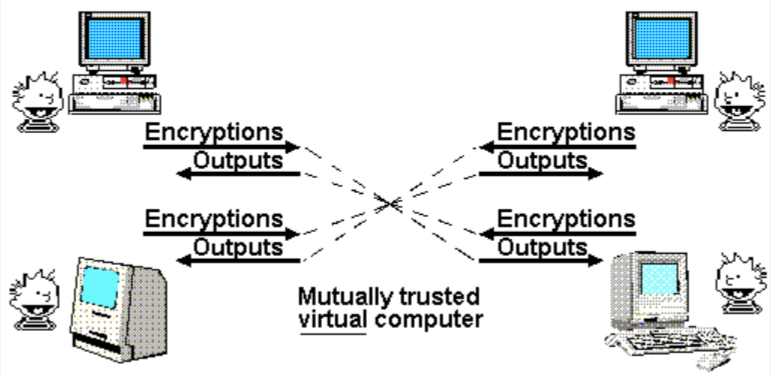
Source: Vitalik
Researchers believe combining iO with blockchain technology could enable decentralized applications that require minimal trust. Possible use cases include private voting systems, confidential smart contracts, and other protocols that would otherwise rely on trusted intermediaries.
However, obfuscated programs cannot prevent themselves from being copied, meaning they cannot independently manage stateful assets such as digital currencies.
The search for secure obfuscation has faced repeated setbacks. In 2001, researchers showed that an ideal form of obfuscation that reveals nothing beyond a program’s outputs is mathematically impossible. That result shifted academic attention toward indistinguishability obfuscation as a more practical and achievable alternative.
(adsbygoogle = window.adsbygoogle || []).push({});Modern iO constructions are based on a framework introduced through a series of academic papers beginning in 2015. These designs combine succinct functional encryption with another cryptographic primitive, XiO, to gradually transform software into an obfuscated program.
Succinct functional encryption enables encrypted inputs to be evaluated against a specific function while revealing only the intended output. XiO then compresses the resulting encoded program into a compact representation without exposing its internal logic. Researchers recursively apply these techniques to process individual input bits while preventing exponential increases in storage and computation.
The architecture also incorporates universal circuits and randomized encodings to conceal the original program’s structure. In later stages, garbled circuits enable computations to be executed securely by hiding intermediate values, further protecting the underlying code.
Despite steady theoretical progress, researchers acknowledge that current implementations remain impractical for everyday use.
Related: Ethereum Foundation to Reduce Budget by 40%, Says Vitalik Buterin


