
Australia’s crypto travel rule is coming into effect: Here’s what's changing

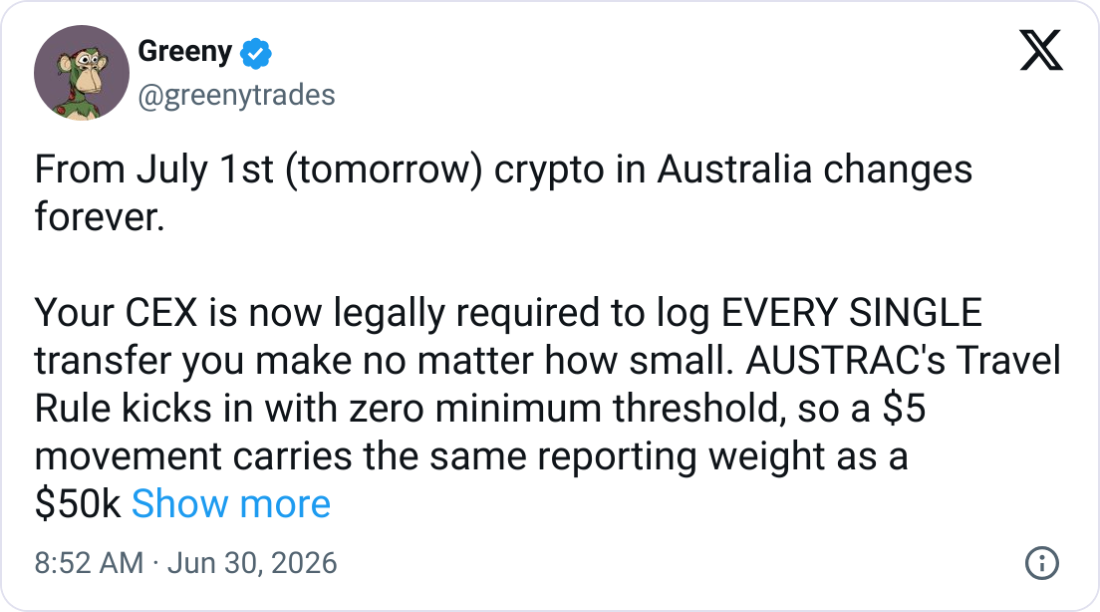
Crypto exchange users in Australia will soon face stricter rules on all transfers as the country’s travel rule is set to come into force on Wednesday, aligning it with similar rules in the EU, US and UK.
From July, all crypto sent and received on locally-regulated crypto exchanges will require users to provide additional information, such as the name of the person the crypto is being sent to or received from, and the name of the platform.
Gabby Lewis, the head of fraud and financial crime at Swyftx, told Cointelegraph that for most exchange users, “the impact should be very limited. They’ll provide the required details once, and then these will be saved for future use.”
The rules are set to bring Australia in line with other countries that have implemented the travel rule for years, which the Financial Action Task Force, an international policy-making body, first extended to crypto in 2019.
Crypto users have long expressed concern that the rule would impact the anonymity of the technology and the risks of data linking crypto transfers to personal information being leaked.
However, Lewis said that the “travel rule isn't crypto-specific. It already applies across financial services and has been implemented in areas including Singapore, the United States, New Zealand and the UK. Australia is now following suit.”
The rule aims to prevent money laundering, terrorist financing and scams by increasing the traceability of crypto transfers. It will be enforced by the Australian Transaction Reports and Analysis Centre (AUSTRAC), the country’s financial intelligence agency.
Transfers from a regulated crypto exchange to a self-custodial address, such as a cold storage wallet, will also prompt a user to verify and declare that they are the owner of that address.
“We’re generally talking about a quick confirmation that the wallet is theirs,” Lewis said. “The additional steps mainly come into force for transfers that involve another party or another exchange.”
Australia’s travel rule has no minimum value threshold, meaning a transfer of any size will require an exchange to gather information, aligning it with countries including France, the Netherlands and Japan that have no minimum.
Other countries have set minimum reporting thresholds, such as the US, which only collects information on transfers starting at $3,000.
Some crypto exchanges operating in Australia have already begun to implement the travel rule, such as Kraken, which started on March 31, and CoinJar, which started on Tuesday.
Related: Australia passes digital asset bill bringing crypto platforms under licensing
Crypto users online have recently given mixed reactions to the rule, which the Australian parliament passed into law in 2024.
Disclaimer: The content of this article solely reflects the author's opinion and does not represent the platform in any capacity. This article is not intended to serve as a reference for making investment decisions.
You may also like
XRP Pundit: First Thing You Should Do When You Become a Crypto Millionaire
 VIPTradFi Focus: Where Does the RWA Market Stand Today?
1. Crypto outperformed traditional equity indexes following the rate hike, but elevated interest rates remain a key constraint on cross-asset allocation. From September 12 to 18, BTC, ETH, and SOL gained 4.83%, 3.84%, and 9.96%, respectively, while the S&P 500 edged down 0.08%. The U.S. Dollar Index rose 1.11%, and the 10-year U.S. Treasury yield closed at approximately 4.998%. Improving risk appetite is therefore coexisting with elevated discount rates, raising the bar for RWA allocation: investors need to compare not only returns on the underlying assets, but also on-chain liquidity and collateral efficiency. 2. Growth in tokenized equities is occurring even as the overall RWA market remains under pressure. As of September 18, Distributed Asset Value across RWAs stood at $38.503 billion, down 1.13% week over week, while tokenized equities reached $3.056 billion, up 6.03%. This week's data are better explained by capital reallocating across different RWA segments than by a broad-based expansion of the entire RWA market. 3. For exchanges, the opportunity lies in connecting spot holdings, collateral, and derivatives. Reality's distributed asset value stands at approximately $155 million, while eligible rTokens can already be used within Bitget's UTA margin framework. Across CoinGlass's verifiable sample of 177 TradFi instruments, open interest reached approximately $11.498 billion, up 2.06% week over week, even as weekly trading volume declined 7.60%. The medium-term opportunity remains intact, but deeper utilization will depend on liquidity, collateral use, and sustained trading activity. 4.Assets to watch: BTC, ETH, SOL, NEAR, ZEC, gold, tokenized U.S. equities, COST. 5.Key metrics to watch: rToken collateral utilization, the durability of TradFi open interest and trading volume, and next week's employment and consumer data.

Gold prices fall Rs 1,331/10 gram, silver dips Rs 1,600/kg as Mideast tensions outweigh oil fall: Key levels to track
Strategists Say Market's ‘Wall of Worry' Is Healthy, Not a Warning Sign

Crypto prices
More


