
Business use of stablecoins set for growth surge: Cybrid report

Business use of stablecoins is poised to surge in the next 12 months as adoption of the digital currency goes mainstream, according to a new report from payments infrastructure firm Cybrid.
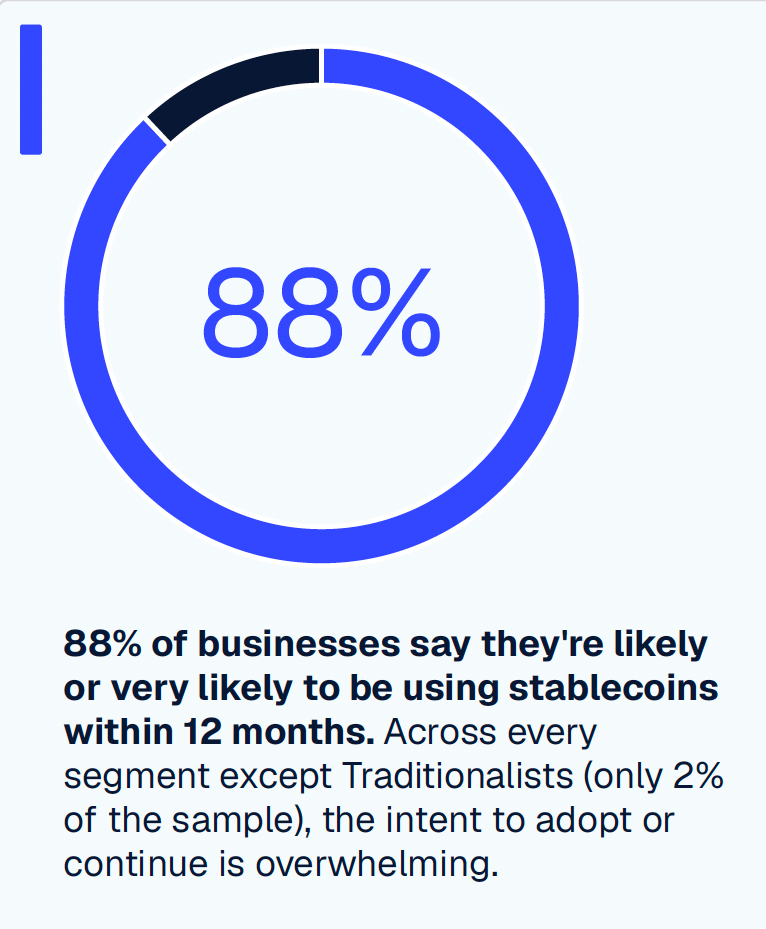
The report found 42% of businesses surveyed are already using stablecoins for cross-border payments and 88% of respondents said they are likely or very likely to use stablecoins within the next 12 months. Still, only 2% identified as committed users of traditional payment rails.
Businesses using stablecoins reported average cross-border payment cost savings of 35%, with companies processing more than $100 million in monthly payment volume reporting average savings of up to 47%, according to the survey.
Source: Cybrid report
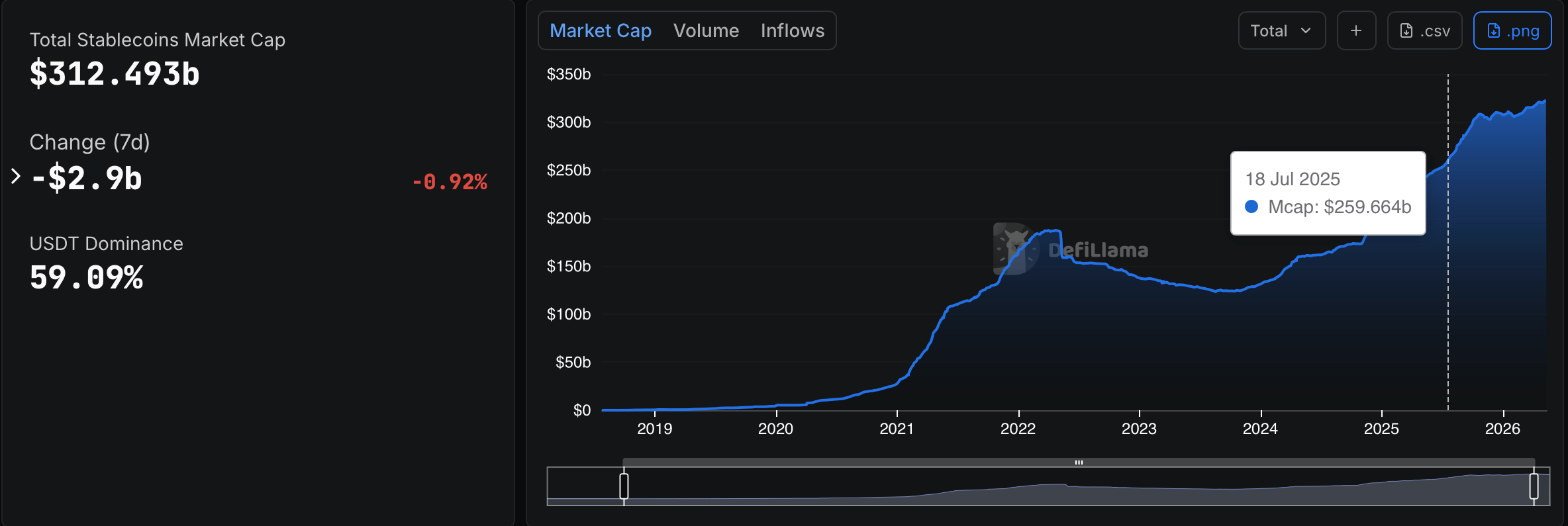
The global stablecoin market cap is now at $307.64 billion, led by Tether's USDT, at $184.7 billion, and Circle's USDC, at $73.51 billion, Coingecko data shows. Fueled by recent legislation, GENIUS Act-compliant stablecoins have reached a market cap of more than $76 billion. That established the first federal regulatory framework for payment stablecoins in the United States.
The report is based on a survey of 468 executives and business leaders conducted between April 28 and May 4.
Varied users look for regulatory clarity to gain confidence
Payroll and contractor payments were the most common stablecoin use case among respondents, followed by supplier payments, customer payments, investment and yield generation, vendor payments, and treasury and liquidity management.
Regulatory clarity was also a top factor respondents said would increase their confidence in expanding stablecoin use, with 71% identifying it as more important than trusted infrastructure providers or integration with existing systems.
Respondents came from the technology, financial services and ecommerce sectors in the United States, Canada and the United Kingdom, including C-suite executives, finance and treasury managers, and payments and operations leaders.
Companies expand infrastructure for stablecoin payments
Separate industry data points to the same trend. In June, payments infrastructure provider Paybis said business customers accounted for nearly 98% of stablecoin payout volume processed through its platform during the first four months of 2026, up from 36% in 2023.
Paybis also cited McKinsey research estimating that business-to-business transactions accounted for roughly 60% of the $390 billion in global stablecoin payment volume recorded in 2025.
Companies have continued expanding infrastructure to support growing business demand. In May, Falcon Finance debuted the dollar-backed stablecoin fUSD through Anchorage Digital Bank's federally regulated issuance platform, targeting institutional trading, collateral and treasury workflows.
On Monday, BNY expanded its digital asset custody platform to support Circle's USDC, allowing institutional clients to store, transfer, mint and redeem the stablecoin directly through the bank.
Disclaimer: The content of this article solely reflects the author's opinion and does not represent the platform in any capacity. This article is not intended to serve as a reference for making investment decisions.
You may also like
XRP Pundit: First Thing You Should Do When You Become a Crypto Millionaire
 VIPTradFi Focus: Where Does the RWA Market Stand Today?
1. Crypto outperformed traditional equity indexes following the rate hike, but elevated interest rates remain a key constraint on cross-asset allocation. From September 12 to 18, BTC, ETH, and SOL gained 4.83%, 3.84%, and 9.96%, respectively, while the S&P 500 edged down 0.08%. The U.S. Dollar Index rose 1.11%, and the 10-year U.S. Treasury yield closed at approximately 4.998%. Improving risk appetite is therefore coexisting with elevated discount rates, raising the bar for RWA allocation: investors need to compare not only returns on the underlying assets, but also on-chain liquidity and collateral efficiency. 2. Growth in tokenized equities is occurring even as the overall RWA market remains under pressure. As of September 18, Distributed Asset Value across RWAs stood at $38.503 billion, down 1.13% week over week, while tokenized equities reached $3.056 billion, up 6.03%. This week's data are better explained by capital reallocating across different RWA segments than by a broad-based expansion of the entire RWA market. 3. For exchanges, the opportunity lies in connecting spot holdings, collateral, and derivatives. Reality's distributed asset value stands at approximately $155 million, while eligible rTokens can already be used within Bitget's UTA margin framework. Across CoinGlass's verifiable sample of 177 TradFi instruments, open interest reached approximately $11.498 billion, up 2.06% week over week, even as weekly trading volume declined 7.60%. The medium-term opportunity remains intact, but deeper utilization will depend on liquidity, collateral use, and sustained trading activity. 4.Assets to watch: BTC, ETH, SOL, NEAR, ZEC, gold, tokenized U.S. equities, COST. 5.Key metrics to watch: rToken collateral utilization, the durability of TradFi open interest and trading volume, and next week's employment and consumer data.

Gold prices fall Rs 1,331/10 gram, silver dips Rs 1,600/kg as Mideast tensions outweigh oil fall: Key levels to track
Strategists Say Market's ‘Wall of Worry' Is Healthy, Not a Warning Sign

Crypto prices
More


