
Revisiting the “Pig Cycle”: Industry Cash Flow Is Drying Up, Supply Clearance May Arrive in a “Nonlinear” Manner

1. What happened? — Multiple Historical Extremes Overlap, Industry Plunges into a “Bleeding” Abyss
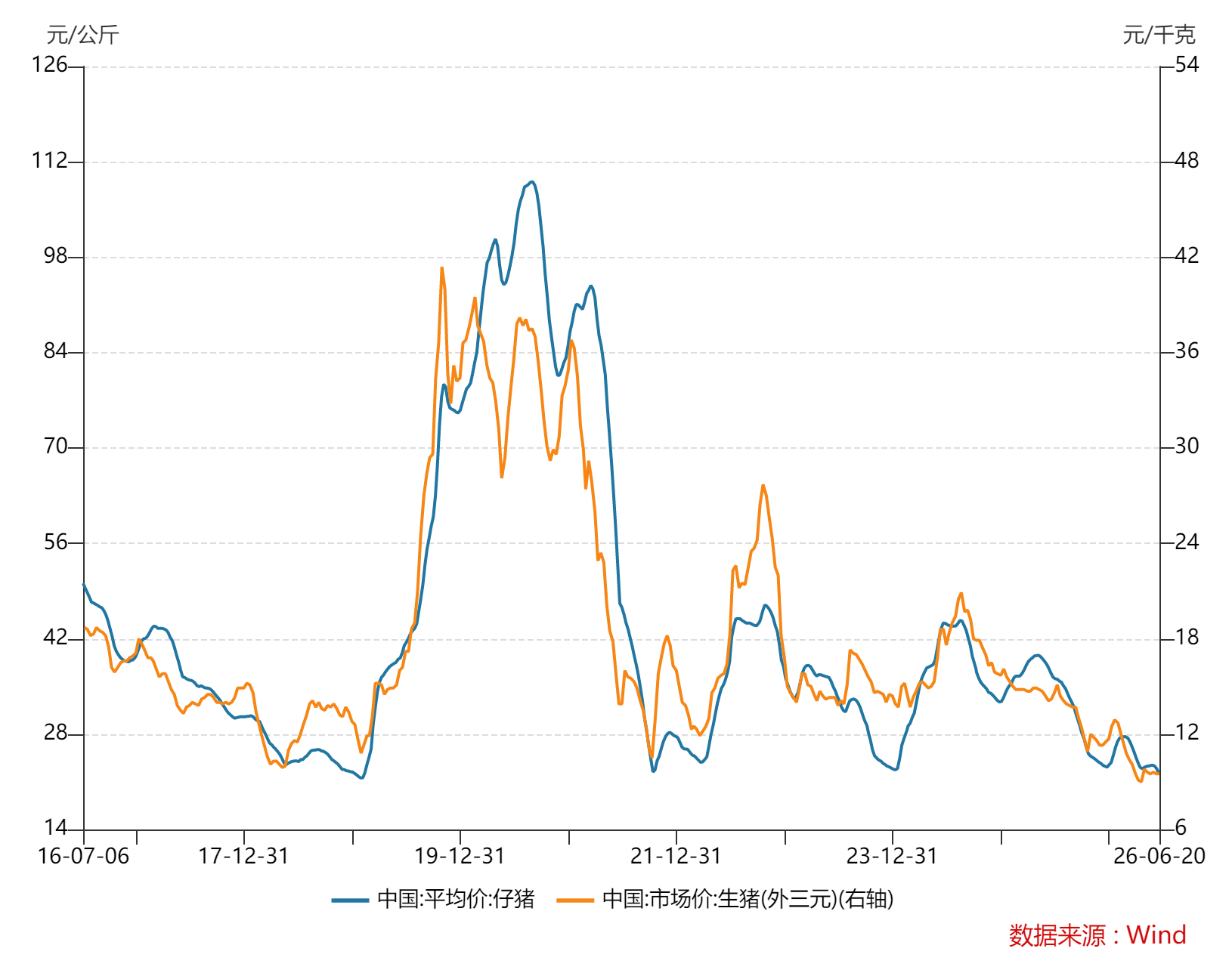
Prices are under pressure across the board. As of June 26, 2026, the national average live hog price was 9.4 yuan/kg. After hitting a 20-year low of 8.67 yuan/kg in mid-April, it has continued to fluctuate at a low level within a narrow range of 9-10 yuan/kg, presenting a typical “bottom grinding” pattern. The piglet market has simultaneously collapsed—by June 23, the price of 7kg weaned piglets had dropped to 157 yuan per head, down 64% year-on-year and 13% month-on-month, deeply inverted relative to the industry cost line of 280 yuan per head.
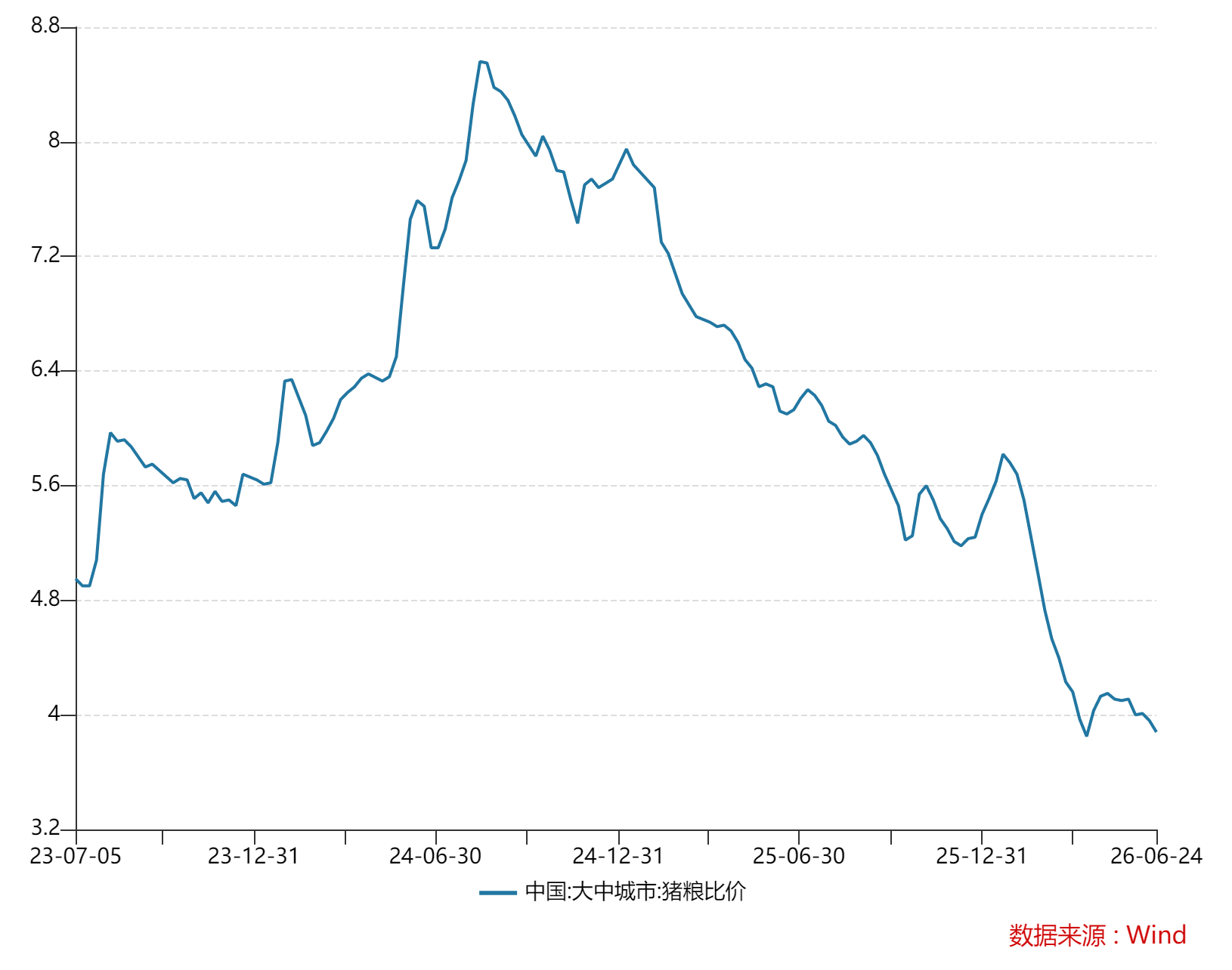
Historical indicators are continuously being breached. As of June 24, the national hog-to-feed price ratio in major cities had dropped to 3.88, approaching the historic low set in April this year. The hog-to-feed ratio is the core metric for measuring farming profitability—6:1 is breakeven, below 5:1 is generally loss-making, and below 4:1 means the industry has entered a zone of extreme deep losses. The emergence of this historical extreme indicates that the sector is currently at a cyclical bottom.
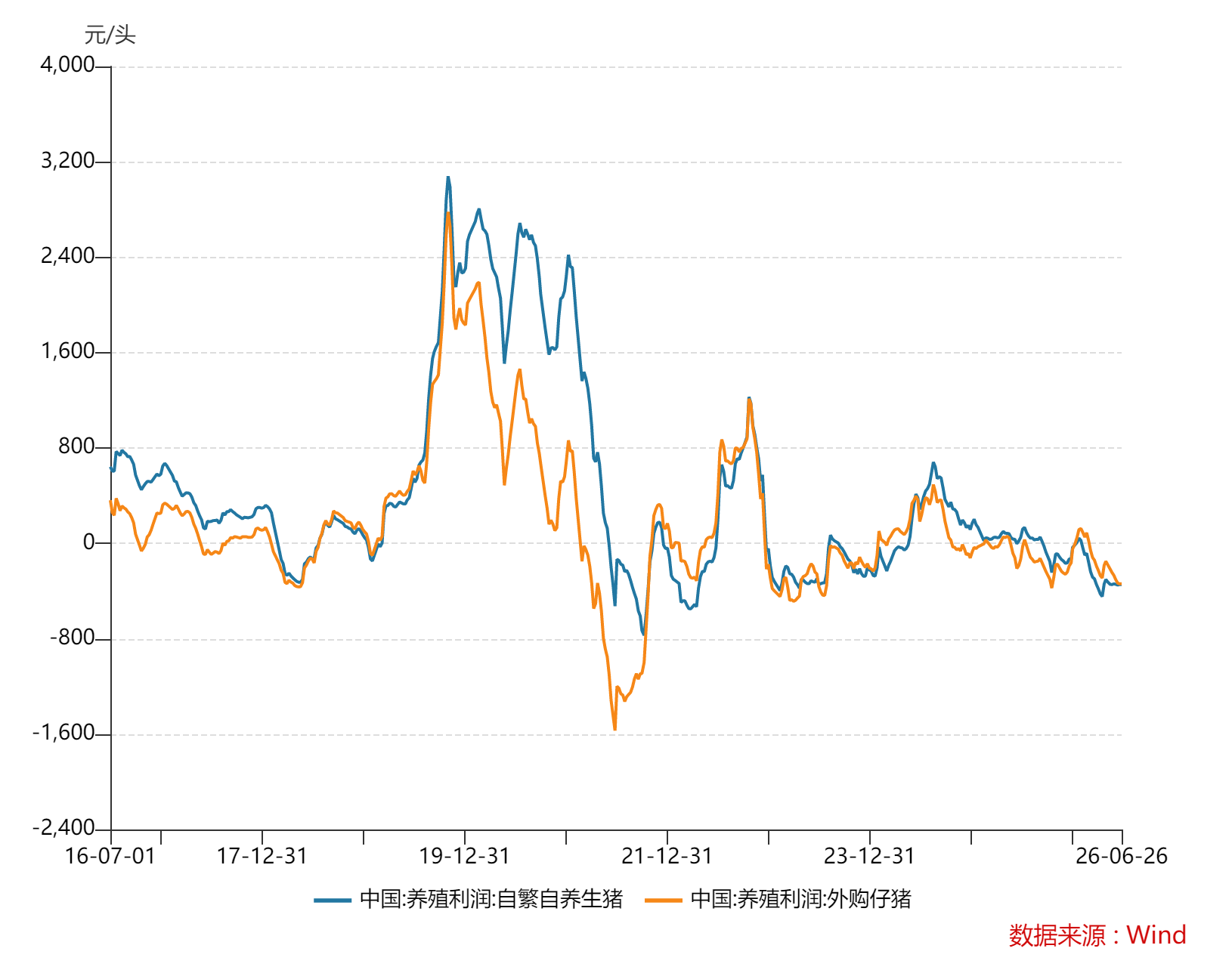
The farming end is experiencing comprehensive and deep losses. As of June 26, under the self-breeding and self-raising model, the loss per head was 346 yuan, while in the model of purchasing piglets, loss per head was 339 yuan. Both models show similar loss depths, the second-deepest since 2014. The self-breeding and self-raising model has been losing money for over 9 consecutive months since September 2025, and the purchased piglet model for over 10 months. The industry has shifted from a simple “profit loss” to a continuous “cash flow drain,” with the entire sector in a systemic “bleeding” state.
2. Why does it matter? — Nonlinear Clearing Logic amid Cash Flow Exhaustion
1. Why did this bottoming process dramatically exceed expectations: the “dual trap” of oversupply and weak demand
The duration of bottoming in this cycle has far exceeded market expectations. The root cause lies in the structural mismatch between supply and demand.
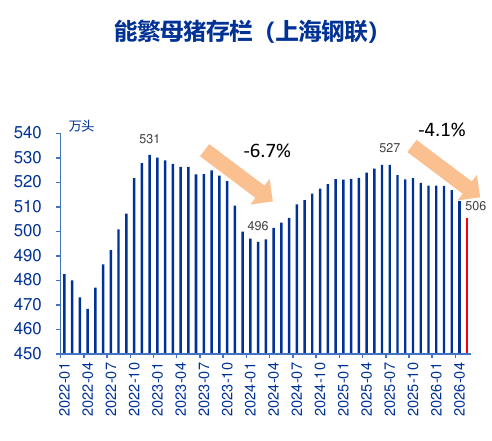
On the supply side, the high inventory of breeding sows in the previous period, compounded by systemic leaps in production efficiency, have created a “double squeeze.” As of March 2026, the national inventory of breeding sows was 39.04 million, still 1.54 million greater than the latest Ministry of Agriculture and Rural Affairs' target of 37.5 million, indicating potential for further destocking. Meanwhile, industry-wide average PSY (pigs sold per sow per year) rose from 22.7 in 2023 to 24.3 in 2025, so improved farming efficiency has substantially increased output capacity with the same sow numbers.
In Q1 2026, national live hog slaughter reached 200 million, up 2.8% year-on-year, and pork production rose 4.2% versus the same period last year. Additionally, frozen meat storage utilization has climbed to a historical high of 32.96%, more than 15 percentage points higher year-on-year. This huge refrigerated inventory acts as a “barrier lake,” continuously suppressing any rebound in pork prices.
......
Disclaimer: The content of this article solely reflects the author's opinion and does not represent the platform in any capacity. This article is not intended to serve as a reference for making investment decisions.
You may also like
The "debt black hole" behind the AI boom: $1.2 trillion external financing may be needed in the next five years
The rapid surge of AI is creating an unprecedented "debt black hole": according to Bank of America estimates, total capital expenditure for building AI data centers between 2025 and 2030 will reach as much as $5 trillion, with external financing needs of core cloud giants alone reaching $1.2 trillion to $1.5 trillion. Free cash flow is already running low for giants such as Amazon and Meta, while Nvidia and Broadcom have quietly taken on the role of "implicit guarantors"—marking the beginning of a capital gamble that is set to reshape global credit markets.
Analyst Makes Bold Prediction: Micron (MU.US) Expected to Surpass Microsoft (MSFT.US) in Fiscal Year 2027 Profit; Memory Prices Are the Key Factor
Is Micron (MU.US) expected to earn a net profit of $35 billion in a quarter, surpassing Microsoft's (MSFT.US) profits?
Warning Signs of US Stock Market Crash Reappear as in 2018 and 2022? Fed Tightening and US Treasury Supply Hit Amid Worsening Market Breadth, Liquidity Crisis May Be Approaching
Liquidity pressures may not yet be apparent on the surface of the market, but as market breadth in both stock and bond markets continues to deteriorate, these pressures are steadily accumulating internally.
X Finance Bull highlights $3,300 XRP price model filed with SEC
Crypto prices
More


