
Yield-bearing stablecoin slowdown ends three-year run for crypto-native products

Yield-bearing stablecoin supply fell by more than $3.5 billion in the second quarter of 2026, reversing nearly three years of quarterly growth as crypto-native products contracted and Treasury-backed tokens expanded.
Crypto exchange CEX.IO reported Thursday that the category declined by 15% during Q2. Ethena’s sUSDe lost 52% of its supply, shedding nearly $2 billion, while Sky’s sUSDS declined by 16%.
Treasury-backed products moved in the opposite direction. BlackRock’s BUIDL grew by 2%, Circle's USYC increased by nearly 16% and Ondo Finance's USDY rose by over 66%, highlighting a widening divide between crypto-native yield assets and products backed by traditional assets.
The divergence came as the broader stablecoin market recorded its first quarterly contraction since the third quarter of 2023, according to CEX.io. Total supply fell to $312 billion in Q2, while adjusted transaction volume declined by 5.5%.
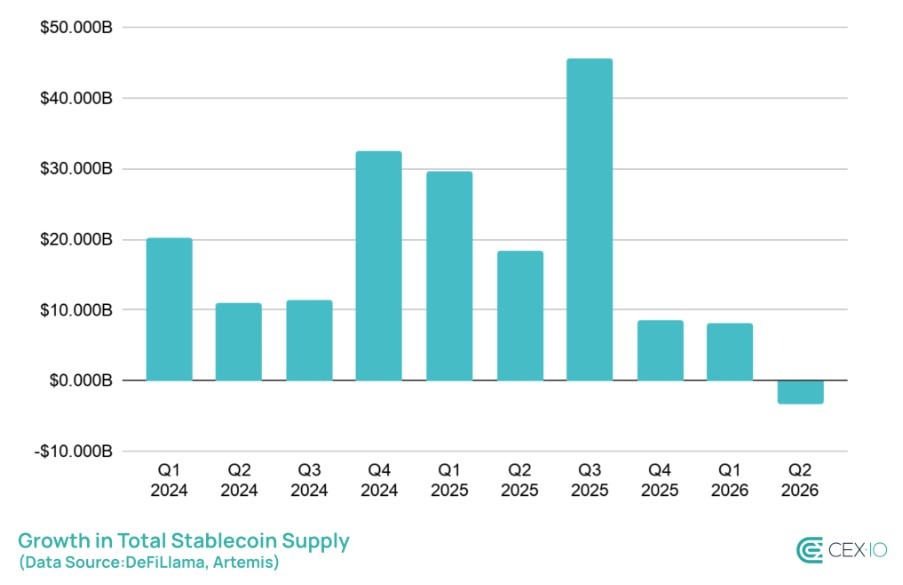
Supply growth per quarter, compiled by CEX.io. Source: CEX.io
Stablecoin slowdown deepens after weaker Q1 signals
The Q2 decline marks a sharp reversal from the start of 2026. In Q1, stablecoin supply increased by about $8 billion to a record $315 billion, with yield-bearing products among the main growth drivers.
However, signs of weakening organic demand had already emerged early in the year. During the first quarter, retail-sized transfers fell by 16%, while automated activity accounted for roughly 76% of stablecoin transaction volume.
The slowdown continued through Q2. According to CEX.io, total stablecoin transaction counts fell by 530 million to 4.48 billion, the largest quarterly decline on record. However, transfers below $250 increased by 5% to $19.39 billion, suggesting that smaller peer-to-peer payments were more resilient than larger automated and trading flows.
Related:
Contraction comes amid weaker crypto market activity
The stablecoin contraction also adds to broader concerns about weakening activity across crypto markets. On Wednesday, institutional data provider Talos identified declining stablecoin supply alongside spot Bitcoin (BTC) exchange-traded fund (ETF) outflows and slower Bitcoin purchases by Strategy as three key demand channels that weakened in Q2.
Tanay Ved, senior research associate at Talos, told Cointelegraph that a recovery in stablecoin supply would signal “fresh capital coming back into the ecosystem more broadly” and help support onchain liquidity.
Ved said spot ETF flows remain the most important demand channel to watch because they tend to reflect more durable shifts in institutional appetite. However, he added that ETF flows, corporate Bitcoin purchases and stablecoin supply often move together when market momentum changes.
Magazine:
Disclaimer: The content of this article solely reflects the author's opinion and does not represent the platform in any capacity. This article is not intended to serve as a reference for making investment decisions.
You may also like
XRP Pundit: First Thing You Should Do When You Become a Crypto Millionaire
 VIPTradFi Focus: Where Does the RWA Market Stand Today?
1. Crypto outperformed traditional equity indexes following the rate hike, but elevated interest rates remain a key constraint on cross-asset allocation. From September 12 to 18, BTC, ETH, and SOL gained 4.83%, 3.84%, and 9.96%, respectively, while the S&P 500 edged down 0.08%. The U.S. Dollar Index rose 1.11%, and the 10-year U.S. Treasury yield closed at approximately 4.998%. Improving risk appetite is therefore coexisting with elevated discount rates, raising the bar for RWA allocation: investors need to compare not only returns on the underlying assets, but also on-chain liquidity and collateral efficiency. 2. Growth in tokenized equities is occurring even as the overall RWA market remains under pressure. As of September 18, Distributed Asset Value across RWAs stood at $38.503 billion, down 1.13% week over week, while tokenized equities reached $3.056 billion, up 6.03%. This week's data are better explained by capital reallocating across different RWA segments than by a broad-based expansion of the entire RWA market. 3. For exchanges, the opportunity lies in connecting spot holdings, collateral, and derivatives. Reality's distributed asset value stands at approximately $155 million, while eligible rTokens can already be used within Bitget's UTA margin framework. Across CoinGlass's verifiable sample of 177 TradFi instruments, open interest reached approximately $11.498 billion, up 2.06% week over week, even as weekly trading volume declined 7.60%. The medium-term opportunity remains intact, but deeper utilization will depend on liquidity, collateral use, and sustained trading activity. 4.Assets to watch: BTC, ETH, SOL, NEAR, ZEC, gold, tokenized U.S. equities, COST. 5.Key metrics to watch: rToken collateral utilization, the durability of TradFi open interest and trading volume, and next week's employment and consumer data.

Gold prices fall Rs 1,331/10 gram, silver dips Rs 1,600/kg as Mideast tensions outweigh oil fall: Key levels to track
Strategists Say Market's ‘Wall of Worry' Is Healthy, Not a Warning Sign

Crypto prices
More


