
US and Iran Send Signals of Negotiations Amid Ongoing Clashes; Gold Begins Recovery Trend

FX168 News, July 9th—— Iran seeks talks, global risk appetite recovers, gold prices rebound
On Thursday (July 9) during Asian and European trading hours, spot gold saw a bottoming and rebounding pattern, currently trading near 4103, up 0.66%.
The entire sequence of events began with Iran
In response to the fierce US bombardment,
Geopolitical tensions continued to intensify. On the night of July 8 local time in Iran,
Late at night on July 8 local time, explosions were reported in the port city of Bandar Abbas and the Sirik area in Hormozgan province in southern Iran. Debris from munitions fired by the US during the attacks hit Imam Ali Hospital in Chabahar. Two docks and a maritime traffic control tower in the southeastern coastal city of Chabahar were damaged, and three of Chabahar's power transmission lines were cut, causing nearly half of the city to experience blackouts.
According to a US official, the ongoing US strikes against Iran are expected to be larger in scale than those carried out the previous day.
Invisible Restraint under Maximum Pressure: Full-scale War Is Not in Anyone's Interest
Although the flames of war are spreading, and Trump has released aggressive signals on social media (threatening to pinpoint Iranian power plants, desalination facilities, and even to send troops to control its Kharg Island oil export hub), both sides have maintained a certain degree of restraint in the midst of fierce firefights—the Strait of Hormuz remains open to this day.
For Iran: Nearly 90% of its crude oil exports rely entirely on Kharg Island and the Strait of Hormuz.
Therefore, pragmatists within the country are seeking to restart peace negotiations after the Khamenei funeral.
For the United States: Although current President Trump has adopted strong rhetoric, America’s political focus is highly concentrated on the domestic midterm elections.
Trump also hinted in early trading that US-Iran hostilities "will not turn into a protracted military conflict" and would be "quick in and out."
Elliot Hentov, Chief Macro Policy Strategist at State Street Global Advisors, commented,
Hentov noted that since April, there has been little change regarding the willingness of parties to go to war or the possibility of further escalation. In short, neither side seeks to fully restore hostile relations, so the conflict may eventually calm down.
Forecast by Institutions: In State Street Global Advisors' spring war scenario projections, the firm assumes Brent crude oil will remain around $80 a barrel for the rest of the year, fully reflecting residual risk inherent in any cease-fire agreement.
Fed’s Inflation Worries Persist, AI Demand as Support
As geopolitical uncertainties abound, US monetary policy outlook also weighs on gold prices.
Barclays strategists still believe macro risk is significantly skewed towards further hikes.
Strategists point out the latest Fed policy meeting minutes highlight mounting concerns among officials about inflation, with persistent high-inflation risks remaining prominent.
Notably, beyond traditional economic variables, strong demand for artificial intelligence (AI) investments serves as a key factor supporting high rates.
With tech giants making massive CapEx investments in AI infrastructure, the resilience and overall demand of the US domestic economy is boosted, making the path for inflation to fall bumpier. There remain clear divisions within the Federal Reserve on future policy direction.
Safe-Haven Reversal: Trump’s Negotiation Signal Eases Fears, Dollar Index Retreats, Gold Rebounds
Just as markets panicked over Barclays’ "prolonged high-rate war" forecast and Middle East conflict, a turning point in geopolitics emerged this afternoon.
This strong statement confirms that the US-Iran negotiation pathway is still open and shows both sides’ tacit understanding to talk while fighting—neither wants to slide into all-out war.
Trump’s negotiation signal immediately soothed market nerves.
US Dollar Index Drops from Highs: His comments rapidly pulled back extreme safe-haven trades driven by geopolitical tensions, and together with fading fears of "Middle East–induced rampant inflation," the Dollar Index fell back from its intraday highs.
For gold, a weaker dollar has granted the metal a breather, but the more fundamental logic lies in the market's repricing of the macro environment.
Supported directly by both dollar weakness and falling oil prices, spot gold has successfully stopped declining and is now awaiting the release of subsequent US aviation data and developments in the struggle for control of the Strait of Hormuz.
Technically, spot gold remains capped by the fan-shaped area defined by the descending trend line and channel upper boundary, and it is not advisable to chase gains blindly unless significant breakthroughs occur in rates, geopolitics, or inflation.
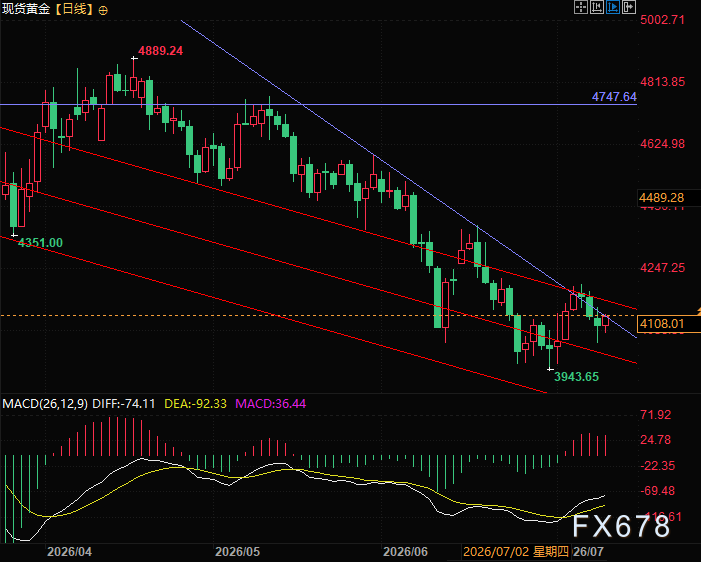
(Spot gold daily chart, source: FXEASY)
At 15:51 (UTC+8), spot gold is quoted at $4108 per ounce.
Disclaimer: The content of this article solely reflects the author's opinion and does not represent the platform in any capacity. This article is not intended to serve as a reference for making investment decisions.
You may also like
Kalshi’s perpetual security futures filing requires a $100 billion stock cap
Top Trending Cryptocurrencies Today: PENGU and PRL Surge as EDEL Falls

X-Art turns XRP Ledger’s creation into sitcom parody with “The One Without Mining”
US Stocks Lower Pre-Bell as Traders Await Chinese President's US Visit, Monitor Iran War Developments
Crypto prices
More


