
Will the "subprime moment" of AI debt arrive? The real risk factors may not have emerged yet

In the past two years, market discussions around AI have focused more on model capabilities, GPU shipments, and the growth of cloud businesses. However, as Hyperscalers’ (large-scale cloud providers) capital expenditures have soared, another issue has begun to surface: As AI infrastructure increasingly relies on external capital, could the risk shift from an industry issue to a credit problem, and even trigger financial turmoil similar to the 2008 subprime mortgage crisis?
At this stage, it is not rigorous to equate AI debt directly with a “subprime crisis replay.” AI has indeed started to exhibit some financialization characteristics worth watching—such as increased off-balance-sheet financing, rapid private credit involvement, and the gradual expansion of SPVs and securitization structures. However, the credit quality of core borrowers, the direct exposure of the banking system, and the connection to the household sector are fundamentally different from the situation before 2008. A more accurate statement would be: AI is shifting from a capital expenditure cycle into a credit expansion cycle that merits serious research.
I. What’s Happening?—AI is Moving from a Capital Expenditure Cycle to a Credit Expansion Cycle
1. Internal Cash Flow of Hyperscalers Can No Longer Keep Up with Investment Pace:
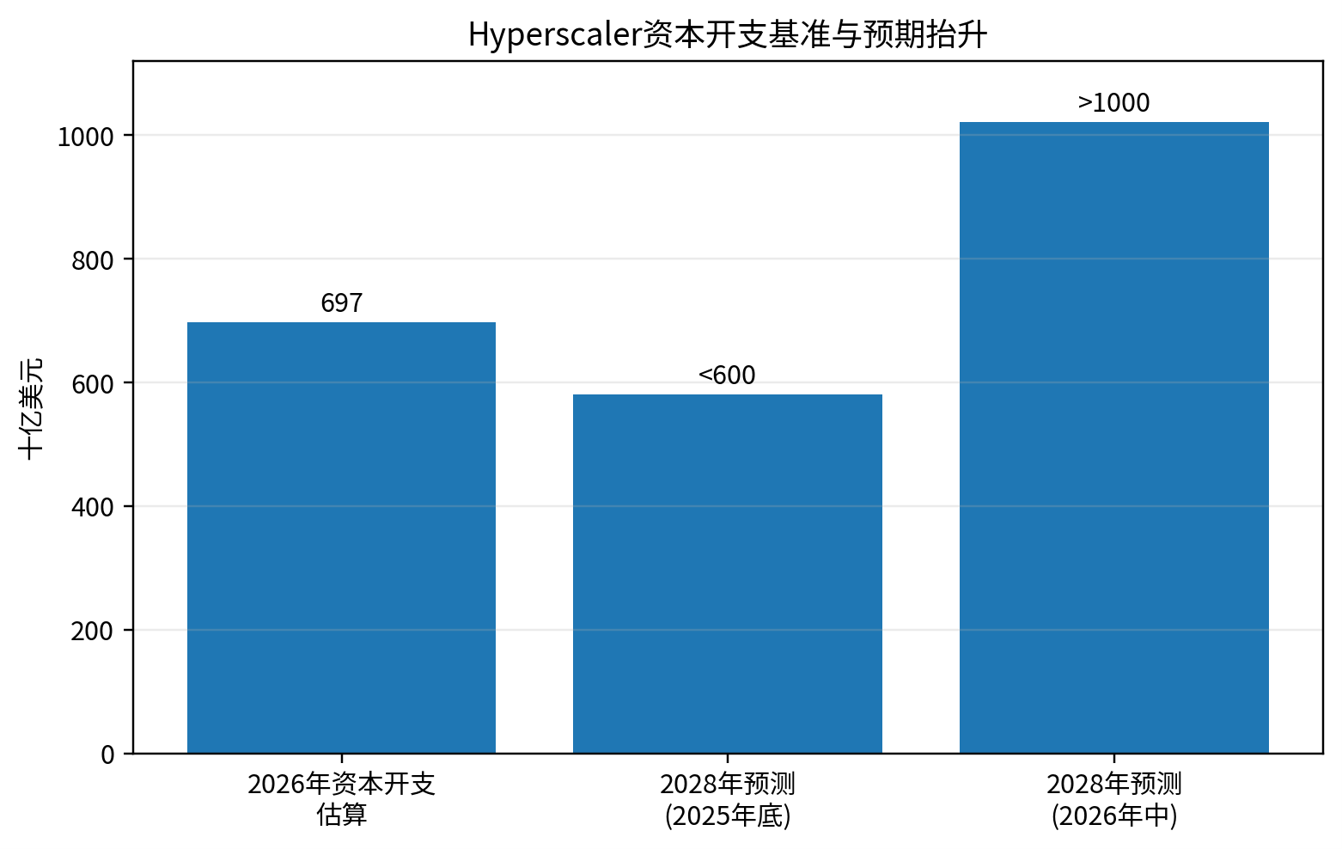
AI debt has suddenly become a market topic mainly because the size and duration of capital expenditures have far exceeded early expectations for this AI cycle. In July this year, the Bank of England noted that AI-related companies would face a trend in 2025 where infrastructure investment demand exceeds internal cash flow capacity. Market forecasts for the five largest Hyperscalers’ capital expenditure by the end of 2025 stood below $600 billion; now it has surpassed $1 trillion. JPMorgan estimates that Hyperscalers’ capital expenditure will be around $697 billion in 2026.
This round of investment differs from the traditional software industry: GPUs are just a part. Funds must also go into servers, switches, liquid cooling, power systems, land, data center construction, and even grid access. As single large-scale AI campuses see investments reaching tens of billions of dollars or more, even the tech giants with the strongest cash flows increasingly need to rely on external capital to maintain their expansion pace.
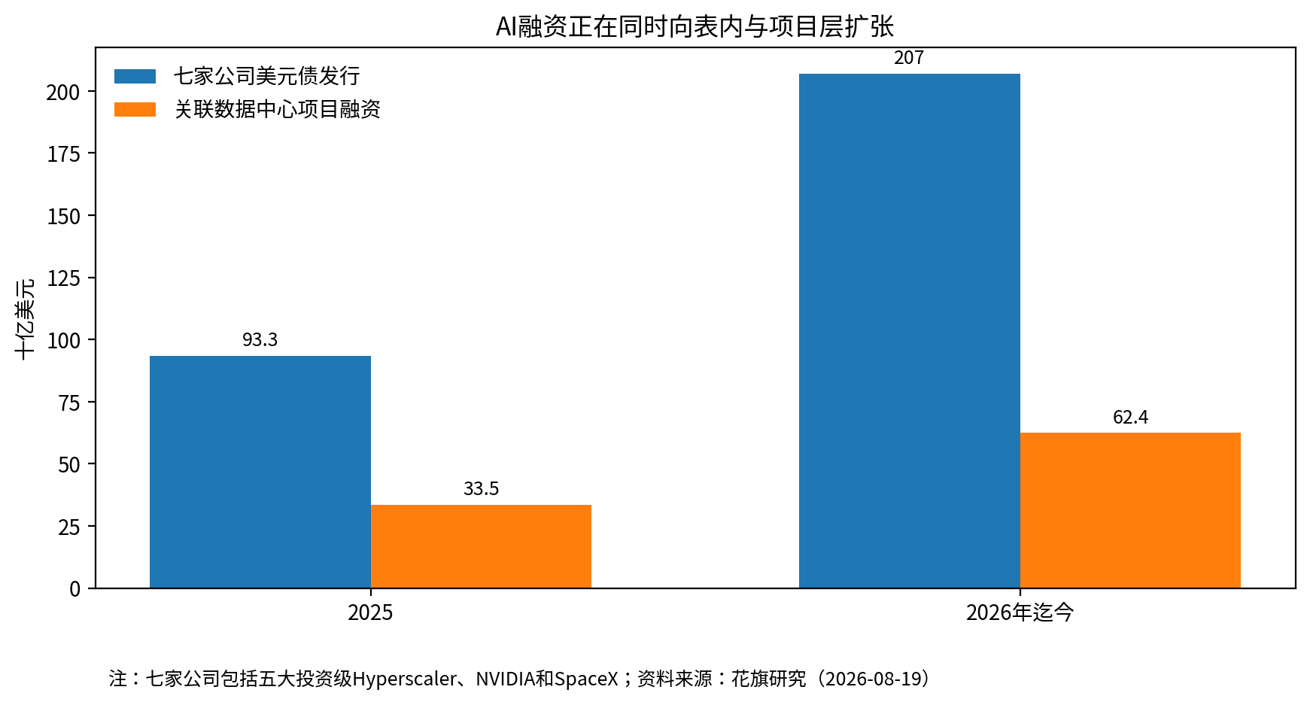
As a result, the financing structure is rapidly changing. By the end of 2025, Meta, Alphabet, Amazon, Microsoft, and Oracle accounted for only about 3% of the outstanding US investment-grade bonds, but by early May 2026 they had already contributed over 15% of the investment-grade bond issuances for the year. By early July, the five companies’ annual bond issuance totaled about $194 billion—a 79% year-over-year increase. According to Citi, seven companies—including the big five Hyperscalers, NVIDIA, and SpaceX—have issued $207 billion in US dollar bonds since 2026, more than double the entire year of 2025. AI infrastructure is moving from being driven by corporate cash flows to a stage where both the bond market and third-party capital drive expansion.
2. What’s Even More Noteworthy is Off-Balance-Sheet Credit Expansion:
Public company bonds are just the most visible layer. Harder to trace is that Hyperscalers are increasingly using financing leases, long-term purchase commitments, SPVs, and project financing to turn what would be direct AI capital expenditures into multi-year payment obligations. Therefore, the interest-bearing debt shown on companies’ books may not fully reflect their true capital constraints.
Disclaimer: The content of this article solely reflects the author's opinion and does not represent the platform in any capacity. This article is not intended to serve as a reference for making investment decisions.
You may also like
Qualcomm (QCOM.US) acquires robotics software company PickNik to strengthen its presence in the physical AI field
Qualcomm announced on Wednesday that it will acquire the robotics software company PickNik to enhance its presence in the field of physical AI and robotics.
10-Yr Benchmark Govt Yields - Germany vs Other Nations
Four Mac Studio systems run trillion-parameter models, Apple challenges Nvidia's narrative on inference
Apple's hardware chief pointed out that after enterprises purchase devices outright, there is no need to pay by token, and the cost-effectiveness of local computing power might be superior to long-term rental of cloud GPUs. Goldman Sachs believes that if more inference tasks shift to end devices, Nvidia's share in incremental AI activity may fall short of market expectations. Currently, Nvidia's implied volatility is at its lowest since before the pandemic, and option pricing has almost no risk premium allocated for this narrative change. Therefore, Goldman Sachs recommends buying Nvidia put options and going long on Apple.
Canadian Prime Minister: US-Canada trade agreement is still possible, but Ottawa will not give up its right to deepen cooperation with the EU
Canadian Prime Minister Carney stated that while it remains possible to reach a trade agreement with the United States, Canada will not trade its sovereignty for any deal, particularly insisting on its right to independently sign trade agreements. Meanwhile, Carney is actively promoting deeper cooperation between Canada and the European Union, covering critical minerals, energy, scientific research, and student exchanges, aiming to reduce dependence on the US and defend national sovereignty. He emphasized that in an era when connectivity can be weaponized, diversified cooperation is a necessary choice for safeguarding sovereignty.
Crypto prices
More


