
Ireland excludes crypto from new tax-advantaged investment accounts

Ireland’s Department of Finance has unveiled plans for a new tax-advantaged investment account to encourage more retail investing, but crypto will be excluded from the preferential structure alongside derivatives, underscoring regulators’ ongoing cautious approach to digital assets.
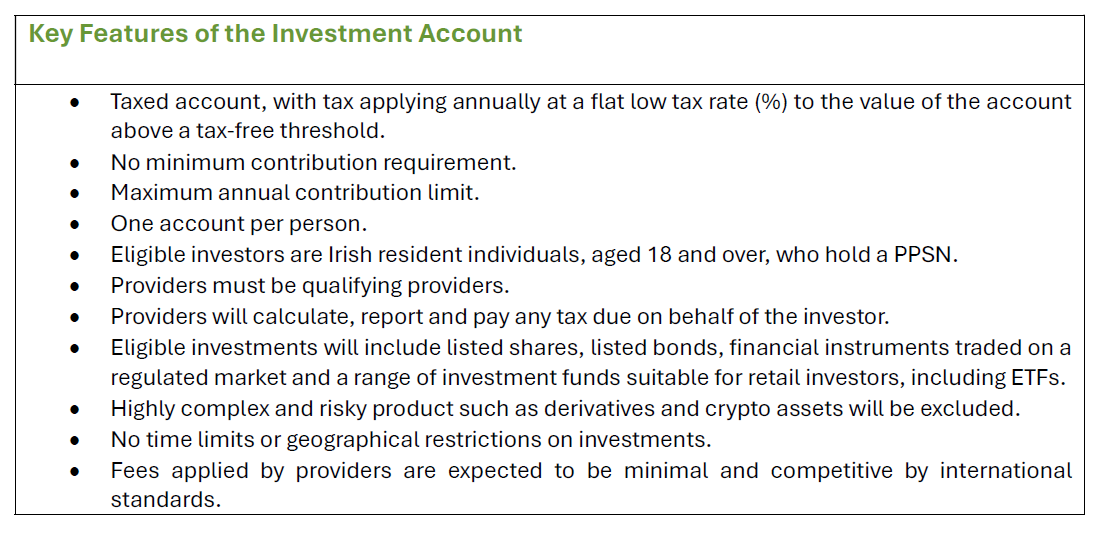
In a roadmap published Monday, the department said the accounts will allow investments in stocks, bonds, exchange-traded funds and other investment funds. Crypto assets and derivatives will be excluded, with the government classifying them as “highly complex and risky” products.
According to the roadmap, the accounts will be available to Irish residents next year, although no specific launch date has been set. The tax rate and tax-free threshold will be announced in Ireland’s Budget 2027.
The exclusion leaves digital assets outside a new framework intended to make investing easier and more tax-efficient for Irish residents. It also comes as Ireland takes a more active approach to crypto oversight, including proposed reforms to strengthen Anti-Money Laundering requirements for the sector.
Disclaimer: The content of this article solely reflects the author's opinion and does not represent the platform in any capacity. This article is not intended to serve as a reference for making investment decisions.
You may also like
Ethereum’s $2,540 Retest Becomes Key Test for the Rally
Canton Network breaks 2 month range! – CC’s run to $0.15 depends on THIS zone
Analysis: Wall Street Is Not Yet Ready to Short AI in Large Numbers
Overseas capital is aggressively buying US stocks! Net inflows reached $942 billions over the past 12 months, marking a record since 1985.
According to data from the US Department of the Treasury, in the 12 months ending July this year, overseas investors made net purchases of US stocks totaling $942 billion, marking the highest rolling 12-month total since records began in 1985. The net purchases in the second quarter alone reached $426 billion, setting a new single-quarter record. Meanwhile, overseas demand for US Treasuries has noticeably cooled, with purchase volumes falling significantly. As a result, the US is facing higher costs in government debt financing.
Crypto prices
More


