
Gold Falls Below $4,300: Is the Bull Market Logic Still Intact? TD Securities and BMO Still Eye $5,000

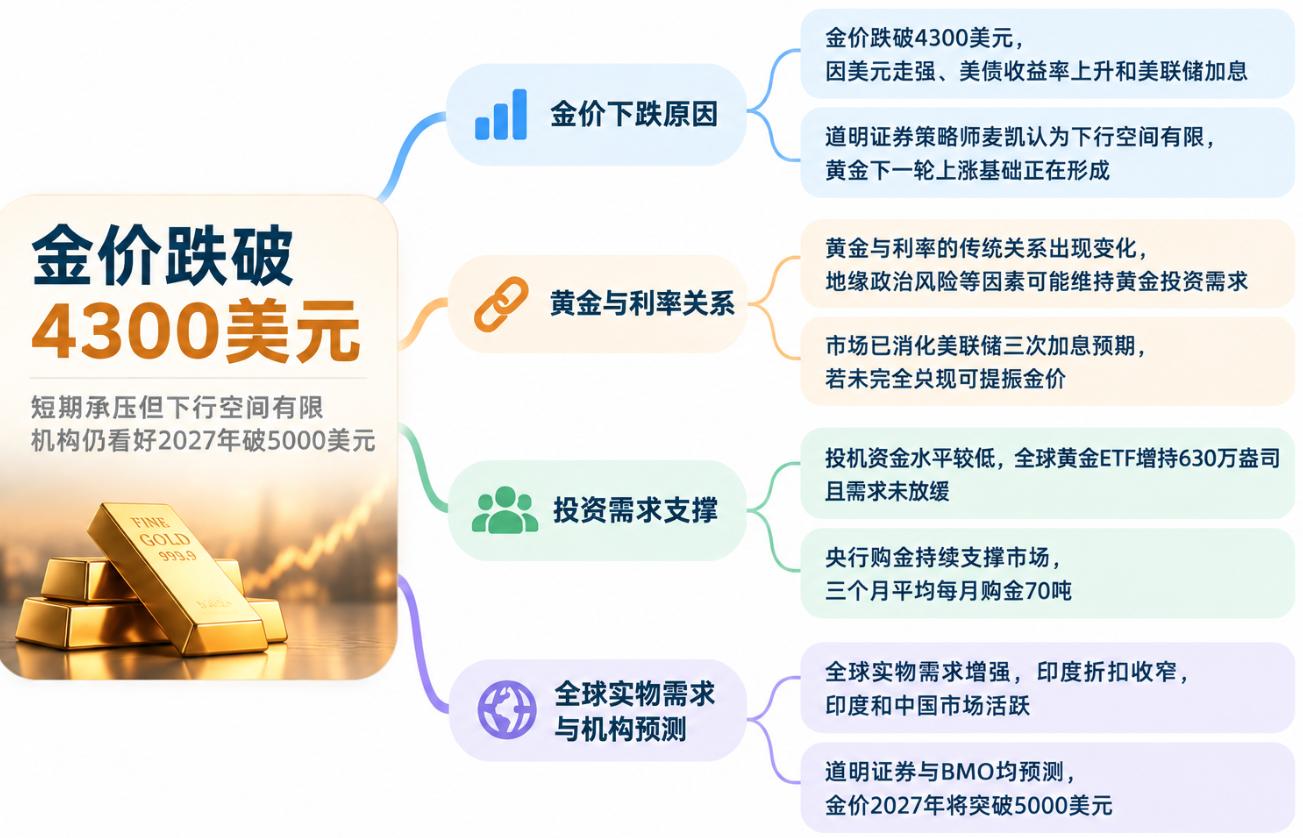
Gold prices have recently come under pressure, having fallen below $4,300 per ounce. The renewed strength of the US dollar, rising US Treasury yields, and the Federal Reserve's resumption of rate hikes have all increased the cost of holding gold.
However, Ryan McKay, Senior Commodity Strategist at TD Securities, believes that the downside for gold prices may be limited. He argues that the foundation for the next upward movement in gold is being laid and expects gold prices to once again break above $5,000 per ounce by 2027.
"The moment for the next rally in gold is approaching," McKay said. "This yellow metal has demonstrated the ability to remain resilient even in a Fed hiking environment. With investor and central bank interest increasing again, gold looks poised to once again challenge prices above $5,000 per ounce by 2027."
Pressure from Rate Hikes Persists, but Gold's Relationship with Interest Rates is Changing
Traditionally, rising real interest rates weaken the appeal of gold, which does not generate interest income. But McKay believes that the conventional relationship between gold and rates has recently shifted.
Historically, gold prices have also increased during periods of rising real interest rates. TD Securities believes that when geopolitical risks, de-dollarization, concerns about currency depreciation, worsening fiscal conditions, and inflation risk become the market’s primary focus, gold can still attract investment demand.
McKay also pointed out that the market has already priced in expectations of three more Fed rate hikes. If these hikes are not fully realized, gold may have further upside potential.
Another factor supporting this view is that speculative capital in the gold market remains at relatively low levels. According to McKay, since June, discretionary macro investors have been rebuilding net long positions, and bullish speculative positions are gradually improving.
New geopolitical concerns, stronger central bank demand, and growing investor doubts about the Fed's ability to control inflation initially drove funds back into gold. More recently, US fiscal policy and currency depreciation risks have emerged as new points of focus.
TD Securities estimates that discretionary investor positioning is still about 30% below the 2022 peak and 50% below the estimated historical high in 2016. This means that if investment demand continues to recover, the market still has additional capacity to absorb more gold.
Western investment demand is already showing improvement. TD Securities estimates that since July, global gold ETFs have accumulated about 6.3 million ounces of net inflows, with no clear evidence yet that demand has slowed due to the Fed's renewed tightening of monetary policy.
"While the strength of these inflows has improved, we are still at a very early stage of what a new rally might look like," McKay said.
Central bank demand is also providing support. Based on customs data, trade flows, and inventory discrepancies, TD Securities estimates that on a three-month moving average, global central banks are buying nearly 70 metric tons of gold per month.
McKay believes official sector buyers may be increasingly inclined to buy on dips, adding to gold reserves at or even below current price levels.
China remains an important source of demand. Chinese gold ETFs continue to see inflows, and the net gold positions of the largest traders on the Shanghai Futures Exchange are nearly at their highest levels since TD Securities began tracking them in 2017.
BMO: Physical Demand is Also Gaining Momentum
Another institution, BMO Capital Markets, has also observed that gold demand is improving.
In its latest precious metals report, BMO commodity analysts note that investors continue to use gold to hedge against currency depreciation risks and concerns about the sustainability of US fiscal policy. Meanwhile, global physical demand is also showing signs of strengthening.
"Physical demand appears to be rising, with local Indian market discounts narrowing amid resilient wedding-related demand, while Chinese import, ETF buying, and futures activity all point to healthy underlying investment demand," the analysts said.
BMO points out that since last week’s Fed meeting, both the dollar and 10-year US Treasury yields have noticeably risen, yet gold has managed to remain relatively stable between $4,300 and $4,400 per ounce.
BMO’s economists expect the Fed to raise rates by another 25 basis points before year-end. Even so, analysts note gold’s ability to withstand higher rates further shows that its traditional relationship with bond yields is weakening.
"Nevertheless, gold’s resilience continues to highlight the growing disconnect between gold and opportunity cost, with speculative and official sector demand providing the main counterbalancing forces," the analysts said.
BMO notes that ETF inflows are also strengthening this trend. Over the past week, global gold ETFs attracted $4.2 billion in inflows, with total holdings now close to pre-Middle East conflict levels.
Of that, North American-listed funds saw $2.2 billion in inflows, European funds $1.1 billion, and Chinese funds $637 million. BMO believes that this broad-based inflow reflects investor attention toward currency depreciation and the fiscal sustainability of the US government.
Physical consumption is also improving. India is the world's second-largest gold consumption market. Despite gold prices being at historical highs, demand remains resilient as the festival and wedding season approaches.
Consumers are still buying gold, but increasingly turning to lighter-weight jewelry. BMO data shows that over the past two weeks, the discount for Indian gold relative to London prices has narrowed by $20 per ounce.
The Chinese market is also supporting physical demand. According to BMO, China’s net imports of non-monetary gold in August rose 48% year-over-year to 124.5 tons. Although the growth rate slowed compared to the second quarter, cumulative imports as of August have already surpassed the total for all of 2025.
Domestic investment activity in China also remains strong. BMO reports that as of August, Chinese gold ETFs had increased their holdings by about 44 tons, and average daily trading volume of gold futures on the Shanghai Futures Exchange rose 36% month-on-month to 396 tons per day. At the same time, net long positions held by the top 20 market participants increased by 37 tons to 154 tons since July, further demonstrating strong domestic investor participation.
In the short term, BMO remains relatively cautious on gold. The bank lowered its forecast in June, expecting the average gold price in the second half of 2026 to be $4,625 per ounce, but still anticipates that prices will once again break above $5,000 per ounce in the first quarter of 2027.
Going forward, investors will pay close attention to the upcoming US-China talks and next week's release of the core personal consumption expenditure (PCE) inflation data. BMO believes that progress in trade could affect market assessments of tariff-driven inflation and global economic growth, while the inflation reading will provide new signals as to whether the Fed needs to tighten policy further.
Disclaimer: The content of this article solely reflects the author's opinion and does not represent the platform in any capacity. This article is not intended to serve as a reference for making investment decisions.
You may also like
Litecoin network activity rises to $1 billion as price holds above $56.13 support
Will the AI Boom Repeat the Railroad Investment Bubble? Blackstone President: This Time Is Different
Canadian Dollar holds steady amid oil uncertainties, hawkish Fed sentiment
Crypto prices
More


