
Consumption stratification intensifies, Costco remains "firmly seated in Diaoyutai"?


The global leader in discount retail—Costco—released its Q4 FY2026 earnings (16 weeks) as of August 30, after the US stock market closed on September 24. Overall, the results remain robust, with both revenue and profit slightly exceeding expectations. The company returned most of the tariff rebates received this quarter to members through price reductions, fulfilling its commitment not to profit from rebates. Specifically:
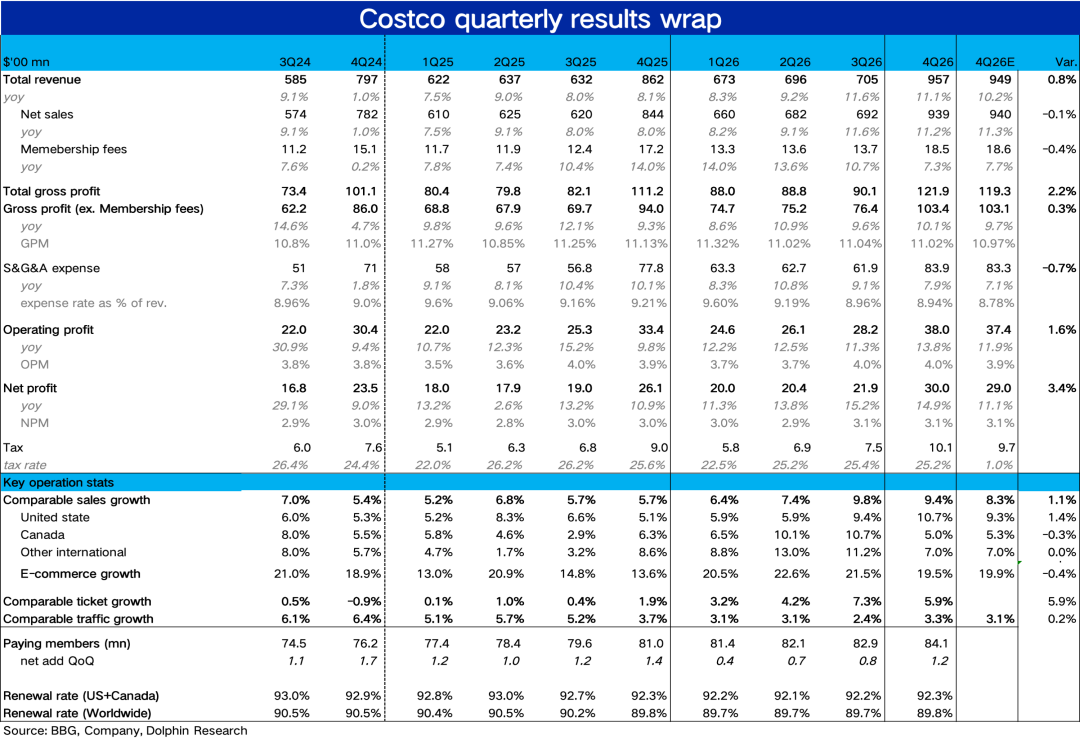
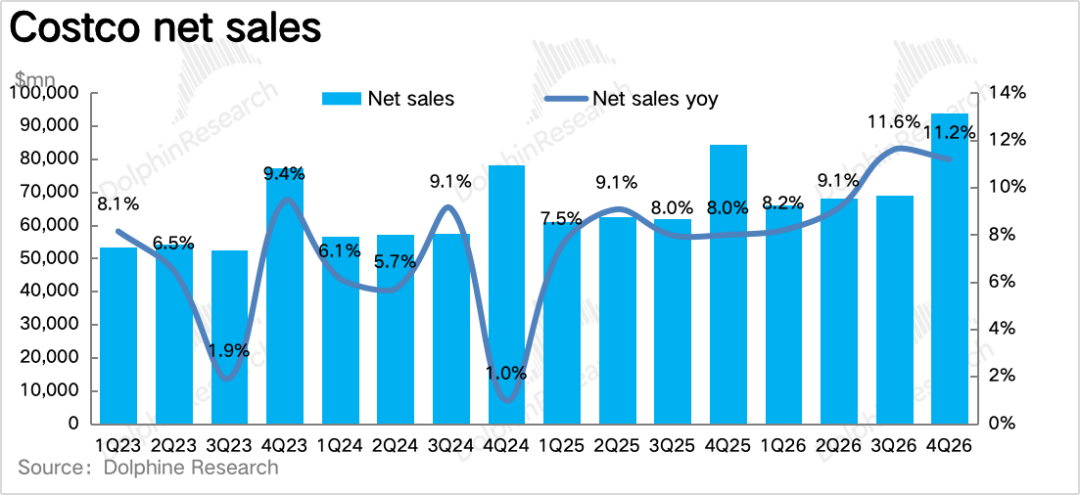
1. Tariff rebate received, overall performance remains solid. In terms of revenue, total revenue this quarter was $95.7 billion, up 11.1% year-on-year, maintaining double-digit growth for the second consecutive quarter (slightly higher than the market expectation of $94.9 billion).
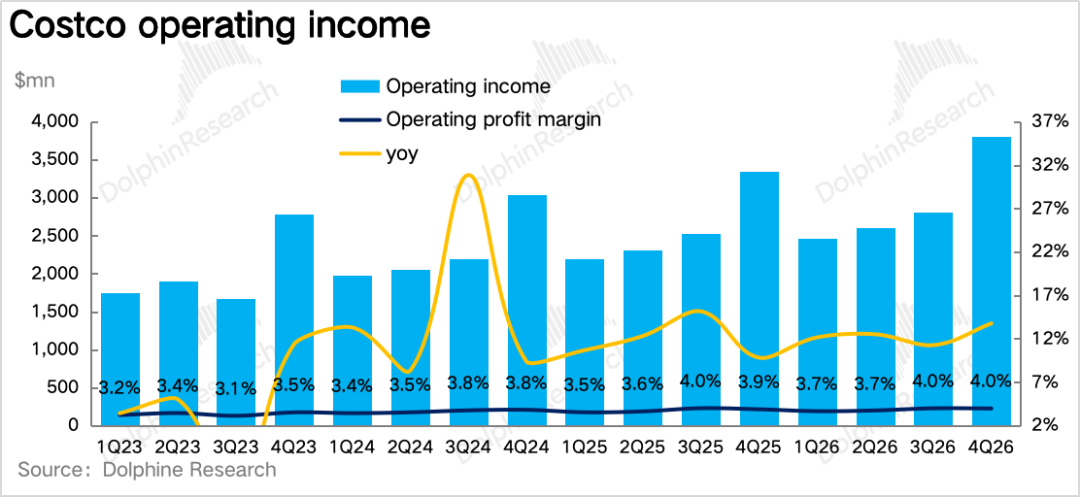
Operating profit reached $3.8 billion, a year-on-year increase of 13.8%, including a one-time net gain of $90 million from tariff rebates. Excluding this, operating profit grew about 11%, and the profit margin remained basically stable year-on-year, showing no signs of revenue growth without profit growth, similar to last quarter. Overall, a strong performance.
2. Same-store growth still price-driven, but traffic has recovered. For core operating metrics, overall same-store sales grew 9.4% year-on-year this quarter, slightly slower than the previous quarter. Excluding fuel and exchange rate effects, same-store sales rose 6.7%, with about three points of growth coming from higher gasoline prices.
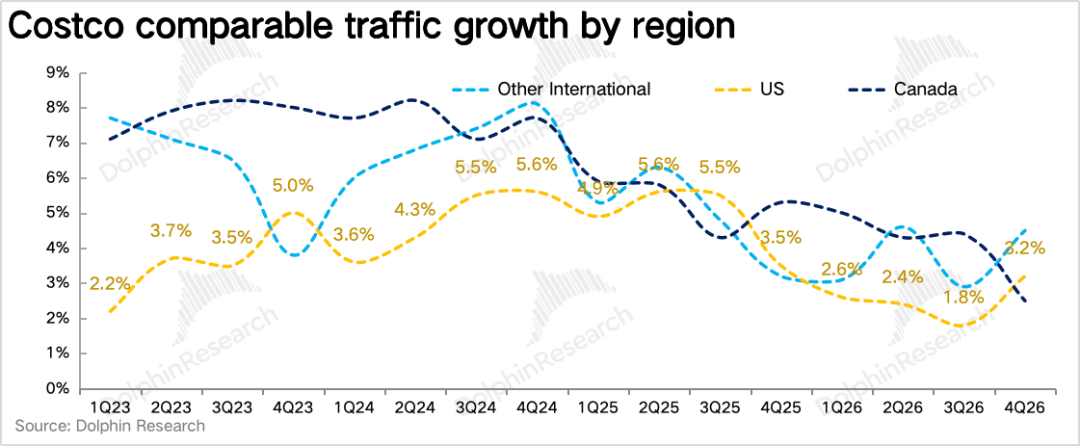
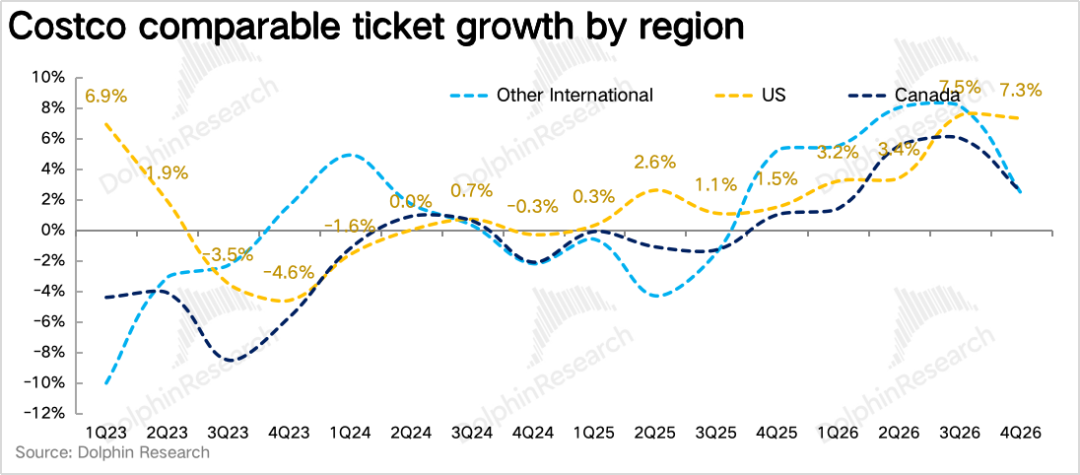
Breaking down price and volume, same-store traffic increased by 3.3% year-on-year this quarter, a significant rebound from last quarter’s 2.4%, marking the first acceleration in the past five quarters; basket size excluding fuel and exchange rates grew by 3.3%, slightly down from last quarter. The traffic recovery can partly be attributed to higher fuel prices driving more visits to gas stations (gasoline volume reached a historical high this quarter), but even so, the rebound in traffic remains the most positive signal from this report.
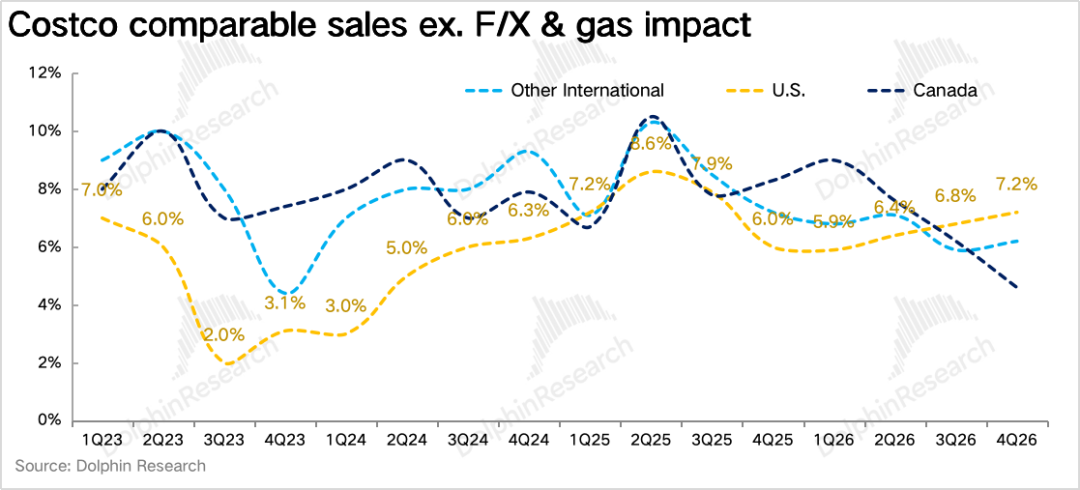
3. US remains the most resilient, while Canada is dragged by trade negotiations. By region, excluding currency and fuel impacts, US same-store sales rose 7.2%, continuing to accelerate from 6.8% last quarter and remaining the strongest among all markets (same-store traffic +3.2%, a marked improvement from 1.8% last quarter, basket size ex-fuel/ex-rate +3.9%).
Canada’s same-store growth slowed markedly to 4.6% from 6.2% last quarter, mainly due to the negative impact of US-Canada trade negotiations in August. Other international markets saw same-store growth of 6.2%, up slightly from 5.9% last quarter.
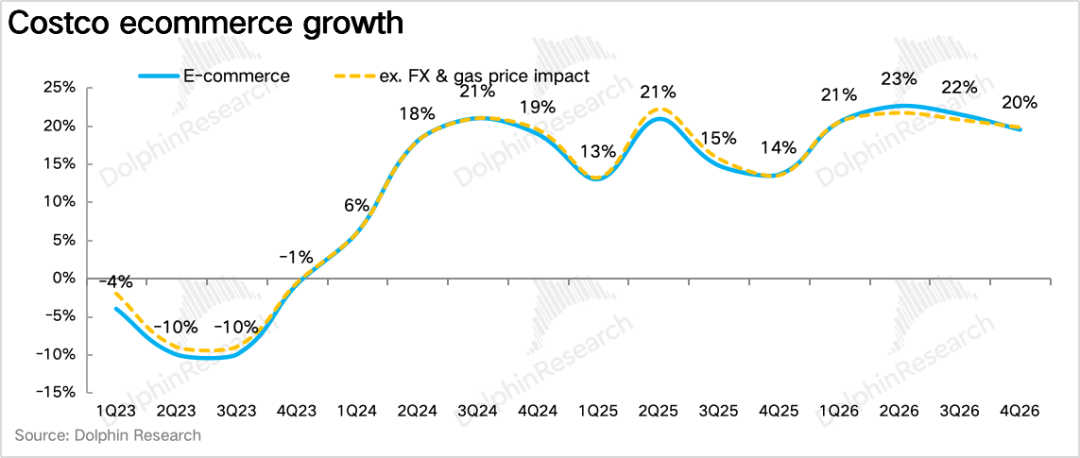
4. Online growth rate declined but still far outpaces offline. Costco’s e-commerce sales grew 19.5% year-on-year this quarter (excluding FX: 19.8%), slightly slower than 21% last quarter, with website and app traffic up 30%.
It’s worth noting that this quarter the company expanded Uber Eats’ instant delivery from 17 states to nationwide, and DoorDash was also fully launched. Management stated that “most of the third-party delivery sales are incremental, have limited impact on in-store grocery operations, and the users are noticeably younger”. This channel expansion and its incremental sales are worth watching going forward.
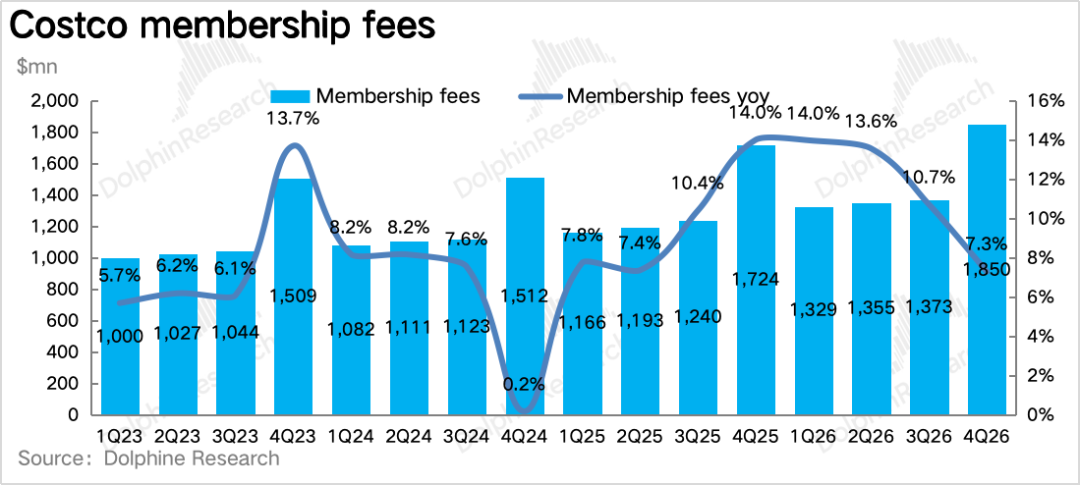
5. Pricing benefit exhausted, membership penetration rises: Membership fee income was $1.85 billion, up 7.3% year-on-year (excluding FX, 7.7%), continuing to slow from 10.7% last quarter (this quarter was the last with a pricing impact, now under 1 point).
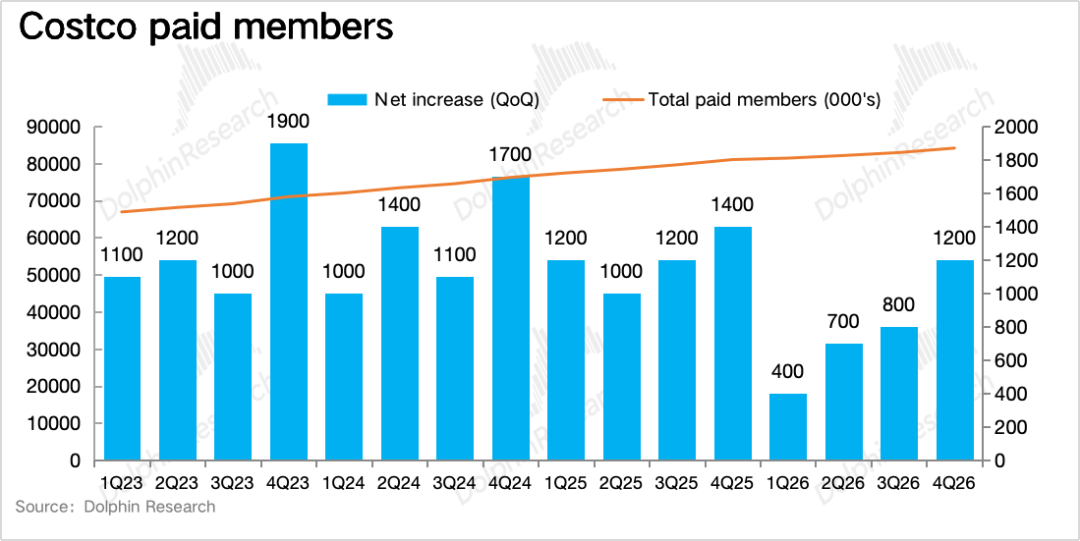
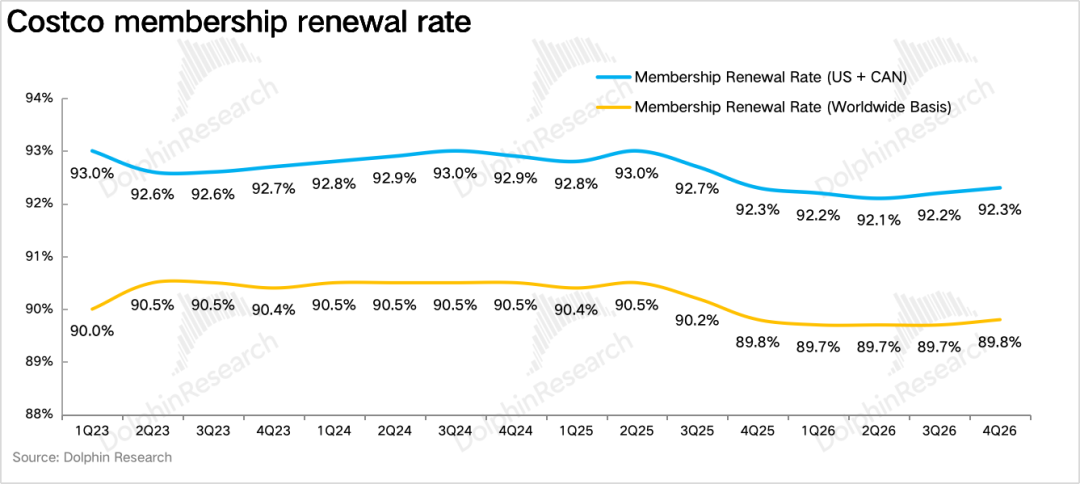
On underlying membership metrics, paid memberships increased by about 1.2 million quarter-on-quarter to 84.1 million, a clear rebound from 800,000 last quarter (premium memberships: 42.3 million, penetration rate at 75.6%, a record high). In addition, renewal rates rose slightly in both global and North American regions, improving for the second consecutive quarter, which is a positive sign.
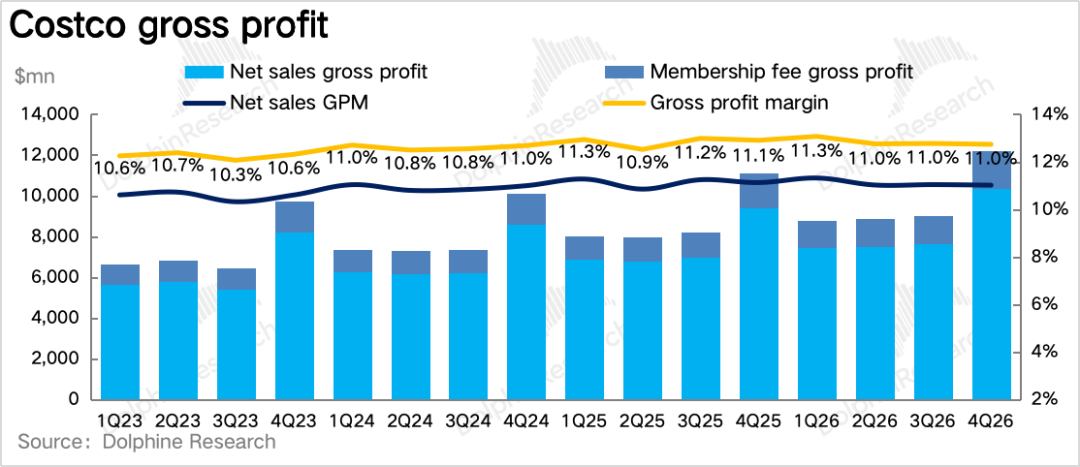
6. Profit margin under slight pressure from rebate price reductions, operating margin remains stable: Due to the cost of tariff rebate price reductions, Costco’s gross margin this quarter was 11%, down 11bps year-on-year, but excluding the effects of rebates and returns, core goods gross margin actually rose by 18bps, with fresh food, non-food, and groceries all improving.
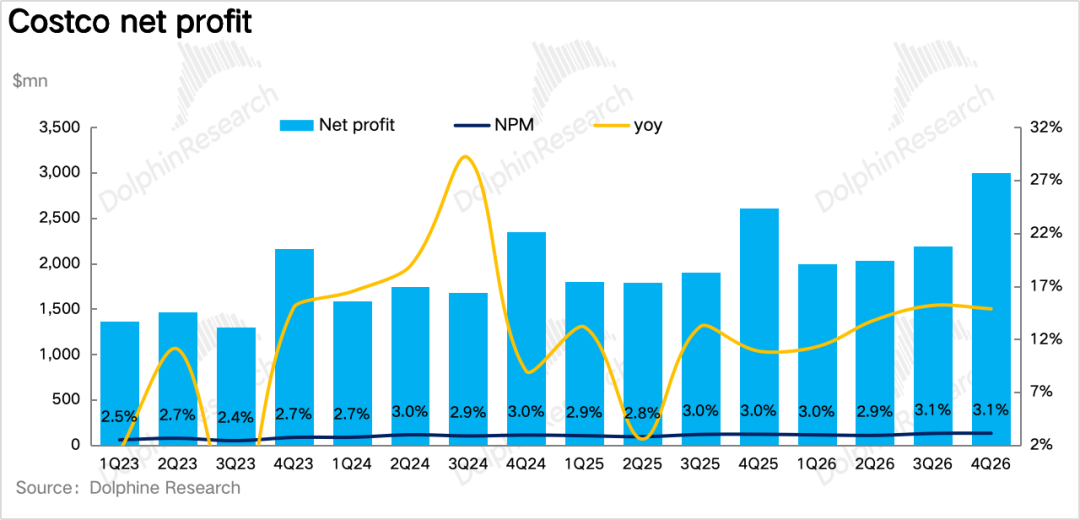
Operating expense rate shrank by 27bps year-on-year, but excluding the dilutive effect of fuel price only shrank by 2bps, suggesting that further cost control has limited headroom. Operating profit margin ultimately was up 9bps year-on-year; excluding one-off rebate net income, it was essentially flat, with net profit at $3 billion, up 14.9% year-on-year.
Dolphin Research’s View:
As seen above, Costco’s performance remains extremely solid: higher oil prices have driven nominal growth, most rebates were not retained as profit, both members and renewal rates have rebounded, and underlying gross margins are improving once adjusted for non-recurring factors.
Compared with Walmart’s earnings, Costco’s same-store sales ex-fuel/ex-rate have been stable within 6%-7% for a year, while Walmart’s US same-store has dropped straight from 4.6% last year to 2.6%, widening the gap from 2-3 points to nearly 5 points. Combined with Walmart’s management statement that “share gains are led by high-income households,” this suggests its base—lower-to-middle income customers—is weakening materially.
Meanwhile, at Costco, both traffic and basket size, as well as discretionary categories, are all growing, with non-food the strongest, indicating middle-to-high income group spending continues to expand and even move to big-ticket items. The conclusion: US consumption stratification is increasing—upper and middle segments are still spending, lower segments are much more cautious.
Back to Costco itself, from here, Dolphin believes the key issue is whether traffic recovery can persist even without the lift from gasoline prices (Costco’s gasoline is the cheapest nationally, many tens of cents lower than nearby stations’ averages for years).
Also, roughly two-thirds of the remaining tariff rebate will be received through the first half of FY27, and the company has made clear it will continue to pass most of it on. This means core goods gross margin will continue to be under pressure from price reductions in the first half of FY27, and reported gross margin will likely see further slight declines.
Detailed Commentary Below
I. Traffic Growth Recovery is the Most Positive Signal
1. Same-store growth remains price-driven, but traffic shows recovery
For core business indicators, Costco’s overall same-store sales were up 9.4% year-on-year this quarter—maintaining strong high-single-digit growth for two consecutive quarters. But excluding oil/gas and exchange rates, same-store was only 6.7%, in line with last quarter’s 6.6%—about three percentage points of the gap comes entirely from the jump in gasoline prices (gasoline volume at a historical high), while foreign exchange was a slight drag of about 0.3 points.
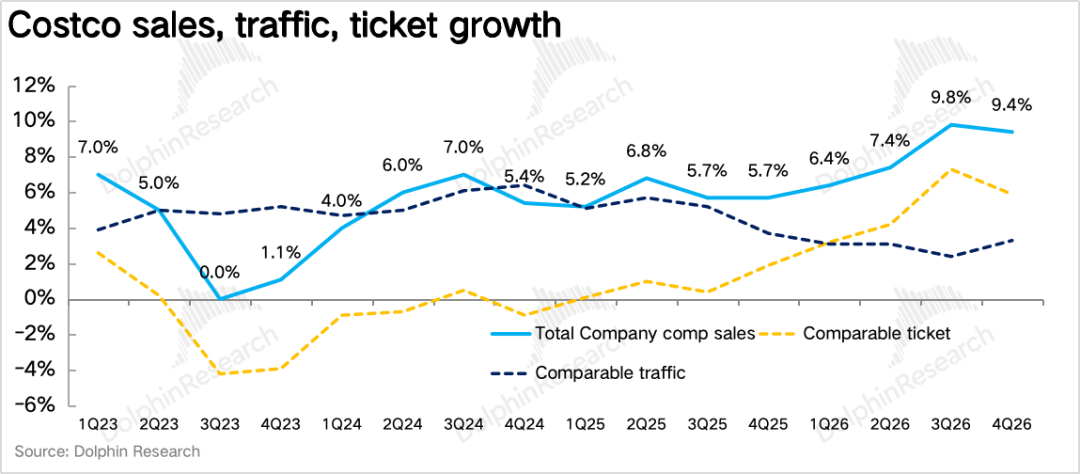
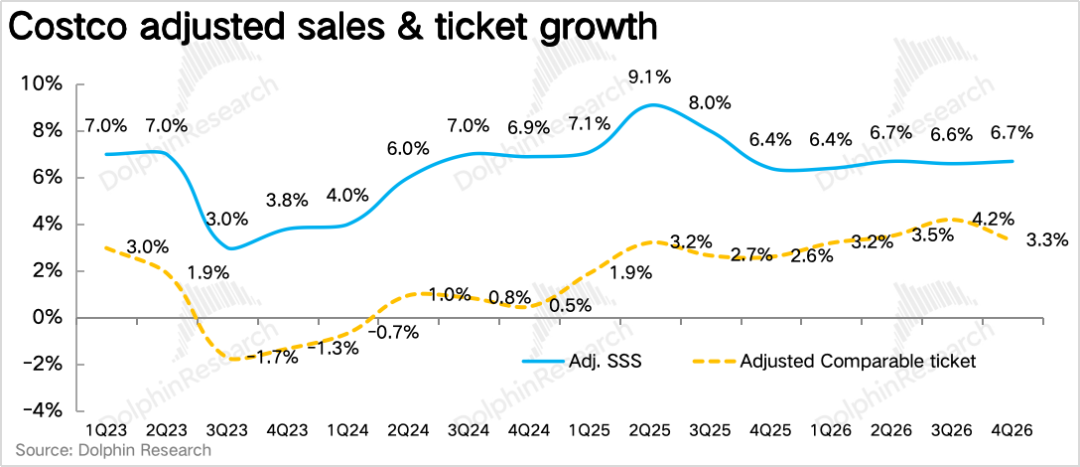
Looking at price/quantity split, global same-store traffic grew 3.3% this quarter, rebounding significantly from 2.4% last quarter—the first acceleration in five quarters; basket size (including fuel and FX) grew 5.9%, and 3.3% excluding those, a narrowing compared to last quarter. Dolphin’s take is that, though some of the traffic recovery in Q4 came from gasoline, US middle-class frequency of Costco store visits has at least not deteriorated, making this earnings report’s most positive signal.
By category, non-food was the strongest this quarter, with gold jewelry, homeware, small household appliances, and health & beauty leading growth. Fresh food grew mid-single-digits (in-house bakery sales doubled, low-price poultry and ground beef, as well as premium Prime and Wagyu beef all increased); grocery food grew low-to-mid single digits, shifting toward high-protein, high-fiber, and other healthy types.
In addition, overall inflation was low-single-digit this quarter; non-food inflation rose due to storage chips and petroleum products, while beef inflation in food was offset by deflation in eggs and dairy.
2. US Most Resilient, International Markets Still in Penetration Phase
By region, excluding FX and oil/gas price impact, US same-store sales grew 7.2%, accelerating from 6.8% last quarter and still the strongest among all markets; Canadian same-store sales slowed sharply to 4.6% from 6.2%, mainly because of the impact from tense US-Canada trade negotiations in August.
Other international markets grew same-store 6.2%, essentially flat from last quarter, with the structure being traffic +4.5%, basket size +1.7%. This is the only region where same-store growth is mainly traffic-driven—primarily because both penetration and warehouse density are not yet saturated internationally.
3. Online Growth Slows Slightly, Third-Party Instant Delivery Becomes a New Driver
Costco’s e-commerce sales grew 19.5% year-on-year this quarter, slightly down from 21% last quarter. Pharmacy, homeware, small appliances, hardware, and home textiles were the fastest-growing online categories, with pharmacy sales up nearly 20% and prescription volume showing double-digit growth.
Additionally, a major change this quarter was the full rollout of third-party instant delivery: Uber Eats expanded from 17 states to nationwide, DoorDash launched, and Instacart continued to cover both the US and Canada, with most delivery times under 45 minutes. Management said on the earnings call that most of these sales are incremental, with limited impact on in-store grocery, and the users are significantly younger—Dolphin believes this is a great way for Costco to reach younger users without changing the warehouse membership model.
In summary, merchandise sales for the quarter reached $93.0 billion, up 11.2% year-on-year, with total revenue of $95.72 billion, up 11.1% and slightly above market expectations.
II. Pricing Upside Runs Out, Membership and Renewal Rates Rebound from the Bottom
On the subscription side, membership income this quarter was $1.85 billion, up 7.3% (excluding FX: 7.7%) from last year, the growth rate continuing to drop from 10.7% last quarter, but beating the market’s 6.3% expectation. Management made clear that this was the last quarter with any pricing benefit, and its effect is less than 1 point, mainly relying on premium membership penetration and new basic member growth.
On underlying metrics, paid members increased by around 1.2 million sequentially to 84.1 million, up considerably from 800,000 last quarter, and 3.8% year-on-year; premium members hit 42.3 million, up 9.4% year-on-year, with both penetration and the proportion of new premium members hitting all-time highs.
Renewal rates rose as well, global up 0.1ppt to 89.8%, North America up 0.1ppt to 92.3%, both improving for a second quarter straight.
III. Rebate Pass-through Pressures Gross Margin, Operating Margin Steady
1. Gross Margin: Excluding Rebates and Oil, Core Merchandise Gross Margin is Improving
Retail gross margin this quarter was 11%, down 11bps year-on-year, but up 20bps when excluding the impact of increased lower-margin fuel sales. Core merchandise gross margin fell by 32bps year-on-year (ex-fuel, -9bps), mainly due to price reductions from tariff rebate pass-through—a total of $184 million received this quarter ($174 million rebate plus $10 million interest), about half of which was passed on in the form of lower prices on items like walnuts, coffee beans, and black pepper (Kirkland’s prices dropped 10%-30%).
But if you exclude both rebates and returns, core goods gross margin actually rose by 18bps, with improvements across fresh food, non-food, and groceries, mainly due to supply chain efficiency and labor productivity gains in fresh (meat, bakery, deli).
2. Cost Control Headroom Shrinks, Margins Hold Steady
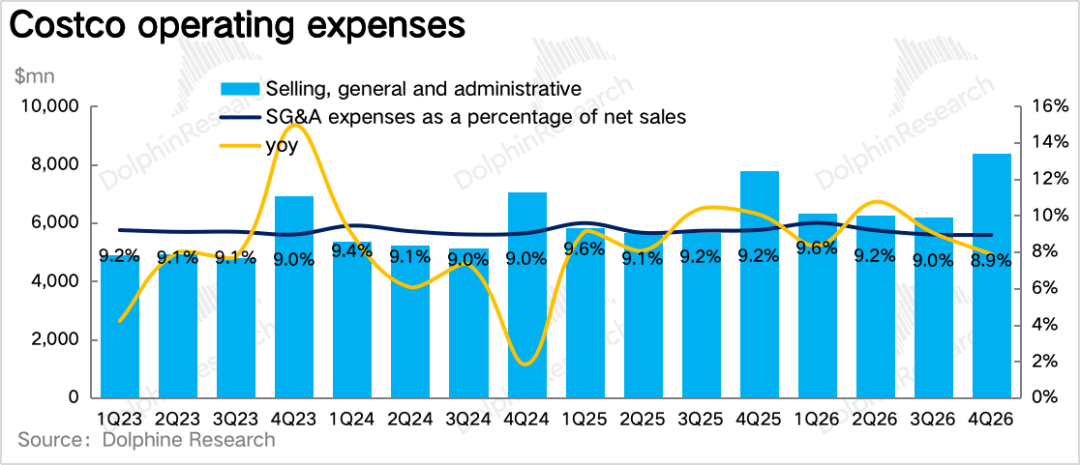
Operating expense rate this quarter was 8.9%, 27bps lower year-on-year, but only 2bps lower when excluding fuel dilution, showing that cost control has limited further room. Operating profit margin was up 9bps year-on-year; adjusted for one-off rebate, it was essentially flat. Net profit reached $3 billion, up 14.9% from a year ago.
- END -

The article is not easy to write, give it a ‘Share’ to charge me up~
Disclaimer: The content of this article solely reflects the author's opinion and does not represent the platform in any capacity. This article is not intended to serve as a reference for making investment decisions.
You may also like
Meta (META.US) surged 36% in September: Muse validates AI strategy, market cap targets $2 trillion
Meta's stock is on track to achieve its best monthly performance since July 2013, and is only about a 1% increase away from joining the $2 trillion market cap club.
Is the market less confident in US Treasury bonds than before?
Up 36% in September! Meta achieves its best monthly performance since 2013, with market value approaching $2 trillion
Since September, Meta's stock price has rebounded significantly. The rapid rise of Muse has reignited market expectations for its AI commercialization. Muse reached 902,000 downloads within six days of launch and is quickly expanding into shopping, travel, and other scenarios. The market is beginning to bet that AI agents could unlock new growth opportunities beyond advertising. However, security and privacy risks, as well as high computing power costs, remain key factors in realizing these expectations.
Crypto prices
More


