
Gold falls below $4,200: Triple pressures rise, bears eye $4,000 or even $3,800

After Trump rejected Iran’s latest proposal to reopen the Strait of Hormuz, some of the optimism that had fueled a market rebound over the weekend quickly faded. On Monday, bonds and equities weakened, oil prices rose, and precious metals suffered sell-offs.
At the time of writing, spot gold broke below $4,200/oz for the first time since August 5, dropping nearly 2.5% on the day. Spot silver fell over 4%, with a daily decline of more than $2, trading near $61.65.
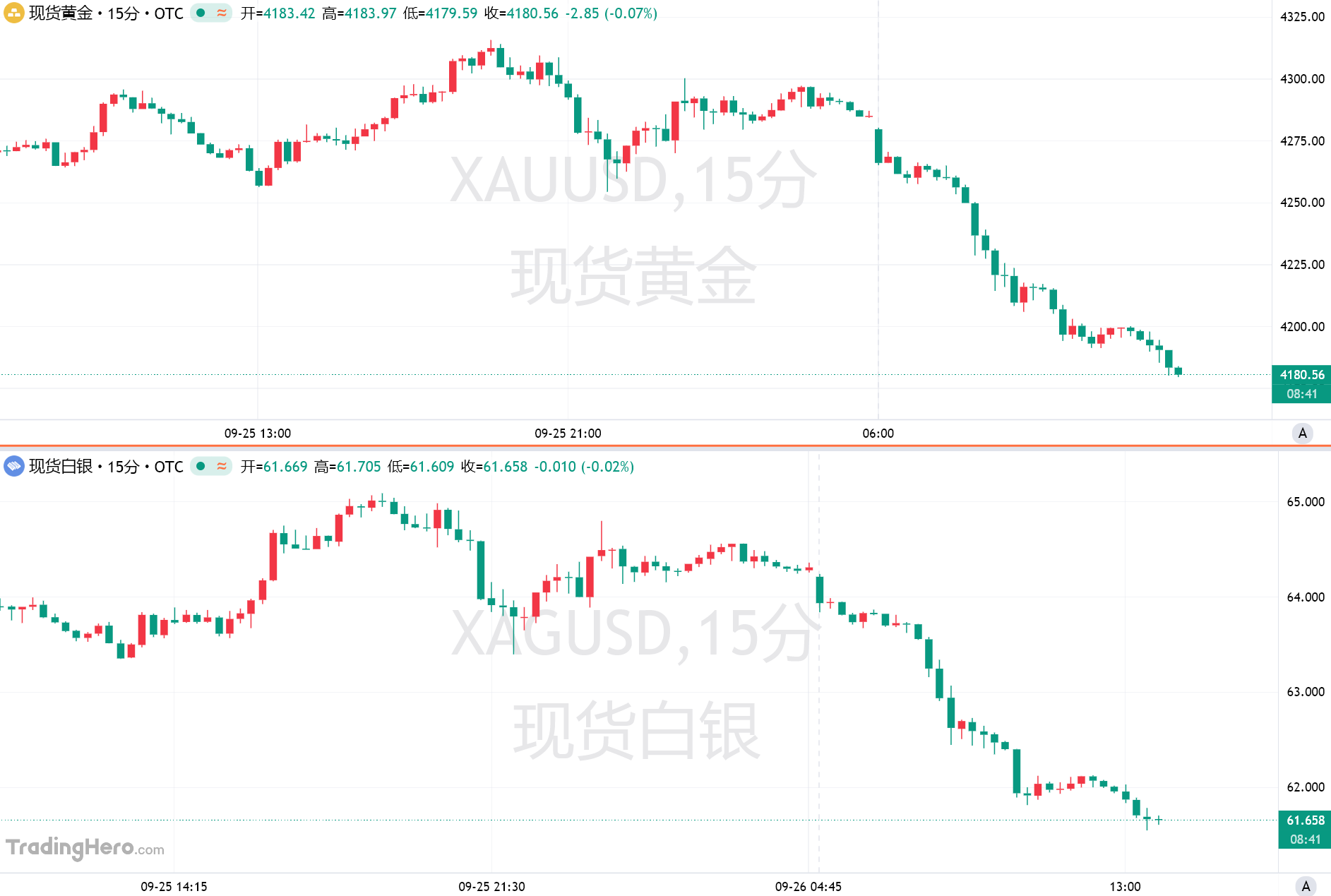
The energy market has once again become the main driving force. Rising oil prices not only push up inflationary pressures but also strengthen expectations that the Federal Reserve will deliver further rate hikes, which in turn lift bond yields and the U.S. dollar, suppressing precious metals.
Rajeev De Mello, senior macro portfolio manager at Gama Asset Management, said: “Investors are once again disappointed by the lack of diplomatic progress. The market had hoped that these talks would help ease Middle East tensions and pave the way for reopening the Strait of Hormuz, but that hope has now been dashed.”
U.S. Treasury yields return to highs, gold under pressure
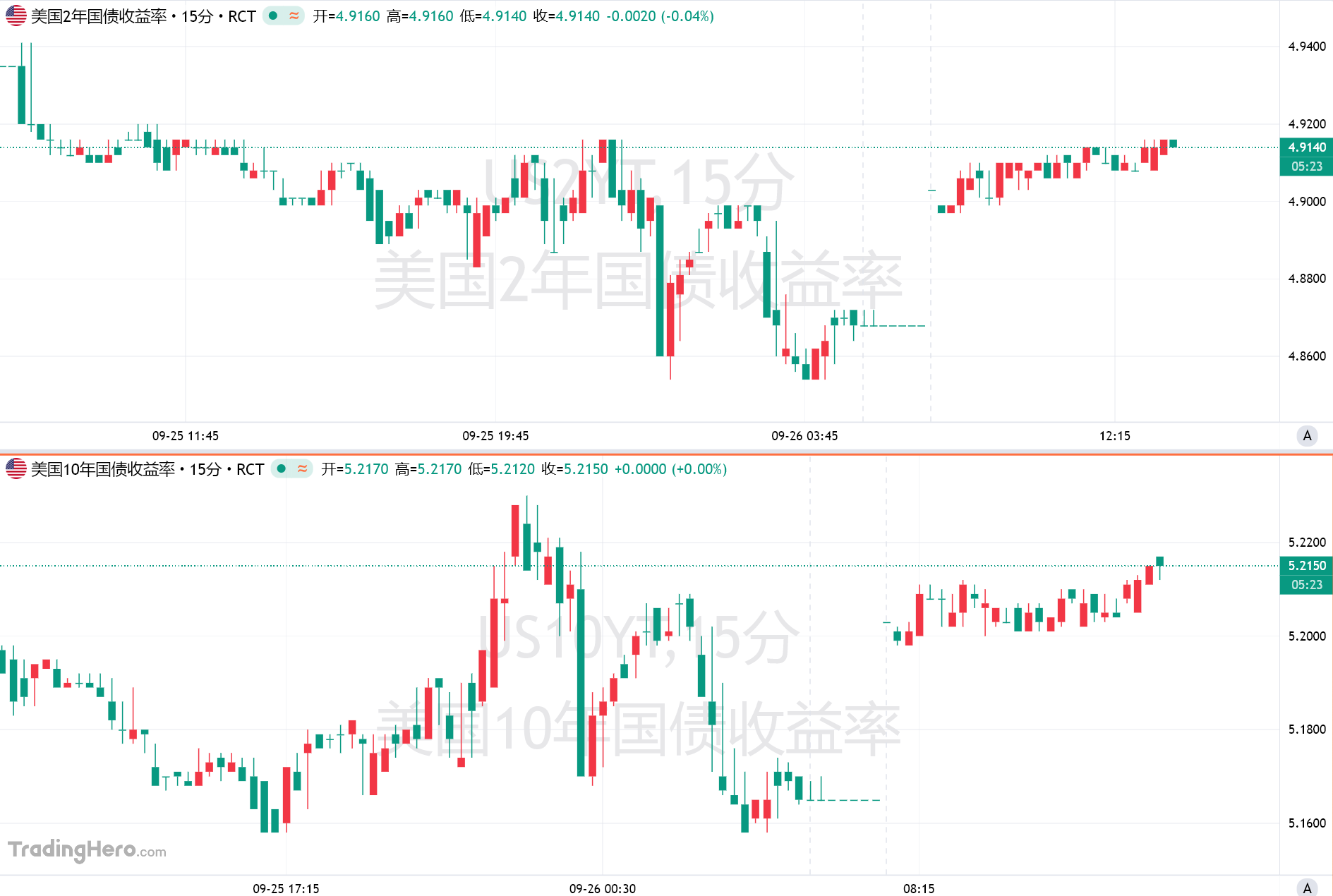
U.S. Treasuries faced renewed selling during Monday’s session. The two-year Treasury yield rose 5 basis points to 4.90%, the 10-year yield climbed 4 basis points to 5.20%, with Japanese and Australian sovereign bond yields also trending higher.
Previously, yields across various U.S. Treasury maturities had already reached multi-year highs last week. Markets are reassessing the Fed’s recent policy signals and the impact of high oil prices on the inflation and interest rate path.
Damien McColough, head of fixed income research at Westpac, said: “The Fed’s ongoing hawkish signals, along with oil prices holding near $100 a barrel, are key reasons for the bearish bond market.”
Justin Lin, analyst at Global X ETFs, commented that gold remains highly sensitive to fluctuations in oil prices and shifting market expectations about Middle East resolutions. Until there is greater clarity on how the Iran conflict will end, most natural buyers are likely to stay on the sidelines.
Meanwhile, real yields continue to rise. Lin noted that gold sellers are currently taking their cues primarily from real yields.
Ole Hansen, head of commodity strategy at Saxo Bank, believes the first thing to watch this week is whether gold can hold above $4,235/oz—clearly, as of writing, gold has already dropped below that level.
He stated: “A drop below this level may mean the market faces a deeper correction, and attention may shift back to the $4,000 area seen in June and July.”
If gold can withstand the pressure from rising yields and a stronger dollar, this may signal resilient underlying demand. Hansen said that only a breakout above the resistance at $4,400 would possibly shift the market’s defensive focus.
GivTrade market analyst Waleed Said believes that $4,000 is a likely target for the bears. He noted that aggressive expectations for a Fed hike before year-end are not overstated, while inflation remains distinctly above the 2% target.
“As long as yields stay this elevated, I see the risk tilted to the downside,” Said noted. He even does not rule out the possibility of gold dropping to $3,800.
Barbara Lambrecht, commodity analyst at Commerzbank, said the market is increasingly pricing in the possibility that the Fed hikes earlier than expected, pushing up U.S. Treasury yields and real interest rates, and also increasing the opportunity cost of holding gold.
According to CME Group's FedWatch tool, the market currently sees a 65% probability that the Fed will hike at its next meeting at the end of October.
Many analysts see limited downside risk for gold
Despite significant near-term downside risk, analysts point out that gold prices remain fairly resilient.
Lambrecht pointed out that long-term investors are still buying gold ETFs, which supports gold prices and may limit the extent of any pullback.
Neil Welsh, head of metals at Britannia Global Markets, also believes the gold market still has structural buffers, including ongoing central bank purchases, geopolitical tensions, and deepening fiscal concerns.
Joy Yang, global head of index product management at MarketVector Indexes, believes that gold may also be supported in the near term by subdued equity market volatility.
Even as inflation and bond yields rise together, the S&P 500 remains near historic highs above 7,000 points. Yang commented that some equity investors may be underestimating bond market risks and are using gold as a hedge while awaiting signs of relief from inflationary pressures.
Looking at a longer time horizon, some analysts still see gold's weakness as a potential buying opportunity.
Said pointed out that the last time U.S. Treasury yields reached similarly high levels, U.S. debt stood at about $8.9 trillion—today it exceeds $40 trillion. This means that for every 1 percentage point rise in average borrowing costs, U.S. annual interest payments increase by approximately $400 billion.
“If yields go above 5%, this is unsustainable,” Said noted. “Either growth slows and the Fed backs off, or inflation quietly erodes the debt and the dollar. Both outcomes support gold.”
The market’s focus will now shift to upcoming U.S. economic data.
Prashant Newnaha, TD Securities’ senior APAC rates strategist in Singapore, said that ahead of the Fed’s preferred inflation metric (PCE) and this week’s coming nonfarm payrolls report, the Middle East stalemate “is likely to remain a focus for markets.”
Some analysts believe the nonfarm payrolls data could have a greater impact on gold than the PCE report.
Disclaimer: The content of this article solely reflects the author's opinion and does not represent the platform in any capacity. This article is not intended to serve as a reference for making investment decisions.
You may also like
Ondo Crypto Holds $0.53 as Bulls Defend Key $0.52 Support Amid Market Slide
AI boom reshapes the wafer foundry landscape! UBS: Explosive demand accelerates advanced process expansion, mature process enters upward cycle
UBS stated in a recent research report that within the foundry market, the Total Addressable Market (TAM) for the N2 (2nm) node far exceeds expectations, A14 (1.4nm) production expansion is accelerating, and the upcycle for mature process nodes has already begun.
$1,999 Foldable iPhone Is Ready, but Apple (AAPL.US) Faces Over $5.7 Billion Patent Penalty
As Apple intensifies its efforts in foldable displays and AI business, it faces a haptic technology patent compensation ruling exceeding $5.7 billion. On September 25, a federal jury in California found that Apple's Taptic Engine, used in certain iPhone and Apple Watch models, infringed on two patents held by Taction Technology.
Prospects for the opening of the Hormuz Strait are overshadowed, Asian bonds under pressure: 2Y Japanese bond yield approaches 2%, 3Y Korean bond yield rises to highest level since 2022
With high oil prices, short-term bond yields in South Korea and Japan have risen.
Crypto prices
More


