
Gold price tests trend support as U.S. Treasury yields pull back

Huitong Finance, September 30—— Gold prices are seeing a rebound opportunity, but have yet to give traders enough reason to be reassured. After a round of sharp sell-off, gold is trying to stabilize near a key chart level. This position alone is enough to attract buying interest, especially after the selling has become excessive.
Gold prices are seeing a rebound opportunity, but have yet to give traders enough reason to be reassured. After a round of sharp sell-off, gold is trying to stabilize near a key chart level. This position alone is enough to attract buying interest, especially after the selling has become excessive.
However, the market is still locked in a tug-of-war between bulls and bears. The slight cooling in U.S. Treasury yields has given gold some breathing room, but overall concerns about interest rates have not dissipated. The core question now is: is this truly the start of a substantial rebound, or just a routine technical correction after a steep drop?
The current rebound has occurred as the U.S. 10-year Treasury yield slid slightly, providing short-term support for gold. The logic is simple: as yields fall, the pressure on non-interest-bearing assets like gold eases. Nevertheless, if gold is to stage a meaningful rally, a small move in rates won’t suffice.
Macroeconomic concerns about inflation and Middle East tensions remain front and center, with energy inflation as a key factor. If energy-driven inflation continues to pressure the bond market and push yields higher, gold’s traditional safe-haven appeal may be undermined. For traders who take it for granted that rising geopolitical tensions always benefit gold, this is a reality worth noting.
Technical test: key trendline support
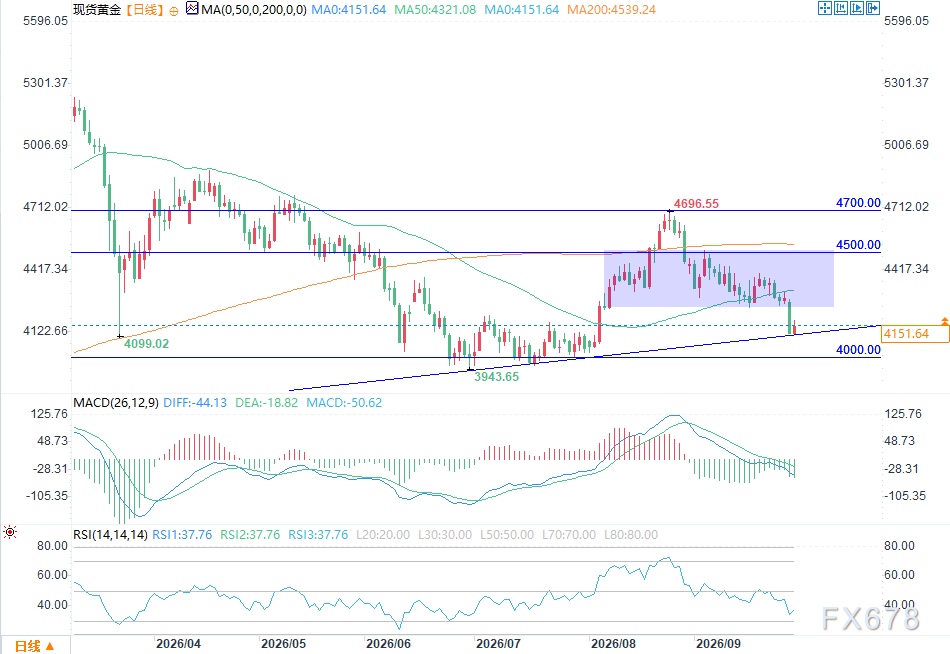
(Spot Gold Daily Chart Source: Yihuitong)
After the recent sell-off, gold is testing an important trendline. The market also broke below a neckline of a composite head-and-shoulders pattern, which explains why selling has been so severe in recent sessions.
Therefore, the range around this trendline is particularly significant. During Tuesday's session, gold prices found support in this region; if prices break below this level convincingly, the psychological threshold of $4,000 will enter focus. Conversely, if yields continue to decline, gold may try to return to its previous consolidation range. Based on current chart signals, a rebound in gold is possible, but it is not yet confirmed that the overall trend has reversed.
Being overly bearish on gold at current levels carries risks as well. Central banks continue to be net buyers of gold, creating an underlying layer of demand; when the market becomes excessively bearish, this force can slow the decline. Of course, this does not mean traders should blindly go long based only on central-bank buying, but it does mean there is underlying buying interest providing some support.
In the current market, being overly convinced of any one direction can easily result in losses. The technical structure has indeed been damaged, while rising rates remain a headwind for gold. However, historical experience shows that when macro uncertainty lingers and large buyers quietly step in, aggressively shorting gold can be challenging.
Another scenario: If the Middle East situation escalates further and energy inflation fears intensify, pushing interest rates up again, gold could come under renewed pressure, and the impact from rising yields could overwhelm its traditional safe-haven function.
If rates continue to fall, it would weaken the bearish argument, leaving more room for this rebound to extend. The upcoming employment report is also in focus, but for now, attention should stay on Tehran and Washington, and how the bond market reacts.
For now, gold market moves are tracking yield fluctuations more than any single geopolitical headline. Thus, the fate of the trendline and 10-year U.S. Treasury yields are the clearest short-term signals to watch.
In the next few trading days, we’ll see whether this rebound can recapture the previous consolidation range, or if the rate trend will again drag gold back toward the lower end of the chart. Either way, the bond market deserves close attention.
Disclaimer: The content of this article solely reflects the author's opinion and does not represent the platform in any capacity. This article is not intended to serve as a reference for making investment decisions.
You may also like
Anthropic’s $2 Trillion IPO Exposes Weaknesses: 47% of Revenue Depends on Amazon and Google, 16 Cents Taken from Every Dollar
Anthropic's prospectus reveals that in 2025, 47% of its revenue will be processed through Amazon and Google Cloud platforms, a significant increase from 11% in 2023. For every $1 of cloud platform revenue, approximately 16 cents must be paid to the platform as distribution fees, totaling about $351 million annually. Additionally, these two giants serve as Anthropic's investors, computing power providers, distributors, and direct competitors simultaneously.
AI Computing Power Race Heats Up! Anthropic Discloses $84.5 Billion Deal, Far Exceeding May Estimate; SpaceX (SPCX.US) Accelerates AI Growth Engine Again
According to reports, Anthropic has agreed to pay SpaceX nearly twice the previously estimated cost for computing power.
BitMine adds 17K ETH as Ethereum eyes a Q4 breakout against Bitcoin
Crypto prices
More


