
U.S. dollar and Treasury yields continue to pressure gold prices, while multiple Asian countries start a wave of gold resource autonomy

Huitong Network, October 5—— Pressured by a strong US dollar and high US Treasury yields, gold prices have fallen sharply from their August 25 high near $4,700, with another drop last week; however, buy orders continue to provide support above the $4,000 threshold. Soft US non-farm payroll data failed to boost gold prices. Meanwhile, multiple Asian countries are advancing the localization of gold resources, with major Asian nations, Singapore, and Hong Kong improving gold reserves and supporting infrastructure. Technically, if gold prices hold above $4,000, a stabilization and rebound could occur; a break below this level would increase downside risk.
Due to a strong US dollar and high US interest rates, the gold market remains under pressure. However, the continued emergence of buying interest suggests that bears have not yet fully dominated. The downward momentum after the recent peak has slowed, with resistance at $4,100.
Spot gold fell a total of 3.40% last week, closing at $4,140.31 per ounce on Friday, down 0.88% for the day, and the full September decline reached 6.55%.
US Dollar and Treasury Yields as Main Resistance
Gold is a non-yielding asset, and a strong US dollar combined with high Treasury yields have long been the two core factors weighing on gold prices. Last week, the dollar index rose about 1%, and the 10-year Treasury yield temporarily broke above 5.25%. Although both the US dollar and yields pulled back slightly on Friday, gold did not see a notable boost. Even with weaker employment data, overall investor sentiment remains cautious.
On August 25, the gold price surged close to $4,700 before sharply reversing and retreating to the $4,100 range. However, it has been difficult for bears to sustain momentum below $4,000 due to repeated buy-side support, indicating that bulls have not exited amid this correction. If gold breaks below $4,000 convincingly, there will be greater downside potential; if prices consolidate above the support, momentum may build for another attempted rebound.
According to the latest US non-farm payroll data, only 29,000 jobs were added in September, with year-over-year wage growth slowing to 3.0%. Theoretically, soft labor data should ease the Fed's interest rate hike pressure and increase gold's relative attractiveness compared to interest-bearing assets. However, gold prices still closed lower, highlighting the strong headwinds from the dollar and bond market. For gold to mount a meaningful rebound, a simultaneous decline in the US dollar and real yields is needed.

Asian Countries Advance Localization of Gold Resources
With gold near historical highs, multiple Asian nations have begun tapping into domestic gold production value, advancing independent development of gold resources. Indonesia plans to impose export taxes on primary and semi-finished gold, with tax rates set between 7.5% to 15% depending on international prices; the goal is to promote domestic refining and processing.
South Korea has restarted its physical gold purchase plan, jointly with local refiners, to acquire gold that was originally intended for export. This boosts domestic reserves and reduces reliance on international markets.
Major Asian nations continue to increase their official gold reserves, treating gold as a strategic resource and improving control over the domestic gold supply chain.
Singapore and Hong Kong are also expanding regional gold infrastructure, with Singapore establishing a central bank gold storage system and Hong Kong launching a local gold clearing pilot. These moves will benefit physical gold demand in the long run and enhance regional self-sufficiency in gold supply.
Technical Outlook for Gold
After a strong rally in August, the price of gold encountered resistance and retreated near $4,700—a warning signal. As long as gold holds above $4,000, the long-term bullish structure remains intact, and a new support zone has formed below $4,300.
The gold market is currently locked in a tug-of-war: strong demand from major Asian countries and risk-averse capital provide support, but high oil prices, a strong dollar, and the risk of further tightening by the Federal Reserve continue to exert downward pressure. Before monetary policy pressures ease, retesting $4,700 will be difficult for gold.
Conclusion
In summary, as long as the US dollar and Treasury yields remain elevated, gold faces ongoing downside risk, but the buying power above the $4,000 threshold cannot be underestimated. If prices remain above this level, the market may stabilize and embark on a rebound; a sustained break below will damage the technical pattern and bring risk of another sharp drop.
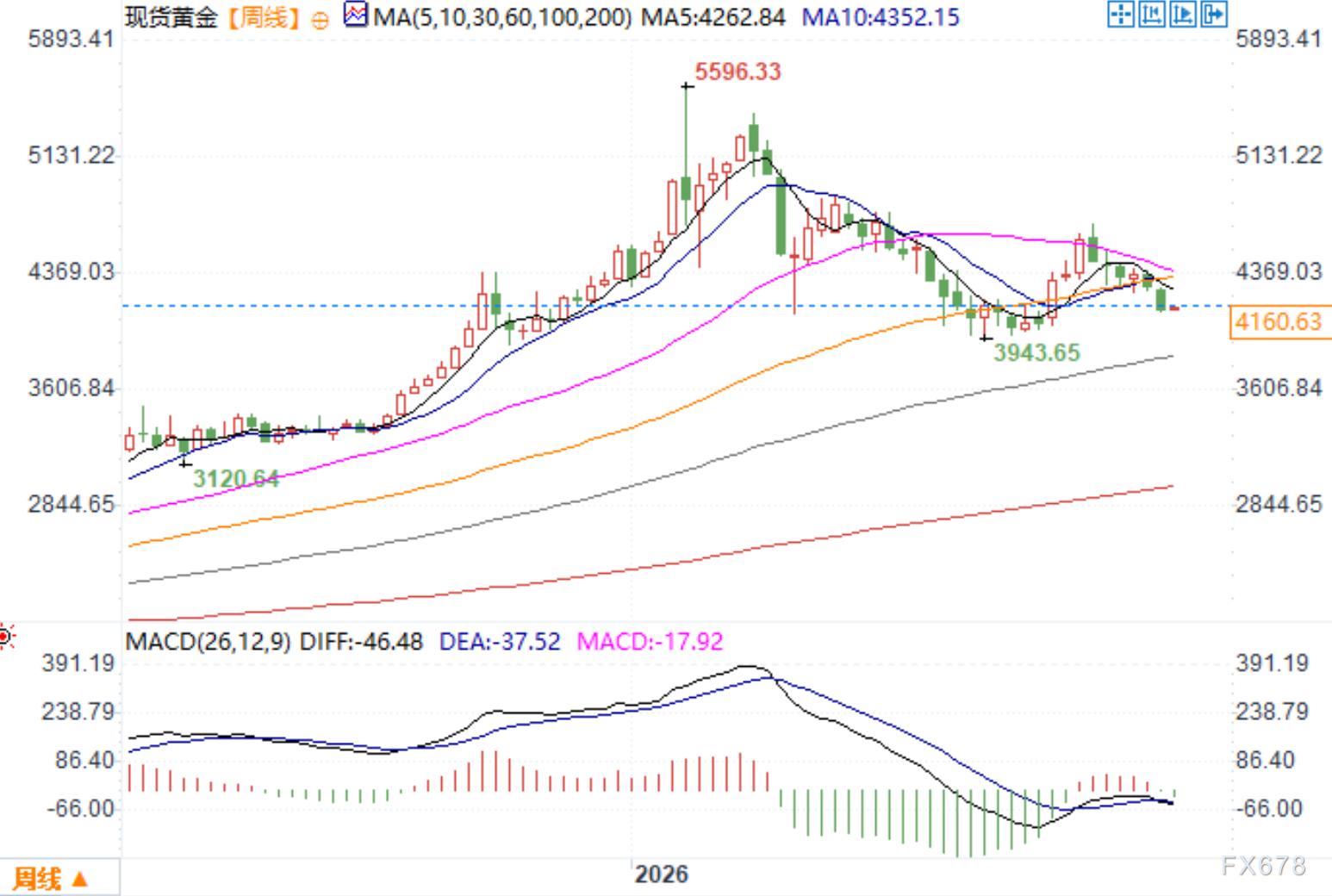
Spot gold weekly chart Source: Yihuotong
Beijing Time, October 5, 10:25 Spot Gold at $4,160.63 per ounce
Disclaimer: The content of this article solely reflects the author's opinion and does not represent the platform in any capacity. This article is not intended to serve as a reference for making investment decisions.
You may also like
Despite Buy upgrade, Cerebras Systems stock falls 1.82% to $166.43

Taiwan Semiconductor Manufacturing stock closes up 2.96%, nears $477 resistance
Bitcoin Traders Brace for These 4 Key Macro Events This Week
"High US Treasury Yields + Strong Dollar" Test Emerging Markets
Morgan Stanley believes that the cumulative rise of nearly 90 basis points in U.S. Treasury yields, combined with a stronger U.S. dollar, has increased emerging markets' sensitivity to external shocks from 25% to a historical high of 55%-60%. With current sovereign spreads at around 200 basis points and valuation buffers exhausted, the divergence between local currency bond inflows and returns has reached its highest level since 2013. The baseline forecast is for subdued returns rather than disorderly sell-offs, with a focus on hedging against the South African rand and Mexican peso; Brazil's election results may be a key variable.
Crypto prices
More


