
Gold signals are mixed, with both bullish and bearish factors intertwining; market sentiment remains cautious

Huitong Network, October 5—— Over the past month, the precious metal gold has experienced a significant downward trend. In recent trading, the speculative characteristic of gold in the short term has been in competition with its solid intrinsic value, leading to dramatic price swings. For speculative traders, gold remains a variety worth continuous attention and participation. The prevailing cautious risk-off sentiment in global markets, combined with a stronger US dollar, has directly pushed gold to make a clear reversal. With mixed bullish and bearish signals in gold's recent trend, speculative participants must be prepared to respond swiftly to rapid shifts in market momentum.
Over the past month, the precious metal gold has shown a substantial downward trend. In recent trading, the short-term speculative nature of gold is struggling with its stable intrinsic value, resulting in volatile prices. For speculative traders, this asset remains worth ongoing focus and participation. The widespread risk-averse sentiment in global markets, along with a strong US dollar, has directly caused a clear reversal in gold's trend. In the backdrop of mixed bullish and bearish signals in gold’s recent trend, speculative traders must be ready for quick changes in price momentum.
In recent weeks, the US dollar has remained strong, and gold did see some minor sell-offs, but the short-term price trend of this precious metal is still hard to predict. Indeed, since the third week of August, gold prices have started to fall, and average retail traders often find it very challenging to understand gold’s sudden violent fluctuations.
In the eyes of many market participants, the long-term value position of gold is unshakeable, but speculative elements always accompany this commodity. The large swings in gold prices not only provide opportunities for betting on gold’s intrinsic value, but also reflect the overall risk sentiment of global markets. Although this is true for all assets, gold’s long history makes it the focus of all kinds of market viewpoints.
Rising US Treasury yields continue to test gold’s resilience
The gold price is hovering around $4150/ounce. Just a week ago, gold prices were around $4130/ounce. This price comparison is worth considering for speculative traders. Even though the US dollar remains very strong in the forex market, gold’s price is higher than a week ago. This raises a question: Are gold’s speculative traders early or late in their assessment of global risk conditions and market sentiment?
All short-term trading in gold is clearly speculative, and the switch of market momentum is critical for traders. On August 25, gold prices once touched $4685/ounce, and in the future, prices will eventually reach that level again—it’s just a matter of when. Recently, the US bond market came under pressure and US Treasury yields rose, weighing on gold prices. When will the large number of gold bulls in the market consider it oversold and rush back in? This is a major point of focus.
Recently, gold’s price volatility has been relatively mild, but the trend could change at any time and suddenly enter a phase of intense fluctuations. Even with a strong US dollar, gold still showed some upward momentum in early trading. For retail gold traders, the choice of trading time cycle is critical, and to grasp frequent shifts in momentum, patience is essential.
Sooner or later, gold will once again demonstrate its appeal as a safe-haven asset, but as long as US Treasury yields stay elevated, gold’s upside will remain challenging. Technical traders can certainly try to take positions, but they must clearly monitor the core indicators: US interest rates and Treasury yields. Market expectations for these two elements dominate the short-term trend of gold.
Long-term buying interest may hinder further declines in gold prices
Some traders believe that as long as global market fundamentals remain unchanged, they can continue to be bearish on gold. However, gold has a large base of long-term bulls who could step in at any time, posing risks for short-term bears. Gold may drop toward $4000/ounce, but once it gets there, a wave of buyers believing gold is oversold could flood in.
Gold traders remain cautious in a choppy market
During the early trading session today, gold dropped to around $4110/ounce before rebounding, as buying interest began to emerge. For experienced traders, this is not surprising since gold prices often directly reflect market sentiment at the time. Currently, the overall market mood is relatively cautious, and gold is likely to remain this way in the short term.
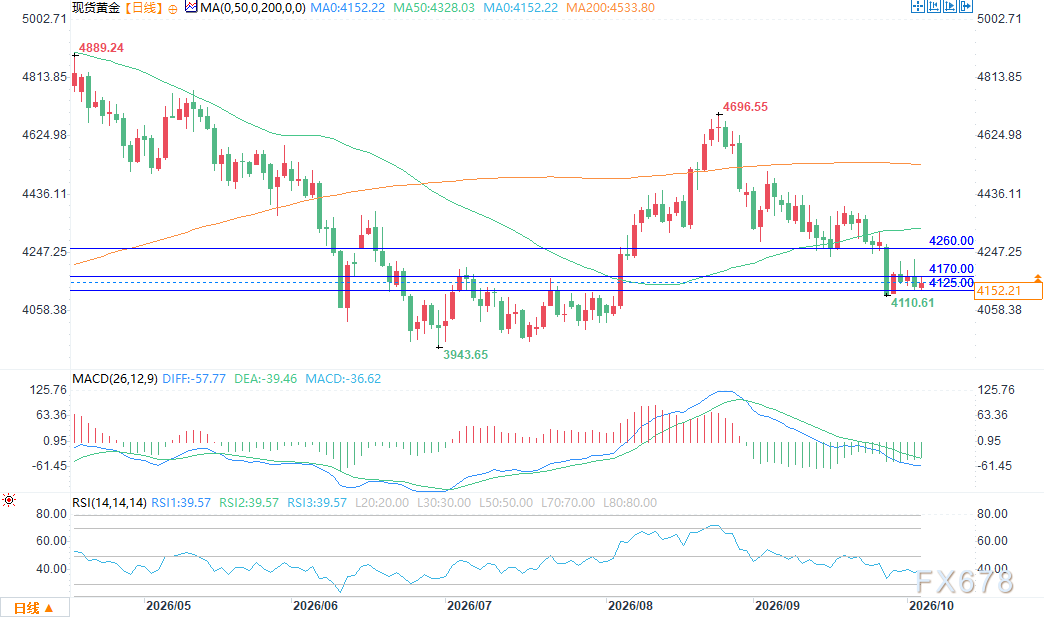
After the recent correction, gold is attempting to find its footing, but the market remains highly sensitive to fluctuations in the US dollar and Treasury yields. This means gold could either stay in a range or see a sudden change in momentum.
The $4170 level is the primary resistance to watch. If gold can consistently hold above this level, it signals persistent buying strength; conversely, if gold repeatedly fails to break this zone, the market will likely remain in a correction phase.
On the downside, $4125 is the nearest support. If this level is broken effectively, focus will shift towards $4050. On the other hand, if gold rebounds and stands firm above $4170, then the $4260 area will come back into market view.
For now, the market performance of gold around these key prices is more relevant than the brief intraday moves. The core question is: Can buyers defend the crucial support given that high yields continue to divert interest away from gold?
Disclaimer: The content of this article solely reflects the author's opinion and does not represent the platform in any capacity. This article is not intended to serve as a reference for making investment decisions.
You may also like
LBMA 2026: Gold is sending a message as debt fears fuel the debasement trade
This year, only tech billionaires are making money: the AI boom drives a $845 billion surge in net worth, with Elon Musk alone accounting for nearly 40%.
According to the Bloomberg Billionaires Index, out of the world's 500 richest people, approximately 100 technology industry billionaires saw their combined wealth increase by $845 billion in the first nine months of this year, setting a historical record for the period. Meanwhile, billionaires from non-technology sectors saw their collective wealth shrink by $62 billion during the same timeframe. Elon Musk alone added $310 billion to his wealth in the first nine months, accounting for about 40% of the total increase in the index.
Is Bitcoin Heading Toward $90,000? Bloomberg Legend Mike McGlone and Three Experts Weigh In

Crypto prices
More


