
Debt-induced currency devaluation trades challenge the traditional relationship between gold and US Treasury yields

Huitong Network, October 6th — At the London Bullion Market Association Precious Metals Conference, experts pointed out that global high debt, inflation, and other factors are driving currency depreciation trades, with the traditional negative correlation between gold and bond yields weakening. As global debt continues to inflate and bond market buyer structures are changing, institutions see potential for increased gold allocation. In Asia, especially in major Asian countries, investors continue to buy gold on dips, while younger generations prefer gold as a store of value. In the long term, the outlook on gold remains bullish, but jewelry demand is falling as gold prices rise, meaning gold prices are likely to remain range-bound in the short term.
At the annual London Bullion Market Association Global Precious Metals Conference, several market experts noted that rising government debt, persistent inflation, and concerns over the long-term purchasing power of fiat currencies are fostering currency depreciation trades. The traditional linkage between gold and bond yields is coming under challenge.
This year’s panel, themed "Long-Term Patterns, Short-Term Trading: Interpreting Currency Depreciation Logic," was chaired by MKSPAMP's Head of Metals Strategy and Research, Nicky Shiels. Analysts and fund managers stated that despite higher global bond yields, gold remains resilient, reflecting increasing investor concern about fiscal situations worldwide.
Global Debt Pressure Mounts, Fiscal Discipline Remains Absent
Vikram Dhawan, Head of Commodities and Fund Manager at Nippon India Joint Fund, noted that the root of the currency depreciation narrative lies in the unsustainable burden of global debt. He said: "Global debt grows by trillions of dollars each year, leaving governments with few choices. They can only resort to some form of financial repression, essentially tolerating higher inflation while attempting to keep borrowing costs low. I see fiscal debt continually rising, but no evidence of fiscal discipline taking shape."
Shayne McGuire, Portfolio Manager at the Teacher Retirement System of Texas, pointed out that currency depreciation is not a new concept. Ancient governments devalued currency by reducing the precious metal content in coins, and now investors fear that mounting debt will ultimately erode the value of money itself. He said: “As debt risks rise, people are becoming more concerned about the shrinking purchasing power of money.”
According to historical patterns, surging global yields would usually severely hit gold prices, but the negative correlation between the two has evidently weakened. Even with bond yields breaching 5%, gold remains supported above $4,000. Vikram Dhawan said that in the short term, gold and yields are still negatively correlated, but in the one- to three-year period after the pandemic, the relationship has weakened significantly, sometimes even moving in tandem. He commented: “

Capital Structure Changes, Institutional Money Likely to Further Increase Gold Allocation
Dhawan believes that rising yields reflect higher term premiums rather than purely strong growth or monetary tightening expectations. The traditional buyer structure of sovereign bonds is shifting; central banks and pension funds, which were previously insensitive to price swings, are being replaced by private investors, who demand greater compensation to absorb duration and fiscal risk. This may continue to decouple the traditional link between gold and the bond market.
McGuire stated that the current issues in the bond market will drive gold further into institutional portfolios. For years, major US pension funds allocated little to gold in their strategic asset mixes, as small positions would hardly impact overall returns. He said: “As problems in the bond market become more apparent, this will inevitably change. Gold may not yield interest, but compared to many bonds, it has appreciated in value. Large institutions have yet to make gold a central part of their discussions, which is a key reason for my long-term optimism.”
Asian Demand Provides Support, Young Investors Favor Hard Assets
DymonAsia Macro Portfolio Manager Wei Yan stated that when domestic real estate and stock markets underperform, major Asian investors have limited options to preserve wealth, so high real yields in Western markets have limited suppressive effect on domestic gold demand. He said: “When the market pulls back, they keep buying. Gold tends to perform better during the Asian trading session, reflecting steady buying from investors in major Asian countries, whereas Western investors are less willing to chase prices higher amid high yield environments.”
Dhawan added that changing preferences among younger generations also favor gold. With persistent inflation, even as nominal assets rise, real purchasing power declines, leading more young people to prefer hard assets as a means of protection. He said: “For those wanting to allocate to hard assets, gold fits all their needs.”
Experts at the forum remain long-term bullish on gold, but caution that currency devaluation trades will not produce one-sided continuous rallies. Dhawan said that rising gold prices suppress traditional physical jewelry demand, so gold prices are likely to trade sideways in the short term. McGuire pointed out that during both Republican and Democratic administrations in the US, fiscal deficits have continued to expand, with no signs of substantive policy improvement. He said: “Regardless of which party is in power, debt and deficit issues remain neglected by the market.”
Conclusion
In summary, global high debt is reshaping the logic of gold pricing, with the traditional negative correlation between gold and bond yields gradually disappearing. Asian physical demand and institutional potential for increased allocation continue to support the long-term outlook for gold. However, in the short term, weakened jewelry demand means gold prices are likely to remain range-bound, making a one-way rally unlikely.
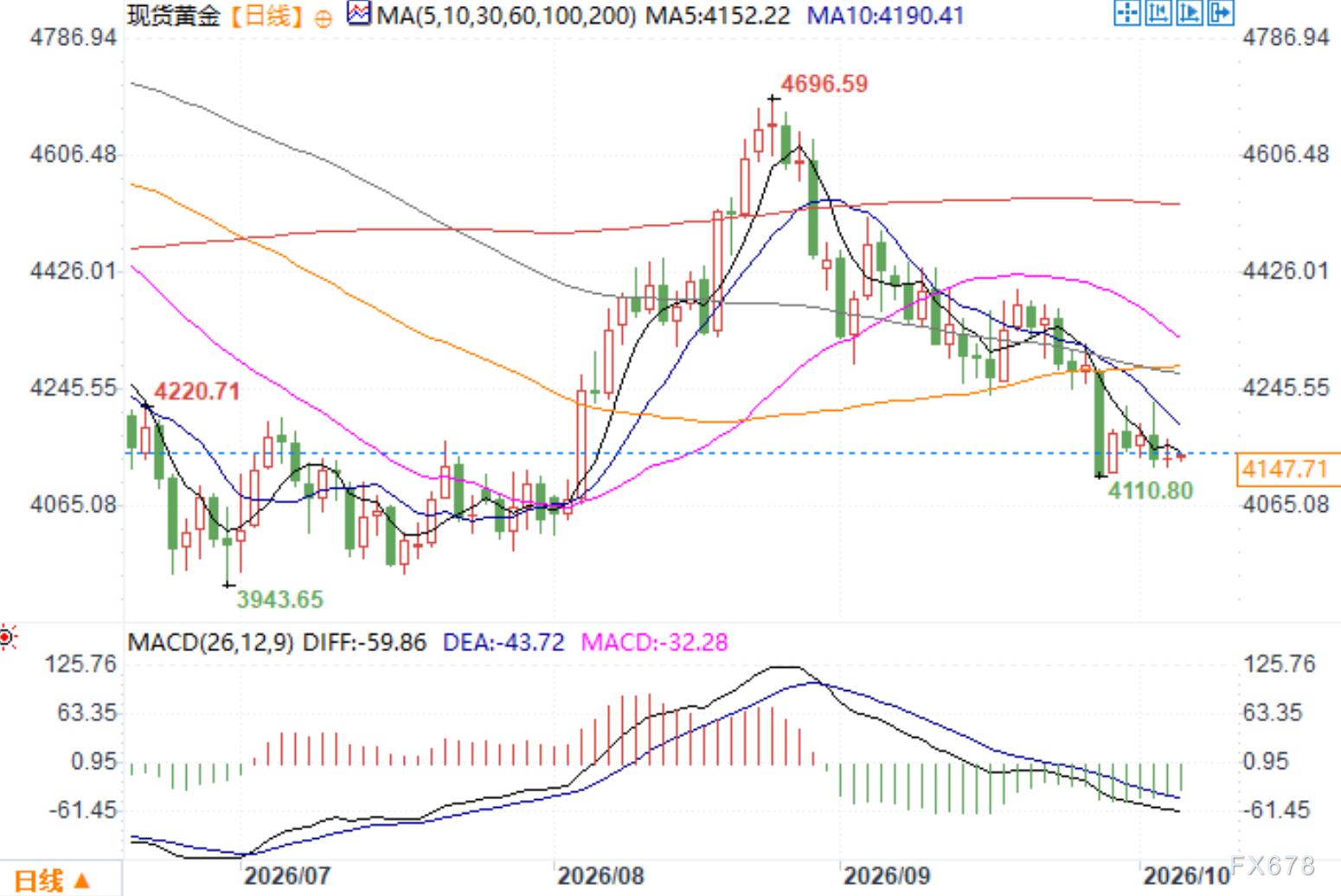
Spot gold daily chart Source: eHuitong
Beijing Time, October 6th, 8:59 — Spot gold quoted at $4,147.71/oz
Disclaimer: The content of this article solely reflects the author's opinion and does not represent the platform in any capacity. This article is not intended to serve as a reference for making investment decisions.
You may also like
NEAR Traders Are Pleased to See the Altcoin Break Above $5 and Trade Above, Will This Momentum Hold?

After Toshiba reported news of HDD production expansion, Morgan Stanley turned more bullish rather than bearish.
Morgan Stanley’s research indicates that the market has seriously overestimated Toshiba’s expansion scale — the doubling of capacity at its Philippines plant over two years translates to an annualized growth rate of about 30%, which is similar to the overall industry supply growth rate and far lower than demand growth. More importantly, channel checks show that Seagate and Western Digital have no intention of following suit with capacity expansion, and there are no signs of loosening in industry pricing.
BitMine lifts ETH holdings to 6 million as price holds above $2,700

Energy & Utilities Roundup: Market Talk
The latest Market Talks covering Energy and Utilities. Published exclusively on Dow Jones Newswires at 4:20 ET, 12:20 ET and 16:50 ET. 0637 GMT - SK Innovation is likely to benefit from higher lubricant base oil prices, LS Securities analyst K.H. Chung says. The South Korean refiner is a global leader in premium lubricant base oils, producing about 80,000 barrels of Group III base oils a day, Chung writes in a note. She expects the supply shortage of lubricant base oils to persist for more than a year. Tight supply of kerosene and diesel and wider refining margins could also continue to boost the company's earnings, she adds. LS Securities upgrades the stock to buy from hold and raises its target price to 187,000 won from 126,000 won. Shares end 2.6% higher at 158,000 won. (kwanwoo.jun@wsj.com) 0113 GMT - YTL Power International could see upside from its expanding data-center and AI infrastructure, as well as renewed power-generation opportunities, says Hong Leong IB analyst Daniel Wong in a note. Its Kulai and Sedenak West hubs offer 2.4GW of potential data-center capacity, while its AI-GPU capacity could scale to 100MW or more and support a new services business. The procurement of seven gas turbines totaling 5.25GW also positions YTL for power-generation growth and supports its expanding data-center pipeline, he reckons. Higher water tariffs and planned treatment plants at its unit Ranhill Utilities should support earnings as Johor's water demand rises, he adds. Hong Leong raises its target price to 8.08 ringgit from 7.58 ringgit and keeps a buy rating. Shares are 1.4% higher at 5.62 ringgit. (yingxian.wong@wsj.com) The price fetched by Amplitude Energy for its natural gas in 1Q should improve on the prior three months, supporting growth in revenue. That's the view of Bell Potter analyst Stuart Howe, who points to higher gas volumes in the quarter. Also, spot natural gas prices recovered to a quarterly average of A$9.77 per gigajoule, from A$8.42 per gigajoule in 4Q of FY26. Amplitude is due to report its 1Q p
Crypto prices
More


