
Gulf supply restoration suppresses geopolitical premium, international oil prices slightly retreat

Huitong Net, October 6 — Falling oil prices have recently directly pulled down the US dollar and US treasury yields, bringing direct benefits to USD-denominated assets.
On Tuesday (October 6), international oil prices continued to retreat. Despite ongoing geopolitical tensions in the Red Sea and the Persian Gulf, multiple crude oil export routes in the Gulf producer countries are gradually resuming operation, sending positive supply signals to the market.
The counteroffensive progress of the Yemeni government forces at the port of Mocha, the rapid repairs of Saudi east-west pipelines, the rebound in Kuwaiti output, and Iraq’s accelerated chartering of tankers have jointly diminished the previously priced-in supply disruption risk premium.
Institutions point out that supply restoration is marginal improvement, and the risks of recurring regional conflicts remain high. The oil price midpoint still has strong support.
This round of price decline is essentially not due to the disappearance of geopolitical conflicts, but rather that the extreme market expectation of a “large-scale disruption of Middle Eastern crude supply” is gradually being debunked; the previously factored-in geopolitical risk premium has been partially digested.
Rapid Recovery of Saudi East-West Pipeline, Red Sea Alternate Export Route Returns to High Level
Saudi Energy Minister Abdulaziz disclosed at an event in Bahrain that the current throughput of the country’s east-west pipeline has reached 5.8 million barrels per day.
This trans-Arabian pipeline was forced to shut down after a drone attack from the Iraqi direction on September 10, and the market was once concerned that Saudi Arabia’s core export route bypassing the Strait of Hormuz would be paralyzed.
However, Saudi Arabia completed repairs and resumed production in just five to six days. The current throughput is over 80% of the pipeline’s 7 million barrels per day capacity, with about 4.5 million barrels per day of crude directly exportable from Yanbu port on the Red Sea.
The east-west pipeline is Saudi Arabia’s most important “Strait of Hormuz alternative.” When Persian Gulf shipping is disrupted by geopolitical conflicts, this line can deliver crude from eastern oilfields straight to the Red Sea’s Yanbu port, sidestepping the shipping risks in the Strait of Hormuz.
The pipeline’s rapid resumption of throughput directly eased concerns over Saudi crude export interruptions, becoming a key supply variable suppressing oil prices.
Marginal Easing on Yemen Battlefield, Lowering Risk Expectations for Red Sea Shipping Route
The Yemeni government forces launched a major counteroffensive, claiming to have recaptured the strategic Red Sea port of Mocha from the Iran-backed Houthi forces.
Mocha port, located about 75 kilometers north of the Bab-el-Mandeb Strait, is a key point controlling the critical Red Sea crude shipping route.
Earlier in September, the Houthis occupied Mocha, and the market once feared the Houthis would fully control the strait, posing a direct threat to Red Sea oil tanker traffic.
Meanwhile, Saudi Arabia, Turkey, and Pakistan reached a consensus to deploy forces and initiate deterrence actions against the Houthis.
Though the Houthi side denied losing control of Mocha port, and Saudi airports Jizan and Najran were also attacked on Monday night resulting in casualties, the conflict has not ended;
Nevertheless, the government forces’ progress along the Red Sea coast has reduced the market’s extreme anticipation of a complete blockade of the Bab-el-Mandeb Strait, and the tail-risk pricing for Red Sea shipping has somewhat retreated.
Many Gulf Countries Simultaneously Restoring Production and Outbound Capacity, Hormuz Strait Flows Rebound
Aside from the Saudi pipeline repairs, other Gulf oil-producing countries’ crude supply is also steadily recovering.
Kuwait announced that its crude production has recovered to 75% of the level before the outbreak of the Iran war; Iraq is actively chartering more tankers to expand its crude oil exports through the Strait of Hormuz.
Multiple countries restoring production and shipping capacity in parallel continues to drive up flows of Persian Gulf crude.
According to the latest research note from the ING energy strategy team, signs of recovery in Persian Gulf crude flows are increasing, and the market is reassessing the probability of Middle Eastern supply disruption. However, the institution emphasizes that this is marginal improvement, not a complete elimination of risks.
Falling Risk Premium ≠ Crisis Over, Oil Price Support Remains Solid
This decline in oil prices is essentially a pullback of risk premiums, not a fundamental shift to a bear market.
On one hand, while there has been progress in the battle for Mocha and Saudi pipeline repairs, the Houthis retain long-range strike capabilities. The attacks on Saudi civilian infrastructure show the region is still prone to sudden conflict flare-ups; any new attacks on infrastructure could quickly drive oil prices higher.
On the other hand, the Strait of Hormuz, as the world's core crude oil corridor, continues to face security uncertainty.
ING believes that the market’s anxiety will not clearly ease until there is substantive progress in US-Iran negotiations, and the risk of further escalation always exists.
Relief in Energy Inflation Pressures Down Market Interest Rates and the Dollar Index
Interestingly, since the European economic fundamentals are highly sensitive to oil prices, falling oil prices also strengthen the euro. At present, oil prices have led to simultaneous weakness in the US dollar and US treasury yields, which directly benefits the euro, gold prices, and tech stocks.
Summary:
In the short term, the restoration of Gulf export routes and partial improvement of the Yemeni battlefield have together suppressed the previously excessive geopolitical fear premium, leading to this round of minor oil price correction.
However, Middle East geopolitical conflict is highly volatile, and the fragility of supply restoration remains elevated. Oil prices will likely maintain a high level of volatility.
On the trading side, the market focus will keep tracking two main lines: first, the continued stable operation of the Saudi east-west pipeline and Yanbu port; second, any new attacks on energy infrastructure in Yemen or the Persian Gulf.
Meanwhile, oil prices’ dual impact on the US dollar and US treasuries means falling oil prices bring direct benefits to USD-denominated assets.
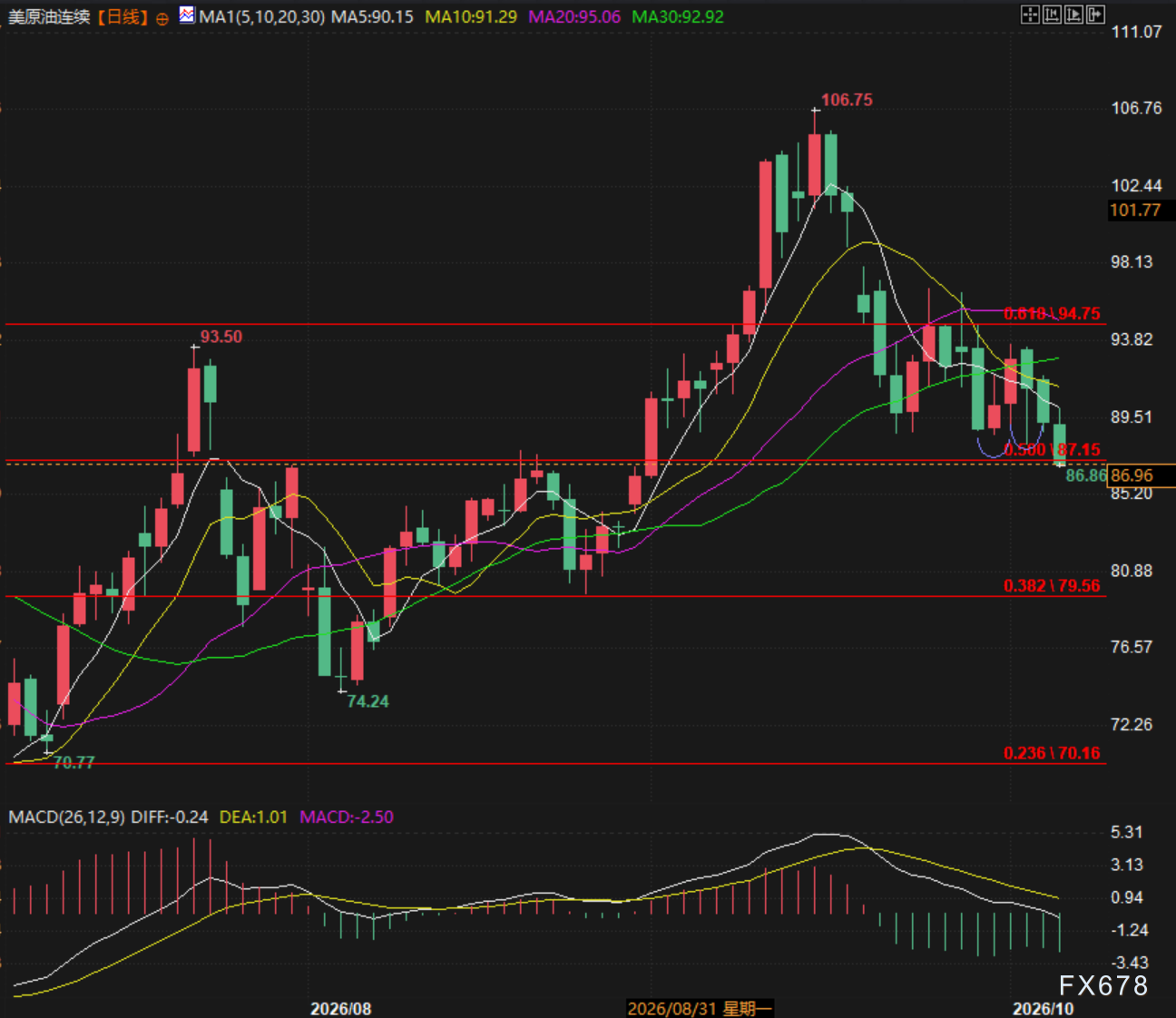
(WTI crude oil main contract continuous daily chart, source: YiHuitong)
WTI crude oil main contract is currently quoted at $87.14/barrel.
Disclaimer: The content of this article solely reflects the author's opinion and does not represent the platform in any capacity. This article is not intended to serve as a reference for making investment decisions.
You may also like
Matt Hougan Says “Zombie Altcoins Will Disappear,” Citing One Altcoin as a Major Exception
Republicans criticize AI danger claims, Democrats question the influence of "big tech" on the Trump administration's AI policy and demand disclosure of regulatory framework amendment procedures
A Republican senator sent a letter to the CEO of Anthropic, warning against adopting an "alarmist" attitude towards AI and urging him to emphasize AI's potential to improve people's lives, enhance national security, and address AI threats. Meanwhile, two Democratic senators wrote to U.S. government officials, including the Treasury Secretary, requesting clarification on whether tech giants influenced the government's adjustment of the AI regulatory framework through lobbying between May and June of this year, and called for the disclosure of records of communication between companies and the government.

Houthi Forces Strike Saudi Arabia, Hormuz Oil Tanker Attacked Again, but Saudi Arabia Says Key Oil Pipeline Operations Restored Over 80%
The Yemeni Houthi forces claimed to have launched three rounds of attacks against Saudi Arabia on Monday, including strikes on the capital's airport; on Tuesday, they launched dozens of attacks on Saudi-backed armed groups, killing or wounding more than 200 people. Saudi Arabia reported that two airports were hit. The Saudi Energy Minister stated that as of Tuesday, the east-west oil pipeline throughput had recovered to 5.8 million barrels per day. On Tuesday, the UK Maritime Trade Operations reported that a tanker leaving the Strait of Hormuz was hit by an unidentified flying object. The Shell CEO stated that Middle Eastern oil flows have recovered to about 80% of pre-Iran conflict levels.
British Pound catches bid as BoE hawk warns inflation is embedded
Crypto prices
More


