
Gold and silver prices rise as yields fall, but the risk of a Fed rate hike in December remains

FX168 Financial News, October 6th—— On Tuesday (October 6th) during the US morning trading session, spot gold and silver prices moved higher. US long-term Treasury yields retreated from the multi-decade highs reached on Monday, while international oil prices fell below $100 per barrel, creating room for precious metals to continue their rebound after the non-farm payrolls data release. Spot gold traded around $4,165.31 per ounce, up 0.60% on the day; spot silver traded around $61.326, up 0.44% on the day.
On Tuesday (October 6th) during the US morning trading session, spot gold and silver prices moved higher. US long-term Treasury yields retreated from the multi-decade highs reached on Monday, while international oil prices fell below $100 per barrel, creating room for precious metals to continue their rebound after the non-farm payrolls data release. Spot gold traded around $4,165.31 per ounce, up 0.60% on the day; spot silver traded around $61.326, up 0.44% on the day.
The market is currently intertwined between bullish and bearish factors. On the one hand, the labor market is signaling weakness, while on the other hand, inflation pressures remain persistent. The US non-farm payroll report for September showed that the unemployment rate remained at 4.2%, with average hourly earnings rising 0.1% month-on-month; combined, July and August nonfarm job numbers were revised down by 60,000. The US ISM Services Purchasing Managers Index for September came in at 54.9, with the price index hitting its highest level since July 2022. Federal funds futures indicate that there is a nearly 78% chance rates will remain unchanged at the October 28 FOMC meeting, but there is still a high probability of at least one rate hike by December.
The 10-year US Treasury yield is near 5.27%, with the 30-year yield around 5.63%. The dollar index has pulled back from the nearly 18-month high set on Monday. A series of key events that could determine the path of interest rates are coming up next: Fed officials' speeches on Tuesday; the release of the September FOMC meeting minutes on Wednesday; weekly initial jobless claims data on Thursday; and the preliminary Michigan consumer sentiment index for October on Friday. Weakness in labor data or consumer sentiment will support gold prices; however, if inflation expectations remain high or the meeting minutes send a hawkish signal, the high-yield environment will continue to weigh on precious metals.
The situation in the Strait of Hormuz and the US-Iran standoff remains unresolved, but with regional oil exports resuming and emergency reserve oil being released into the market, short-term pressures on oil prices have eased. In the last week of September, Middle Eastern crude exports for four days exceeded pre-war levels; at the same time, the G7 agreed to release 100 million barrels of strategic crude oil and diesel reserves. Saudi Arabia's cut to the November official selling price for Arab Light crude to Asia signals an improvement in oil supply conditions. However, geopolitical risk premiums have not fully dissipated: repeated tanker attacks in the Strait of Hormuz, Houthi strikes on Saudi targets, and damage to Gulf region infrastructure keep traders alert to potential further supply shocks. A decline in oil prices could marginally weaken the inflationary forces driving up US Treasury yields and the dollar, supporting gold; but ongoing security risks in the Gulf keep safe-haven buying in gold active, and energy market volatility remains a factor for Fed policy considerations.
Risk appetite warmed somewhat in global markets before the US stock market opened. Dow Jones mini futures rose 281 points, or 0.55%; S&P 500 mini futures rose 30.75 points, or 0.39%; Nasdaq 100 mini futures rose 192 points, or 0.61%, with the AI tech sector leading gains once again.
Other major external markets: New York Mercantile Exchange West Texas Intermediate (WTI) crude fell, trading below $88 a barrel; Brent crude traded near $97.97. The benchmark US 10-year Treasury yield held around 5.284%. The dollar index weakened, but remains elevated.
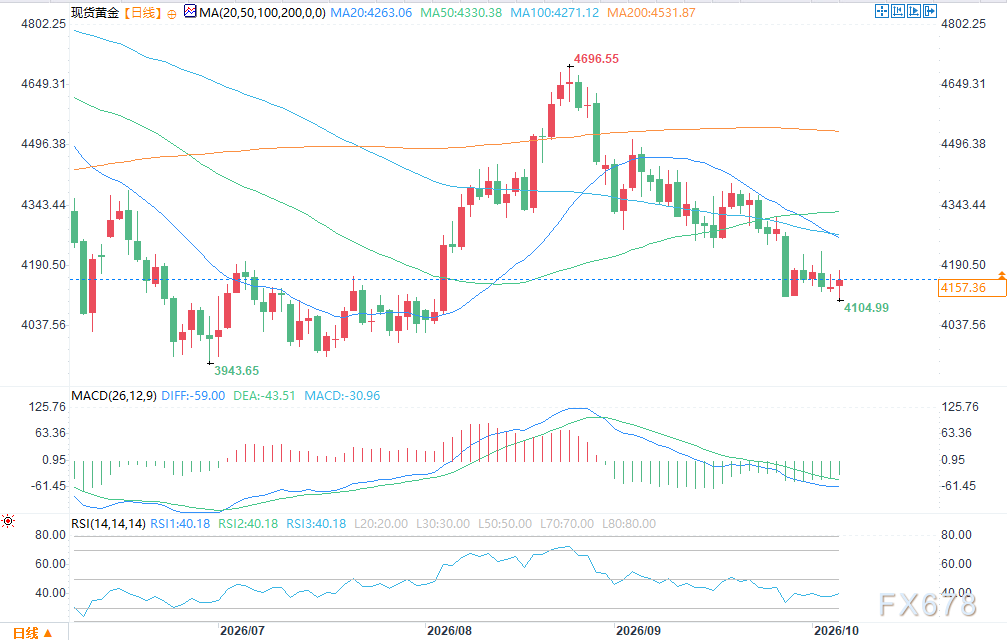
(Spot Gold Daily Chart Source: EFX168)
The next upside target for gold bulls is to push the price above the $4,203.61-$4,230.51 resistance zone. If this is effectively broken, the next target will be $4,319.61, followed by $4,330.43. In the short term, bears aim to push the price below $4,103.52, with further downside targets at $3,996.06 and then $3,942.10. The first resistance lies at $4,203.61, followed by $4,230.51, while the first support level is at $4,164.44, with the next at $4,103.52.
The next upside target for silver bulls is to push the price above the $61.744-$63.060 range. If this is breached, the focus shifts to $65.090, followed by the key psychological level at $66.000. Bears are targeting a break below $59.960, with subsequent downside at $58.940 and then $57.640. The first resistance is at $61.744, followed by $63.060; the initial support is at $60.715, with the next at $59.960.
Disclaimer: The content of this article solely reflects the author's opinion and does not represent the platform in any capacity. This article is not intended to serve as a reference for making investment decisions.
You may also like

Nvidia’s Record Run Signals Another AI Wave: 5 Cryptos Worth Buying Before the Breakout
Apple (AAPL.US) Teams Up with LG to Enter Smart Home Market: Accessories such as doorbells, thermostats, and cameras to feature LG branding
According to sources, Apple is set to expand its smart home device lineup, including doorbells, thermostats, and other accessories. These products will be developed through an unusual partnership between Apple and LG Electronics.
Review Article - ROI - For Trump's Treasury, the "tail" of the auction is the toughest part: McKeever
Repeated, no changes to the main text. By Jamie McGeever Reuters, Orlando, Florida, October 6 - U.S. Treasury auctions are supposed to be dull, predictable, and lacking in news value. But these are unusual times, and the Trump administration now faces the risk of weak government bond sales making headlines. The U.S. Treasury plans to issue nearly $120 billion in bonds this week—the first auction of bonds other than short-term Treasury bills in two weeks: $58 billion in three-year notes on Tuesday, $39 billion in ten-year notes on Wednesday, and $22 billion in thirty-year bonds on Thursday. These auctions would ordinarily be inconsequential, but they're attracting increased attention due to the exceptionally weak auction results from September 22–24—particularly the five-year Treasury auction on September 23, which led to the largest jump in yields since April of last year. Since then, yields have not fallen back, and instead, have surged to multi-decade highs across most maturities. It's important to note that the possibility of a "failed" U.S. Treasury auction is nearly zero. The primary dealers—26 banks and institutions currently authorized by the New York Fed to act as Treasury market makers on Wall Street—are always involved. They essentially underwrite the sales, ensuring the smooth operation of the $30 trillion U.S. Treasury market, which is the most liquid in the world. This, in turn, keeps the entire global financial system running. Trillions of dollars of global debt, assets, and market derivatives are benchmarked off U.S. Treasuries. U.S. Treasuries also serve as collateral to "lubricate" the pipes of the U.S. and global financial systems—in repos, interbank lending, and financing. In short, as long as U.S. Treasuries remain the backbone of the global financial system, there will always be buyers in Treasury auctions. The perpetual question is the price at which these bonds ultimately clear. With borrowing costs in the secondary market now at their highest since the mid-2000s, it's reasonable to expect the Treasury will pay correspondingly high rates in the primary market. But as recent auction rounds have shown, there remains potential for negative surprises. “Too big for the market to digest?” The $70 billion five-year auction on September 23 was among the most concerning in recent years. Demand—as measured by bid-to-cover ratio—was the lowest in nine years. The Treasury sold these notes at a yield of 5.033%, more than 3 basis points above the market yield at the auction deadline. Three basis points might not sound like much, but for a five-year Treasury auction, that's highly unusual. This was the largest so-called "tail" since June 2022. JP Morgan analysts pointed out that the last time the five-year auction saw a three-basis-point tail was back in 2011—when the brewing debt ceiling crisis ultimately led to the U.S. credit rating being downgraded that August. Back to today, concerns over the U.S.'s bleak fiscal outlook have pushed up long-term borrowing costs. Consequently, markets widely expect the Trump administration to gradually shift the Treasury's massive funding needs toward the lower-cost, shorter end of the yield curve. That explains why the five-year auction two weeks ago caused such a stir. A three-basis-point tail is common in long-bond auctions, but rare for securities in the so-called "belly" of the curve. If the Treasury is forced to pay a higher premium to move these bonds, then Houston, we have a problem. Large auction tails can be caused by numerous factors, such as market volatility on the day of the auction or, more worryingly, underlying fundamental issues that could erode demand over time. It's usually difficult to distinguish between these dynamics, as they're not mutually exclusive. On the brighter side, this unease hasn't yet spread to the short end of the curve. At least, not for now. Three- and ten-year Treasury yields have risen by about 50 basis points from the last auction a month ago, hovering around 4.96% and 5.32% respectively. The 30-year yield is up about 35 basis points, to 5.65%. That should be high enough to attract strong demand and ensure smooth sales, right? Probably. But if we get a surprise, volatility and uncertainty could ripple across the entire market. Investors will be… watching developments like hawks. (The views expressed herein are those of the author, a Reuters columnist.) Enjoyed this column? Visit Reuters Open Interest, your essential new source for global financial commentary. Follow ROI on LinkedIn and X. You can also listen to the daily "Morning Bid" podcast on Apple, Spotify, or the Reuters app. Subscribe for seven-day-a-week in-depth analysis of market and financial news by Reuters journalists. US 5-year auction has biggest 'tail' since 2022 https://fingfx.thomsonreuters.com/gfx/mkt/dwpkmkzogpm/TAIL.png (For reader convenience, Reuters automatically translates its reports into several other languages. Automate
Crypto prices
More


