
AI narrative suppresses gold prices, while US Treasury debt pressure lays mid-to-long term opportunities

Huitong Network, October 7—— Gold prices plunged sharply, surprising the bulls. The latest consensus from AI boosted long-term US Treasury yields, putting pressure on gold, but inertia in market perception may hide opportunities for gold.
On Wednesday (October 7), gold prices trended lower throughout the day and are currently trading around 4121. The bullish sentiment accumulated from gold’s rebound yesterday was quickly reversed, disappointing all the bullish capital.
The sharp dip in real interest rates relative to nominal rates was mainly because the market believes the AI investment boom and ongoing geopolitical uncertainty require long-term Treasury holders to demand higher compensation, and since inflation is sticky, money in the future is worth less, causing real rates to drop further.
Meanwhile, the recent volatility in oil prices has continued, putting pressure on the euro and pushing up the US dollar index.

Geopolitical Energy Risks Persist: Driving Up the US Dollar Index
Houthi armed spokespersons have confirmed that their forces successfully repelled a Saudi buildup near the Bab-el-Mandeb strait, using ballistic missiles to inflict losses on opposing personnel and equipment; attacks in the Hormuz Strait are also increasing, making up half of all regional maritime attacks so far this month.
Although some shipping routes have eased the oil supply disruption by rerouting or through ship-to-ship transfers, the EIA predicts that oil production stoppages will visibly decline by Q1 2027. However, Middle East oil supplies will remain limited through 2026, and the tightness in US diesel inventories won’t be resolved soon; East Coast distillate inventories are 32% below the five-year average, and inventories are expected to stay significantly low this winter.
Core Market Risk: AI Redefines Long-Term Rates, Pressures Gold Prices
But the market quickly switched to an even stronger narrative: AI capital expenditure pushes up the long-term equilibrium real interest rate r*, thereby suppressing long-duration assets.
Federal Reserve officials have continued to release hawkish signals, acting as a catalyst for this narrative.
San Francisco Fed’s Daly suggested that AI-driven chip demand and related price pressures are not transitory shocks; if AI, tariffs, and energy shocks persist, the Fed may need to raise rates further. Kansas City Fed President Schmid was even more direct, noting that inflation remains stubborn and that AI-driven data center and semiconductor capex have become key inflation drivers. Even as long-term yields have risen, short-term Fed policy rates cannot relax the fight against inflation.
The market further interprets this logic: Large-scale AI infrastructure and chip expansion are driving a surge in overall investment demand, leading to intense competition for long-term capital. This requires an upward revision in the long-term neutral real rate r*.
At the same time, both Temasek and Bridgewater’s Dalio issued risk warnings, highlighting that the AI investment craze carries bubble risks, as extensive debt supports AI expansion. Should rates remain high, the bubble could pop and weigh on fiscal revenue.
The market is thus simultaneously pricing two layers of risk: short-term, continued AI capital expenditure elevates the cost of funding; long-term, an AI bubble bursting could trigger a recession.
Market Action Confirms: Rising Long-Term Rates Put Pressure on Gold
The market directly validated this narrative: 10-year US Treasury yields rose from a lower open, while two-year yields stayed basically flat, forming a bear steepener.
The main upward force in yields came from a rebound in TIPS real rates rather than a significant upgrade to short-term policy rate hikes.
The rise in real rates overshadowed support for gold from tail risks of energy-driven inflation, causing gold prices to come under pressure.
This reveals a core market conflict: On one hand, ongoing attacks in the Bab-el-Mandeb and Hormuz Strait, combined with oil supply constraints and higher long-term inflation risk premiums, should be bullish for gold;
On the other hand, the market is pricing in an AI-driven rise in long-term funding costs and real rates, increasing the opportunity cost of holding non-yielding assets like gold, creating strong negative pressure.
Outlook: High Rates Are Not a Permanent Headwind—US Debt Pressure May Reverse
The market generally holds to the notion that rising rates must be negative for precious metals, and gold prices may continue to decline in the near term.
But in fact, the reason for rising rates is critical. If rates rise due to heating inflation or sovereign debt risk eruptions, this could actually support gold.
Currently, the Fed’s fight against inflation has a symbolic posture. The US government’s growing debt will serve as a hard constraint, making it difficult for the Fed to keep policy rates high.
Faced with massive debt pressures, the Fed may be forced to stop rate hikes earlier than expected, or even pivot to easing. If that scenario occurs, precious metals could see a significant rally.
From a technical perspective: Gold’s moving averages are in a bearish alignment. Previously, we have repeatedly warned that gold prices are likely to fluctuate, coming under pressure at each rally. While the current trend remains bearish, since prices are near the 4050 support level, a rebound could be imminent.
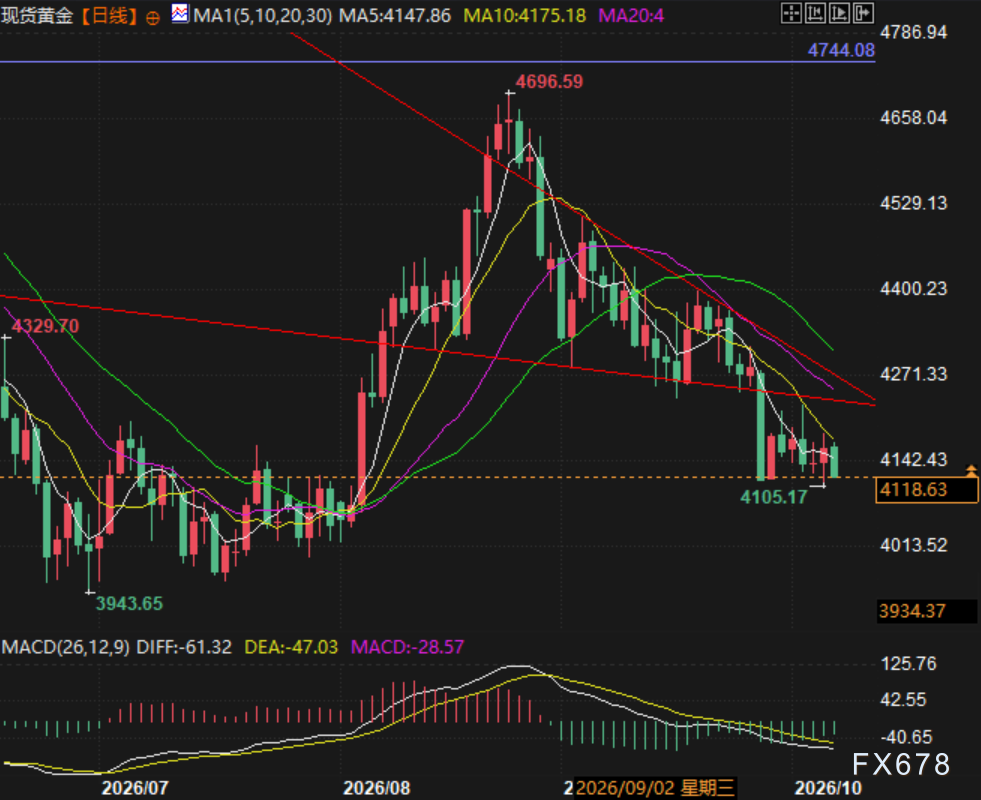
(Spot gold daily chart, source: Yihuitong)
At 18:00 (Beijing Time), spot gold was quoted at $4,117 per ounce.
Disclaimer: The content of this article solely reflects the author's opinion and does not represent the platform in any capacity. This article is not intended to serve as a reference for making investment decisions.
You may also like
FOMC Minutes Today: Will a Hawkish Fed Push the Dollar Higher Against EUR, GBP, and JPY?
Cardano Launches Programmable Tokens as TOKEN2049 Expands to the US
Constellation Brands stock gains 2.08%, but stays below all three daily EMAs
U.S. Economic Resilience Boosts Outlook for Small-Cap Stocks as Wall Street Expects a Rebound Opportunity
Bank of America points out that for small-cap stocks highly dependent on the US domestic economy, manufacturing is the most important macro indicator affecting their relative performance. The latest data shows that US manufacturing has expanded for the ninth consecutive month, marking the longest expansion cycle since 2022.
Crypto prices
More


