
Industry experts reveal: US Treasury yields will continue rising, long-term currency depreciation favors gold

HuiTong Net, October 16th—— Former London bond broker Mario Innecco points out that the 40-year bond bull market has ended, and savers will suffer losses. With the US September CPI reaching 3.7%, he believes that there is deliberate price suppression in the precious metals market. He predicts that after a brief pullback, US Treasury yields will resume rising. Massive debt constrains the Federal Reserve, making it impossible to replicate Volcker's aggressive rate hikes. Long-term currency devaluation benefits gold and even raises the possibility of an official revaluation of gold.
On Wednesday (October 14), the US September inflation report was released, with CPI rising to 3.7% year-on-year, causing gold prices to drop sharply, falling around $80 to near $4,073. However, as Fed officials hinted there was no rush for further rate hikes, the US dollar index and Treasury yields sharply pulled back from their highs, and gold rebounded. On Friday (October 16), during the Asian session, spot gold once rose by 0.35% to $4,186.41/oz.
Mario Innecco, a veteran trader who spent about 20 years in London government bond futures brokerage and bought his first gold back in 2002, pointed out that the bigger story is actually in the bond market. From his perspective, the 40-year bond bull market has ended; interest rates are set to turn upwards, and savers will pay the price. He asserts that amid high inflation and soaring debt, the Fed finds it difficult to replicate Volcker's aggressive tightening.
Rising Inflation and Falling Gold Prices
Data on Wednesday showed that September CPI rose 3.7% year-on-year, higher than August's 3.4%. Gasoline surged 9.1% in a single month, contributing more than half of the month's overall rise. After the data was released, spot gold dropped $82 from the previous close, hitting a low of $4,078.80; silver plunged by more than 5%. US Treasury yields climbed, with the 2-year rising by 15 basis points to 4.94%, and the 10-year up by 11 basis points to 5.32%. The CME FedWatch Tool showed that the probability of a rate hike on October 28th doubled in one day to about 50%.
Innecco stated that professional traders interpret high inflation as a signal that the Fed will further tighten policy, thus increasing the opportunity cost of holding gold relative to Treasuries or bank deposits.

The End of the Bond Bull Market: Rates May Pull Back, Then Rebound Higher
Innecco believes the bigger trend change is in the bond market. In August 2020, the 10-year US Treasury yield reached a historical low of 0.52%, while gold surpassed $2,000 for the first time. As of October 7, the yield had climbed to 5.36%, the highest since 2002, yet gold stayed above $4,000. He said that during the bond bull market from 1981 to 2021, declining rates enabled governments and mortgage holders to refinance at ever-lower costs, supporting economic activity;
He predicts that in the next 3 to 6 months, the 10-year yield could experience a contrarian pullback to around 4.5% or even 4.25%, before climbing toward 6%. He advises savers seeking higher yields to hold short-term Treasuries with maturities within one year. According to his calculations, if the yield rises to 6.25%, a 10-year bond purchased now at 5.3% will lose value to about 94 cents on the dollar after two years. He remarked that in the 1970s, bonds were called "certificates of confiscation." He believes this scenario is likely to repeat, and the US government and the Fed do not mind, as it effectively extinguishes debt.
Market Manipulation Suspicions and a Rush for Physical Metals
Innecco bluntly stated that some participants are deliberately suppressing gold and silver prices, especially silver, as it is more easily subject to price attacks. Traders manipulate paper prices and are keenly aware of price levels that attract buying. He also mentioned that during the Golden Week holidays in major Asian countries, when the gold market is closed, banks dealing in precious metals often seize the opportunity to suppress prices. Regulators have previously penalized such manipulation: in September 2020, JP Morgan agreed to pay over $920 million to settle a US investigation into years of spoofing gold, silver, and Treasury futures.
Despite this,
The Real Cost of Inflation and the Long-Term Risk of Dollar Depreciation
Innecco defines inflation as the growth in money and credit supply, not just CPI data. He estimates that broad money (M2) is expanding at an annualized rate of about 6.7% this year. He does not fully trust official inflation data, pointing out that governments substitute cheaper goods into the CPI basket and mask price increases with quality adjustments. On the same day, the US Social Security Administration announced a 3.6% cost of living adjustment for 2027, raising the average monthly check for retirees by about $75 to $2,170, but Innecco deems this far from enough to make up for inflation.
He says that newly created money flows first to Wall Street and big corporations, and by the time it reaches the bottom 50%, its purchasing power has already been diluted, buying far less. He directly points out,
Fed Unlikely to Repeat Volcker Era; Gold Revaluation May Become a Turning Point
Innecco believes the Fed itself is the creator of inflation, fighting only to manage the public's perception of it. On September 16, the Fed raised its policy target range to 3.75%-4%, the first hike since July 2023 and the first under Chair Kevin Warsh. Innecco describes Warsh as relatively independent, and says he would not be surprised if the Fed raised rates again. However, he judges that any rate hike strong enough to crush inflation would also crush the economy.
He also mentioned the US Treasury's potential revaluation of gold. On the Treasury's books, gold is valued at the statutory price of $42.2222 per ounce, totaling about $11 billion, but at market prices, the same gold is worth over $1 trillion.
Conclusion
All in all, Innecco's views paint a picture of intertwined high inflation, explosive debt, and currency devaluation: the end of the bond bull market with rising rates heavily burdening savers; evidence of deliberate price suppression in precious metals, while physical buying continues on the dips; the Fed constrained by debt and unable to adopt aggressive tightening, resorting instead to money printing to dilute debt, which may eventually bring about gold revaluation or other unconventional measures. After 24 years of hoarding gold, Innecco admits his greatest surprise is how long authorities have managed to delay the inevitable, thanks to the 40-year bond bull market.
Now the wind has changed, and sailing against the current, the road ahead will be even tougher.
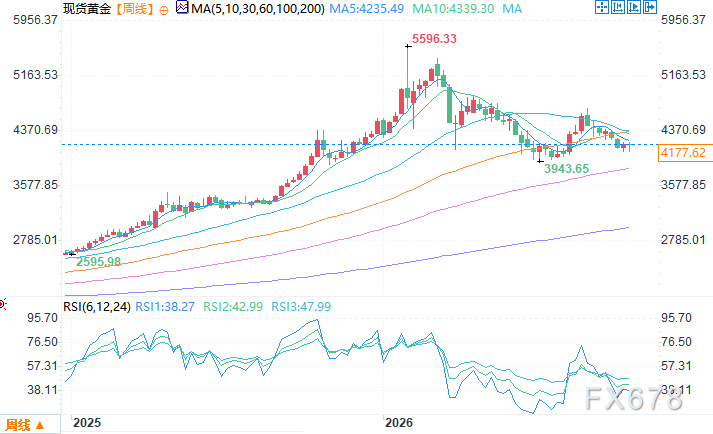
Spot gold weekly chart Source: EasyForex
GMT+8, October 16, 12:12, spot gold quoted at $4,177.62/oz
Disclaimer: The content of this article solely reflects the author's opinion and does not represent the platform in any capacity. This article is not intended to serve as a reference for making investment decisions.
You may also like
QuantumScape stock gains 7.63%, but stays below all three daily EMAs
JPMorgan comments on the Roadster launch: Tesla (TSLA.US) aims to showcase engineering capabilities rather than a commercialization plan, maintaining a "Neutral" rating
After the Roadster launch event, JPMorgan reiterated its "neutral" rating on Tesla.

MSCI downgrade alert triggers foreign capital flight concerns! Indonesia suffers triple blow in stocks, bonds, and currency as stock market sees worst decline in nearly 30 years
After MSCI, the index compilation agency, expressed consideration of downgrading Indonesia's stock market rating and removing it from global indices, concerns about capital outflows triggered a triple sell-off in Indonesia's stocks, bonds, and currency.
Review Article - Interpreting Why CoreWeave’s Predicament Shakes the AI Boom

Crypto prices
More


