CME Group recently expanded its crypto derivatives offering with Uniswap [UNI] and Micro UNI Futures, creating new trading opportunities for Uniswap institutional investors.
The launch reportedly offered two contract sizes, which allow market participants to manage their Uniswap exposure via regulated Futures products.
This development reflected another step toward the integration of decentralized finance tokens with the traditional financial markets.
Uniswap’s inclusion in fact exposed institutional participants to additional tools for managing exposure to decentralized exchange tokens. The Futures launch, however, emerged as Arkham’s recent findings highlighted significant UNI holdings under control of a single investment firm.
a16z’s Uniswap holdings raise ownership concentration questions
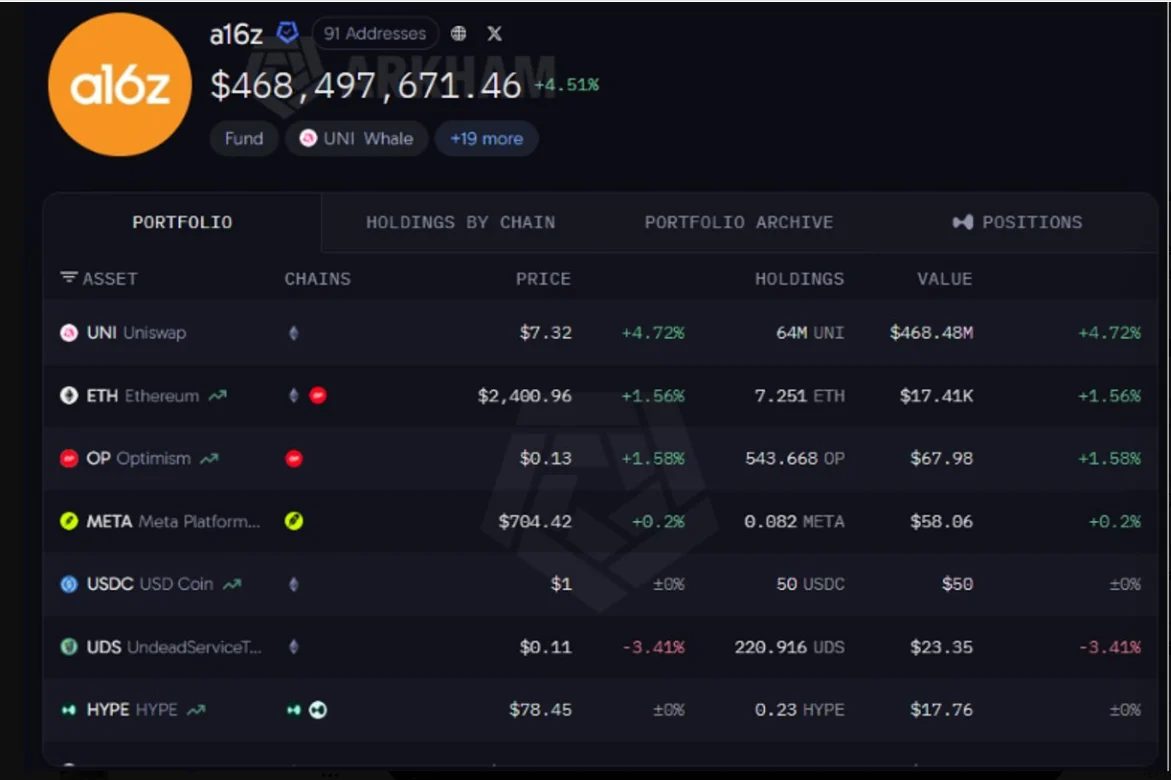
As per Arkham, venture capital firm a16z controlled approximately 64 million UNI, valued around $468.5 million. These reported holdings accounted for roughly 10% of Uniswap’s circulating supply, making the firm one of its largest identifiable holders.
Furthermore, Arkham also identified 91 wallets associated with the investment firm’s holdings of UNI. The findings therefore brought UNI’s ownership structure into the spotlight following CME’s extension into regulated derivatives.
Arkham’s findings, however, did not provide any evidence that a16z had initiated substantial selling; rather, the figures highlighted the concentration of UNI supply among key investors.
The exchange reserve figures and spot trading activity, meanwhile, provided a crucial insight into the broader market conditions.
 Source: Arkham
UNI reserves fall as spot buyers dominate
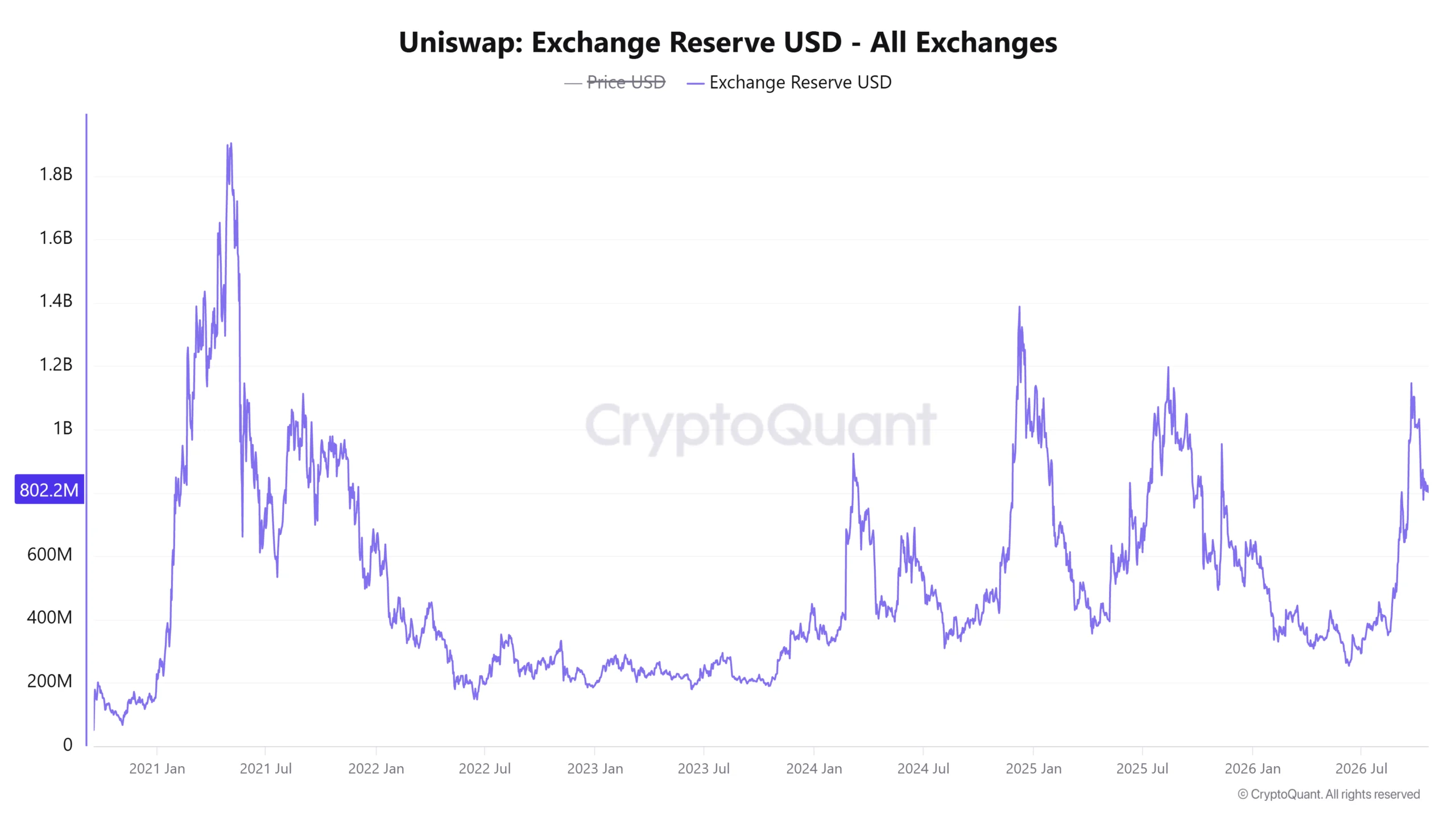
According to data provided by CryptoQuant, UNI’s Exchange Reserves saw a daily decline of 3.32% to roughly $808.55 million.
This exchange decline particularly implied a decrease in the dollar value of exchange-held UNI, even though price changes could influence that valuation. Meanwhile, Uniswap’s Spot Taker CVD signal reflected taker-buy dominance, suggesting stronger aggressive buying than selling activity.
To be specific, the reading suggested that the bulls maintained an edge in market-order execution across the period measured. It is worth noting that the buying dominance interestingly emerged even as UNI struggled to recover from its earlier price correction.
The metrics together presented a mixed outlook of exchange-held supply valuations and spot market participation.
 Source: UNI Exchange Reserve USD on CryptoQuant
UNI tests FVG support below its EMA
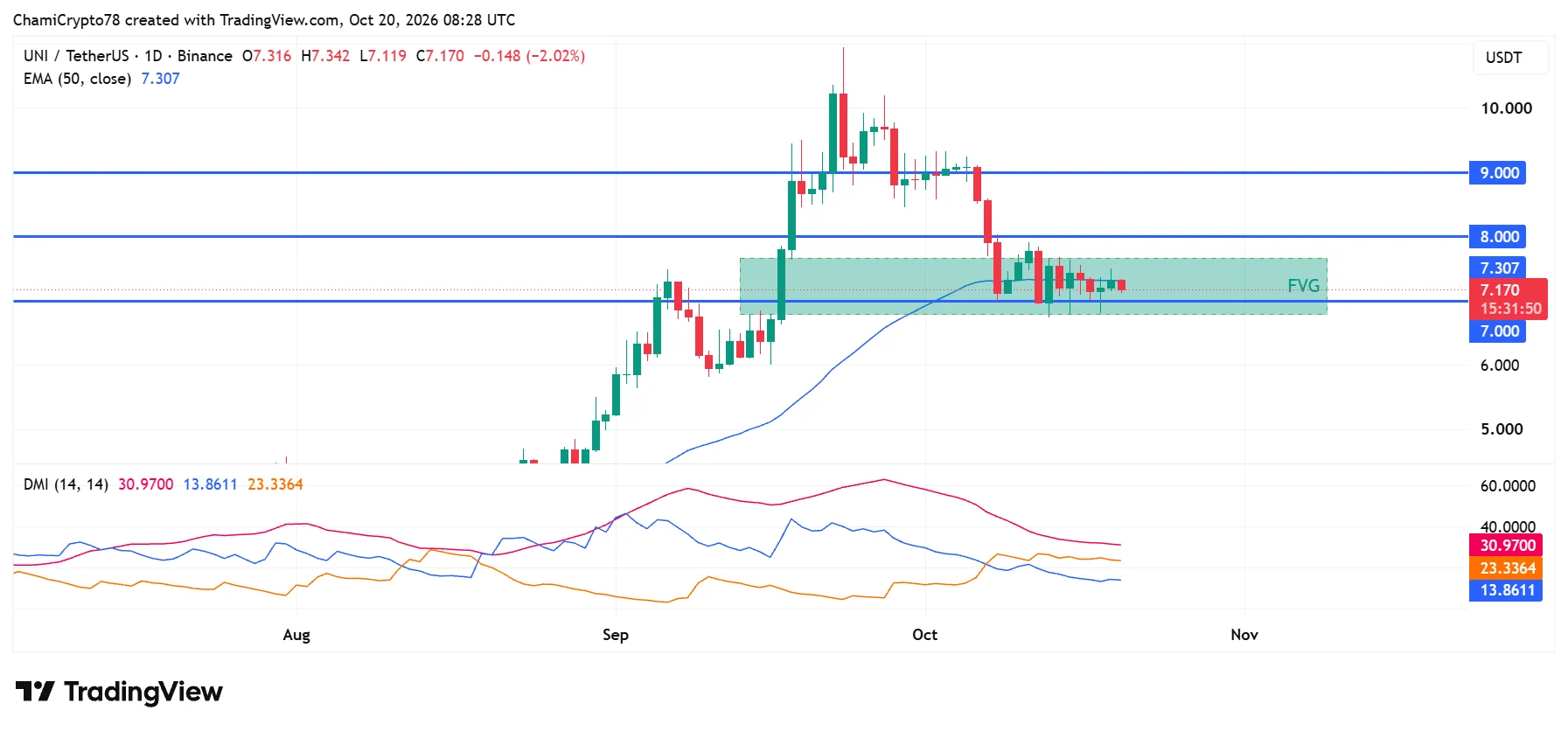
On the daily chart, UNI retreated from its September highs above $10, trading around $7.17 at reporting time, which left its broader recovery incomplete.
After the price correction, the token consolidated within a Fair Value Gap (FVG), as buyers attempted to defend the $7 support zone. Also notably, UNI remained beneath its 50-day EMA at $7.307, which continued to limit its immediate recovery attempts.
Furthermore, the DMI indicator also favored the bears, with the negative directional indicator at 23.34 against the positive signal at 13.86 as of writing. The ADX indicator, meanwhile, stood at 30.97, confirming the strength of the prevailing bearish conditions.
However, a successful reclaim of the 50-day EMA could likely encourage a rebound toward $8, followed by $9. For now, the bearish directional readings implied caution until UNI reclaims its Moving Average.
 Source: UNI/USDT Chart on TradingView
Final Summary
-
- C
ME expanded UNI’s institutional derivatives access, while a16z retained substantial control over circulating supply.
-
UNI held near $7 support, but reclaiming its 50-day EMA remained crucial for recovery.
- C