
Tesla 2026 Q3 Earnings: Energy Storage Weighs on Revenue, but Free Cash Flow Turns Positive, EPS Beats Expectations, Gross Margin Rebounds
 2026/10/22 04:33
🔥 US Stock Hotspot Radar is Live! Content: 3 major themes + 6 selected stocks + 7 key events. Where are this week’s opportunities? Click the link to see all 22 trading directions in one chart →
Core View:
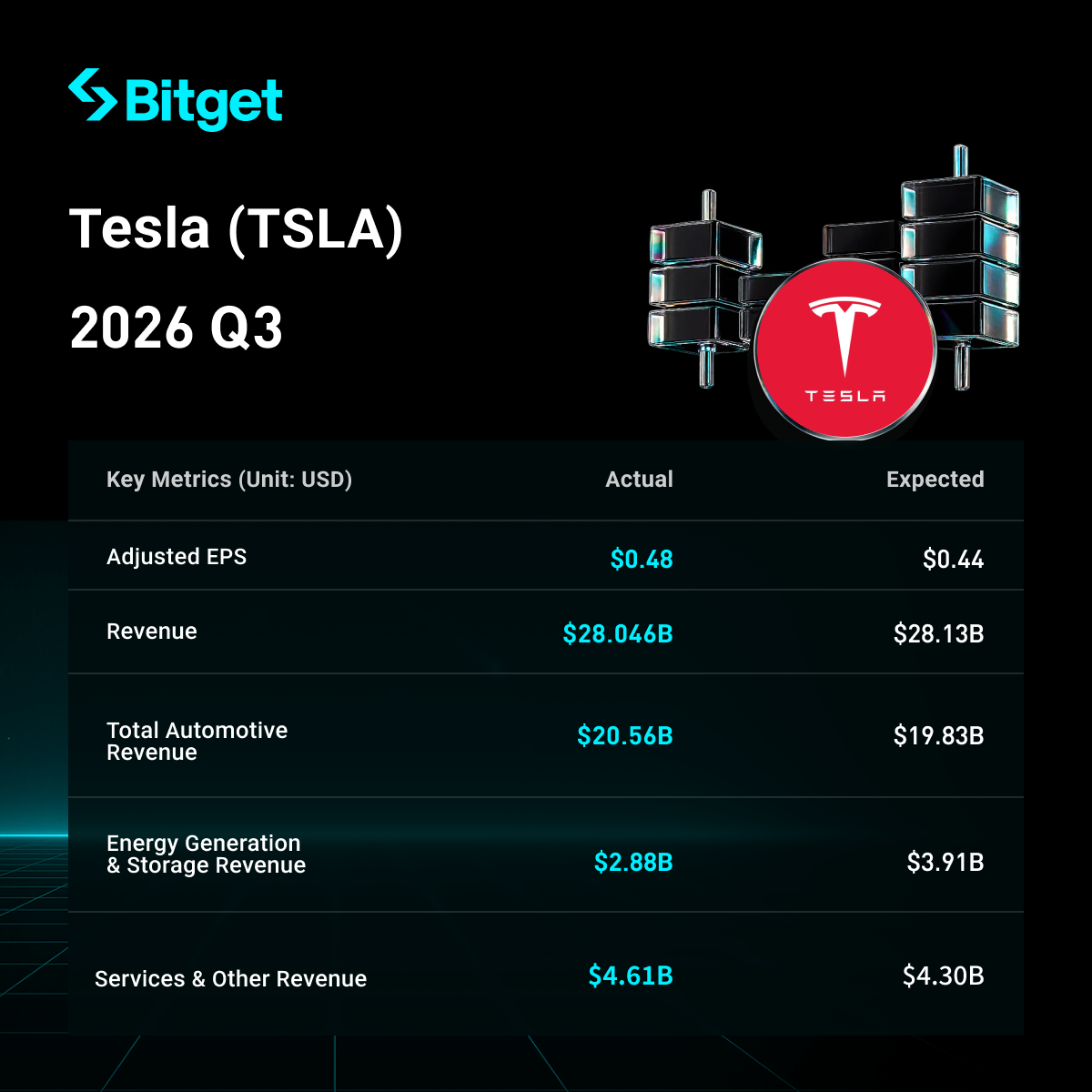
Tesla’s 2026 third-quarter total revenue was $28.046 billion, essentially flat year-over-year, slightly below the analyst consensus of $28.13 billion, and down approximately 0.7% from Q2’s $28.236 billion. Automotive and Services & Other businesses outperformed expectations, but Energy Generation and Storage revenue fell 16% year-over-year and came in well below estimates, becoming the main drag on the revenue miss. Adjusted EPS was $0.48, above the expected $0.44 (about 9% higher), down 4% year-over-year; GAAP EPS was $0.22, down 44% year-over-year. GAAP net profit was $787 million, down 43% year-over-year. Total gross margin rebounded to 19.6%, beating expectations and improving sequentially. Free cash flow turned positive at $1.531 billion, far better than the expected negative figure, with operating cash flow at $6.263 billion. Deliveries were 486,500 vehicles (down 2% YoY), energy storage deployments were 13.7 GWh (up 10% YoY), and FSD active subscriptions reached 1.74 million, above expectations.
The stock initially rose more than 2% after hours before reversing lower. The market focused on the margin recovery, positive free cash flow, and progress in FSD/Robotaxi, while remaining concerned about the revenue miss, declining GAAP profits, weaker vehicle deliveries, and soft energy storage performance.
- Overall Revenue and Profit Performance
- Total revenue: $28.046 billion, essentially flat YoY, slightly below the $28.13 billion consensus, and down nearly 0.7% from Q2’s $28.236 billion.
- Adjusted EPS: $0.48, above the $0.44 consensus (about 9% higher), down 4% YoY; GAAP EPS: $0.22, down 44% YoY.
- GAAP net profit: $787 million, down 43% YoY; adjusted net profit: $1.697 billion.
- Total gross margin: 19.6%, beating expectations by nearly 2 percentage points, up sequentially from Q2’s 16.8%, and up approximately 160 basis points YoY (from ~18.0% a year earlier).
- Free cash flow: $1.531 billion (turned positive and far better than the expected negative $4.99 billion; compared with Q2’s negative $1.092 billion); operating cash flow: $6.263 billion.
- Cash, cash equivalents, and short-term investments at quarter-end: $45.447 billion, up $1.9 billion sequentially.
- Capital expenditures: $4.732 billion, below the expected $7.77 billion.
- Automotive Business Performance
- Automotive revenue: $20.56 billion, down 3% YoY but above the market expectation of $19.83 billion.
- Deliveries: 486,500 vehicles, down 2% YoY; production: 464,400 vehicles, up 4% YoY. Model 3/Y deliveries: 478,200 units, down 1% YoY; other models: 8,295 units, down 48% YoY.
- Global vehicle inventory days: 11 days, lower than Q2’s 15 days.
- Automotive GAAP gross margin: 18.5%; automotive gross margin excluding regulatory credits: 18.1%, higher than Q2’s 16.3% and the prior year’s 15.4%.
- Regulatory credit revenue: $113 million, down 73% YoY (from $417 million a year earlier).
- Other Business Segment Performance
- Services and Other revenue: $4.61 billion, up 33% YoY and above the expected $4.3 billion.
- Energy Generation and Storage revenue: $2.88 billion, down 16% YoY and significantly below the expected $3.91 billion (partly due to tariff-related customer refunds); this was the primary drag on the revenue miss.
- Energy storage deployments: 13.7 GWh, up 10% YoY (slightly higher than Q2’s 13.5 GWh); order rates and backlog both reached historical highs; energy business gross margin approximately 33% (a significant improvement from ~20% in Q2).
- FSD active subscriptions: 1.74 million, above the expected 1.57 million (nearly 11% higher), up 67% YoY; North America new-vehicle FSD take rate exceeded 75% (up nearly 20 percentage points from Q2).
- Robotaxi cumulative unsupervised miles driven: nearly 2 million miles, up 8x sequentially. Optimus began producing the first robots meeting mass-production quality standards on a high-volume line in California.
- Capital Expenditure and Future Plans
- Quarterly capital expenditures: $4.732 billion, below the expected $7.77 billion.
- The company lowered full-year CapEx guidance from $25 billion to approximately $20 billion, emphasizing more efficient capital deployment and plans to fund CapEx primarily from operating cash flow.
- Key investment areas include Optimus production lines, AI compute, Cybercab ramp-up, and the Terafab chip facility related to SpaceX. The company plans to reach 400 MW of superintelligent training compute capacity by year-end.
- The Texas Megafactory has begun production, with planned capacity of 50 GWh.
- Next-Quarter Guidance and Full-Year Outlook
- The article does not provide explicit detailed Q4 revenue or profit guidance.
- Full-year CapEx guidance has been revised to approximately $20 billion (previously $25 billion).
- The company noted that demand significantly exceeds production, energy storage orders and backlog are at record levels, and progress continues on FSD and Robotaxi.
- Market Background and Investor Concerns
- The core tension is that revenue missed expectations mainly due to the sharp shortfall in the energy storage business, vehicle deliveries declined year-over-year, regulatory credits fell sharply, and GAAP profits were pressured by high investments. Offsetting positives included margin recovery, adjusted EPS beating expectations, free cash flow turning positive (primarily from lower spending), and progress in FSD subscriptions and Robotaxi.
- Investors remain concerned about the revenue miss, declining GAAP profits, weaker vehicle deliveries, soft energy storage performance, and future CapEx needs (despite the lower-than-expected quarterly spend and reduced full-year guidance), while monitoring the long-term returns on AI, robotics, and autonomous driving investments. The stock rose more than 2% after hours before reversing lower; it is down roughly 14% year-to-date.
Disclaimer: This content is for reference only and does not constitute any investment advice.
Disclaimer: The content of this article solely reflects the author's opinion and does not represent the platform in any capacity. This article is not intended to serve as a reference for making investment decisions.
You may also like
Elon Musk publicly supports the merger of SpaceX (SPCX.US) and Tesla (TSLA.US); insiders worry negotiations might change.
This week, Musk publicly expressed support for a potential merger between SpaceX and Tesla, but this statement has made insiders involved in the discussion uneasy. They worry that such remarks may invite scrutiny from shareholders and delay the transaction process for several weeks.
Analysis - How the Merged SpaceX-Tesla Will Address Its China Issues
Crypto prices
More


