
$28.5 trillion—This is the "Space AI Empire" super blueprint SpaceX presented to Wall Street

The latest highly anticipated IPO prospectus released by global space exploration leader SpaceX reveals that the company has self-assessed its total addressable market (TAM) at a staggering $28.5 trillion. If this "space AI empire" mega blue print is realized in the future, it would be close to the entire economic output of the United States. In its IPO prospectus, the company states that it has “identified the largest executable total potential market in human history,” primarily driven by AI super software, with significant contributions from the space sector as well.
SpaceX also pointed out that, for the purpose of "illustratively measuring our addressable potential market opportunity," the company has excluded some countries from its global estimation. This $28.5 trillion forecast, compared with the projected U.S. Q1 2026 nominal GDP of nearly $32 trillion, is nearly on par; the enterprise AI super application market alone is estimated at $22.7 trillion, equivalent to about 70% of U.S. economic output. Furthermore, if SpaceX, Tesla (TSLA.US), and xAI eventually pursue deeper integration, their narrative and valuation ceiling could be raised even higher; Wedbush's senior analyst Dan Ives believes SpaceX and Tesla could merge in 2027.
It is important to note that these are not growth forecasts for the space technology giant, nor are they booked orders or valuations. Rather, SpaceX is trying to prove to capital markets that it is not just a rocket/satellite internet company, but is packaging the Starlink system, AI, potential space-orbit AI computing power infrastructure, enterprise software, and space solutions for defense or commercial use into a "super platform narrative crossing AI and space AI data centers."
This TAM is extremely vast, representing a future market opportunity that is ultimately dependent on Starlink cash flows, AI business commercialization, viability of orbital data center technology, launch costs, regulatory, and capital expenditure efficiency.
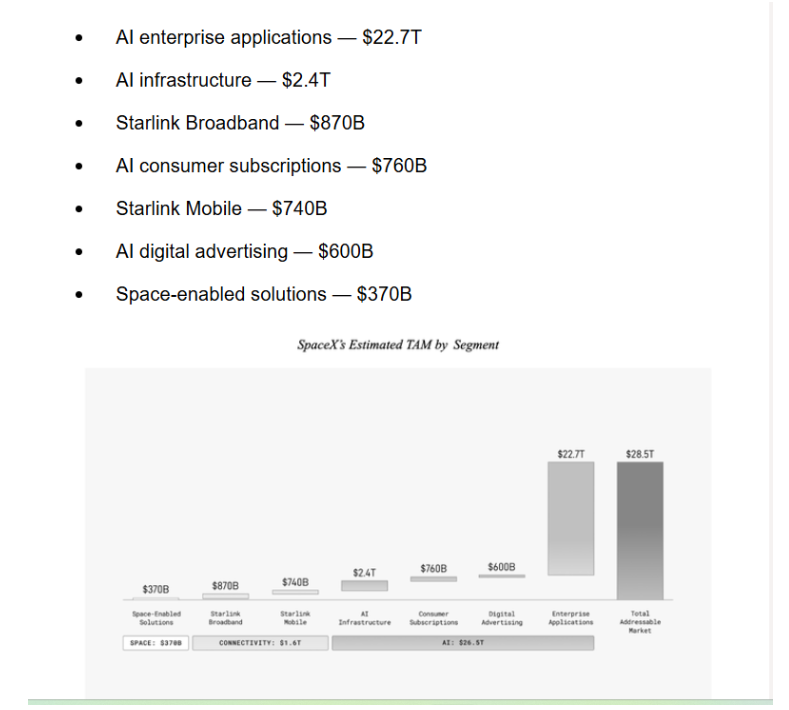
The $28.5 trillion projection covers not only the "space AI data center market size" Musk has referenced recently, but encompasses the total addressable market (TAM) calculated by SpaceX itself in its IPO documents, most of which comes from AI software/enterprise applications, not space or space data centers. Breaking it down, the AI-related component is approximately $26.5 trillion, including $22.7 trillion in AI enterprise applications, $2.4 trillion in AI infrastructure, $760 billion in AI consumer subscriptions, and $600 billion in AI digital advertising. True "space-enabled solutions" constitute just $370 billion, while Starlink broadband and mobile combined are about $1.61 trillion.
As the wealthiest person in the world to date, Musk has previously accomplished feats once thought impossible—engineering commercially viable high-frequency rocket launches through SpaceX, bringing electric vehicles into the mainstream market via Tesla Inc., and providing space-based internet connectivity through Starlink. Yet some investors remain skeptical whether Musk can truly realize his recently charted “most epic” chip-making initiative in Austin, or his dreams of “artificial intelligence, autonomous driving, humanoid robots, and the super blueprint of space AI data centers.”
Below is SpaceX’s breakdown of the $28.5 trillion mega vision:
AI enterprise super applications—$22.7 trillion
AI computing power infrastructure—$2.4 trillion
Starlink broadband system—$870 billion
Consumer AI subscription market—$760 billion
Starlink mobile market—$740 billion
AI digital advertising market—$600 billion
Space-enabled solutions market—$370 billion
SpaceX is not just selling a space story! A $28.5 trillion TAM supports its epic IPO narrative
Overall, Musk has repackaged SpaceX as a “leader in space AI computing power infrastructure + satellite internet cash flow + AI applications giant”—a trinity for the capital markets. From the perspective of its prospectus, SpaceX claims a TAM of $28.5 trillion, with about $26.5 trillion of that stemming from AI-related markets and only $370 billion from true “space-enabled solutions.” In other words, the focus of this IPO’s valuation narrative has shifted from traditional commercial aerospace to AI software, AI infrastructure, Starlink connectivity, and future orbital computing power.
From a financial structure standpoint, Starlink is currently the most reliable cash cow, while xAI is the biggest variable and the largest capital black hole. Public disclosures show that SpaceX’s revenue in 2025 is expected to be about $18.67 billion, with Starlink contributing more than $11 billion; yet the company still recorded a loss of about $4.9 billion, capital expenditures rose to around $20.7 billion, and after absorbing xAI, losses and capital consumption surged further. According to The Verge, xAI will incur an operating loss of about $6.4 billion in 2025; Reuters also reported that SpaceX’s AI business generated $818 million in revenue in the first quarter, but posted $2.5 billion in operating losses. This indicates that while Starlink is indeed generating cash, the buildout of AI computing power is depleting it even more rapidly.
Anthropic’s $1.25 billion monthly purchases of SpaceX/xAI compute power serve as the most critical external validation for this narrative: If the contract lasts until May 2029, the total theoretical value could exceed $40 billion, enough to transform SpaceX from a “satellite internet company” into an AI infrastructure provider. But the risks are just as clear: Reuters, Business Insider, and TechCrunch all note that the agreement allows either party to terminate with 90 days’ notice, and initial fees will adjust as computing power ramps up; therefore, it cannot be simply regarded as a risk-free, long-term guaranteed revenue source.
On the engineering side, SpaceX’s long-term vision stems from Starship, the Starlink V3, ground-based Colossus/Colossus II data centers, and future orbital AI compute power. The logic is: Starship cuts launch costs, Starlink expands communication and data entry points, xAI/Colossus handles AI inference demand, and in the future, attempts will be made to use space-based solar energy and orbital cooling to bypass ground-based electricity/cooling limitations. But up to now, “orbital AI data centers” remain a long-term technical option and not a validated commercial model; what truly supports the IPO’s short-term financial credibility are still Starlink user growth, broadband profitability, the Anthropic computing power contract, and Starship commercialization timelines.
Will the “trinity” ultimately arrive?
Wedbush Securities senior analyst Dan Ives stated that the firm continues to believe that SpaceX (SpaceX and xAI having previously merged) and another Musk-led tech giant—Tesla (TSLA.US)—will ultimately merge into one company in 2027. He points out that the foundation for combining both businesses into a single organization has already been laid. Significantly, after Tesla’s $2 billion investment in xAI was converted into SpaceX shares following xAI’s acquisition earlier this year, Tesla effectively holds equity in SpaceX.
It is worth noting that SpaceX and Tesla recently announced a joint project to build the Terafab chip manufacturing super factory, seen as further linking the two companies’ operations and making business integration more likely, as the current overlap between the two is increasing; Musk himself has kicked off the latest “Terafab” AI computing power wave, aiming to end the chip shortage with a “human-made chip miracle.”
Ives stated in a recent report: "Musk wants to own and control more parts of the AI ecosystem, and step by step, this ‘holy grail’ union might involve some form of combining SpaceX and Tesla, thus providing organizational linkage for these two disruptive tech giants aspiring to lead the AI and computing power infrastructure and energy revolutions.”
Tesla, SpaceX, and xAI joining forces to create a “Musk Super Business Empire” may be the ultimate destiny for these three companies founded by Musk.
As Musk frequently releases positive progress in space AI data centers, large-scale energy storage, artificial intelligence, full self-driving (FSD), Robotaxi, and the revolutionary “Optimus” humanoid robot, the world’s richest man seems to be stringing together “commercial aerospace systems + Starlink satellite communications + space AI computing power systems/AI large models + energy/storage + electric vehicles + autonomous driving + robot manufacturing” into a story of a "super vertically integrated asset chain" that can be financed and clearly articulated, thereby amplifying leverage in both capital markets and industry.
Disclaimer: The content of this article solely reflects the author's opinion and does not represent the platform in any capacity. This article is not intended to serve as a reference for making investment decisions.
You may also like
Solana brings instant trade settlement down from 1–2 days to seconds
Paramount completes massive merger with Warner Bros., forming Hollywood giant Skydance
The merged company’s total debt amounts to approximately $80 billion. David Ellison and co-CEO Ynon Kreiz face a $6 billion cost-cutting target. The senior management teams at CNN and CBS News will remain unchanged. Anzar Mehraj / Harshita Mary Varghese, Reuters, October 6 — Paramount-Skydance (PSKY.O) completed its $110 billion blockbuster acquisition of Warner Bros. Discovery (WBD.O) on Tuesday, giving rise to a Hollywood giant named Skydance and placing CEO David Ellison in charge of one of the world’s largest entertainment companies. The deal combines the studios behind “Mission Impossible”, “Harry Potter”, and DC Films with major TV and streaming networks such as CBS, CNN, Paramount+, and HBO Max, creating a massive entertainment company encompassing film, television, and news. On Tuesday, the merged company’s stock moved from Nasdaq to the New York Stock Exchange, trading under the ticker “SKYD”. A settlement agreement reached with a coalition of several US states and the Hollywood writers’ union (link) cleared one of the main legal obstacles to this landmark media merger. The move comes as Hollywood faces declining cable TV subscriptions, costly battles over streaming viewers, and ongoing union pressure regarding jobs and protections for creative workers. Last week, Ellison stated (link) that the choice of the name “Skydance” was intended to preserve the independent identities of the Paramount and Warner Bros. studios, rather than folding them into a new brand. However, analysts note that the name reinforces Ellison’s control, highlighting that some of Hollywood’s most iconic brands now answer to him and providing a platform for his own strategies and culture. In just 16 years, Skydance has evolved from an independent studio into a central player in one of Hollywood’s most powerful deals. Founded in 2010 by the son of Oracle co-founder Larry Ellison, it gained prominence as the financier and producer behind Paramount’s blockbuster “Top Gun: Maverick”. After merging with Paramount last year (link), Skydance set its sights on Warner Bros., not only engaging in a fierce bidding war with Netflix (NFLX.O) but also attracting interest from other potential buyers, including Comcast (CMCSA.O). Broader Hollywood ambitions Ellison has appointed former Mattel CEO Ynon Kreiz as Skydance’s co-CEO, responsible for day-to-day operations and integration, while Ellison will oversee creative direction and overall strategy. The two must consolidate the two giant companies while achieving the planned $6 billion in cost savings. Paramount stated that a significant portion would come from “non-labor costs”—specifically, integrating the streaming technology and cloud service providers of both companies. However, such wide-ranging cuts are expected to impact jobs across Hollywood. The merged company is projected to carry around $80 billion in debt, putting pressure on Ellison to develop streaming business, sustain cash flow from cable networks, and boost box office performance. CNN President Mark Thompson and CBS News Editor-in-Chief Bari Weiss will continue in their leadership roles at Skydance (link). (For the convenience of non-English speakers, Reuters automatically translates its reports into several other languages. As automated translations may contain errors or lack necessary context, Reuters does not guarantee the accuracy of automated translation texts and provides them solely for reader convenience. Reuters bears no responsibility for any damage or loss arising from the use of automated translation functions.)
NVDA Breakout Confirmed — Analyst Sets $280 Target
US Stock Market Preview | All Three Major Index Futures Rise, Brent Crude Falls Below $100, US Treasury Yields Decline
Futures of all three major U.S. stock indices are rising.
Crypto prices
More


